Dinner · Part 2 of 3: Instructions
Slow Cooker Monkfish Stew with Tomatoes and Capers Step-by-step instructions
- Prep
- Cook
- Total
- Serves
- 4
Before you start
Before beginning, ensure your monkfish is thoroughly cleaned and cut into uniform two-inch chunks to ensure even cooking. Gather your capers, olives, and garlic, ensuring the olives are pitted and the garlic is minced finely.
Have your crushed tomatoes ready at room temperature. Ensure your slow cooker is clean and positioned on a stable, heat-resistant surface in your kitchen with enough clearance for heat dissipation.
Ingredients at a glance (5)
- 1.5 lb monkfish fillets, cut into chunks
- 1/4 cup capers, drained
- 1/2 cup green olives, pitted and halved
- 3 cloves garlic, crushed
- 28 oz crushed tomatoes
Instructions
Assembling the base
- Prepare the basePlace the monkfish chunks evenly across the bottom of the slow cooker insert. This ensures the fish cooks uniformly in the direct heat of the base.Look for Fish is arranged in a single layer at the bottom.Tip Handle the monkfish carefully to maintain the shape of the chunks.
The fish chunks are arranged in the bottom of the cooker, creating a solid base. The environment is ready for the aromatics and liquids to be added, ensuring that all components are prepared and measured before the slow cooking process begins.
Adding aromatics
- Add aromatics and sauceScatter the capers and green olives over the fish. Add the crushed garlic, then pour the crushed tomatoes over all ingredients, ensuring they are well covered.Look for Tomatoes should fully submerge the fish and aromatics.Tip Distribute the capers evenly to ensure a balanced saltiness throughout the stew.
The capers, olives, garlic, and tomatoes are layered over the fish. The ingredients are visually distinct but ready to meld.
The slow cooker is sealed, and the long, gentle heating process is ready to commence to allow the flavors to harmonize.
Final slow cook
- Slow cook and serveCover the slow cooker and cook on low for 3 hours. Ensure the internal temperature of the fish reaches 145°F (63°C). Let it rest for 5 minutes before serving on warm plates.Look for The stew is steaming and the fish flakes easily with a fork.Safe temperature 145°F (63°C) internal temperature (fish)Tip Use a digital thermometer to confirm the internal temperature of the thickest part of the fish.
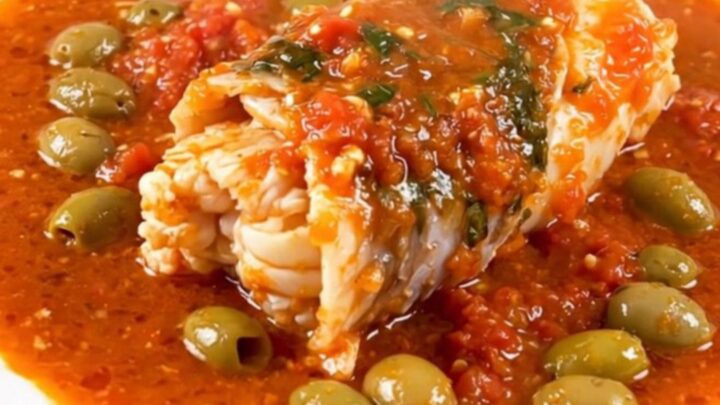
The stew is simmering, releasing a savory, aromatic scent throughout the kitchen. The fish is tender and opaque, the sauce has reached the desired consistency, and the dish is ready for final plating and immediate service while warm.
Common mistakes
Avoid over-crowding the slow cooker, as this can lead to uneven cooking and excess liquid release. Do not lift the lid repeatedly during the cooking process, as this releases heat and moisture, significantly increasing the cooking time.
Ensure the fish is not cooked at too high a temperature setting, as slow, low heat is essential for maintaining the delicate, meaty texture of the monkfish throughout the long cooking duration.
How to tell it’s done
The monkfish is perfectly cooked when it has turned opaque throughout and flakes easily when tested with a fork.
Using a meat thermometer is the most reliable way to ensure safety; the thickest part of the fish should reach an internal temperature of at least 145°F (63°C). The sauce should be thickened and fragrant, with the tomatoes reduced slightly.
- Fish: 145°F (63°C) in the thickest part
Up next · Part 3 of 3
2 variations · storage & make-ahead · 3 answers · printable card
Tips, FAQ & printable recipe (Part 3)← Back to the ingredients (Part 1)