Dinner · Part 2 of 3: Instructions
Slow-Cooker Italian Sausage, Peppers & Onions in Marinara Step-by-step instructions
- Prep
- Cook
- Total
- Serves
- 4
Before you start
Set out the slow cooker where its steam vent has clearance, and give the stoneware a quick look to confirm it sits level. Slice the three peppers and two onions before anything else, since even strips are what melt into the sauce properly.
Keep the sausage links refrigerated until the moment they go into the pot, and move from package to crock without lingering at room temperature. Open the marinara and have a spoon ready for coaxing sauce into the gaps.
Ingredients at a glance (6)
- 3 bell peppers (red, yellow, and green), sliced into strips
- 2 sweet onions, sliced
- 2.5 lb sweet and hot Italian pork sausage links
- 24 oz San Marzano marinara sauce, crushed tomato with oregano
- 4 crusty hoagie rolls, split and toasted
- 4 slices provolone cheese slices
Instructions
Layer the pot
- Slice the peppers and onionsCut the bell peppers in half, remove the ribs and seeds, and slice them into even strips about half an inch wide. Slice the sweet onions into similar-thick wedges so they hold their shape through the long cook. Even pieces mean everything softens at the same rate instead of some melting while others stay crisp.Look for The strips should look uniform, roughly half an inch wide, with no pale ribs or seeds left behind.Tip Use a very sharp knife; peppers glide cleanly instead of tearing and losing juice on the board.
- Layer the vegetables in the slow cookerSpread the pepper strips and onion slices across the bottom of the slow cooker stoneware in an even layer. This vegetable bed insulates the sausages, catches every drop of rendered fat, and becomes the silky base of the finished sauce, so take a minute to arrange it rather than dropping everything in a heap.Look for The stoneware bottom should be completely covered with vegetables in a single even blanket.Tip No need to grease the crock; the sausage fat and tomato sauce keep everything from sticking.
- Add the sausage linksNestle the sweet and hot Italian sausage links on top of the vegetables in a single layer, leaving a little space between each one so heat circulates. Keep the links whole for now; they hold their juices during the long cook and shred beautifully at the end.Look for Every link should sit on the vegetables, not stacked two deep, with air around each one.Tip Mixing sweet and hot links gives the batch range; mark the hot ones with a toothpick if picky eaters are involved.
- Pour in the marinaraPour the San Marzano marinara evenly over the sausages and vegetables, coaxing it into the gaps with a spoon so everything is coated. The sauce thins slightly with the rendered fat and vegetable juices during cooking, ending rich and spoonable rather than watery.Look for The sauce should mostly cover the links, with the tops of the sausages just peeking through.Tip Rinse the sauce jar with a splash of water and pour that in too; nothing goes to waste.
By the end of this phase the slow cooker is fully loaded and switched to LOW: an even bed of pepper strips and onion wedges, the sausage links in a single uncrowded layer, and the marinara poured over with the tops of the links just visible. Nothing should be floating dry above the sauce or stacked on top of another link.
Slow-cook and verify
- Slow-cook on lowCover and cook on LOW for 6 hours. Resist lifting the lid; every peek releases heat and can add 30 minutes or more to the cook. The low, steady heat renders the sausage fat slowly, melts the peppers and onions into the sauce, and lets the oregano perfume the whole pot.Look for After 6 hours the sauce should be bubbling gently at the edges and deep brick red.Tip Start the cooker by early afternoon so dinner lands right at the evening rush.
- Check for donenessLift the lid and insert an instant-read thermometer into the center of the thickest link. The sausages are safely done at 160°F (71°C); the peppers should have collapsed into the sauce and the onions should look translucent. If any link reads short, recover and give the pot another 30 minutes on LOW.Look for Links look plump and glossy, peppers are slumped and silky, sauce bubbles lazily around them.Safe temperature 160°F (71°C) internal temperature (ground meat)Tip Test two links from different spots; slow cookers heat unevenly around the edges.
After six hours on LOW, the kitchen smells of tomato, oregano, and rendered sausage, and the sauce bubbles gently at the edges of the pot. The peppers should be slumped and silky, the onions fully melted into the liquid, and the links plump and glossy.
Confirm doneness with an instant-read thermometer in the thickest link: 160°F (71°C) is the target. If the sauce looks thinner than expected, this is normal; it thickens when the shredded meat folds back in during the next phase.
Shred, toast, and build
- Shred the sausages into the sauceTransfer the links to a cutting board and slice them into thick coins, or pull them apart into rustic chunks with two forks. Return the meat to the sauce and stir so every piece gets coated. The filling thickens slightly as the starchy-sweet pepper juices fold in.Look for The links should shred with almost no pressure, fork-tender all the way to the center.Tip Leave a few bigger chunks for texture; a fully shredded filling can turn pasty on the roll.
- Toast the hoagie rollsHeat the oven to 400°F (200°C) while the filling rests in the warm cooker. Split the hoagie rolls open without cutting all the way through, set them on a baking sheet, and toast for about 5 minutes until the cut faces are pale gold and crisp enough to stand up to the sauce.Look for The cut surfaces should feel dry and crisp, lightly golden, with the outside still crusty.Tip Toasting is not optional; untoasted rolls soak through and collapse under the filling.
- Build the cheesy hoagiesPile the saucy sausage and pepper filling into each toasted roll, spooning extra sauce over the top. Lay a slice of provolone over the hot filling and return the sandwiches to the oven for 2 to 3 minutes, just until the cheese melts and drapes over the meat.Look for The provolone should be fully melted and glossy, hugging the filling without sliding off.Tip A brief broil gives the cheese browned edges; watch closely so the rolls do not scorch.
- Serve hotPull the hoagies from the oven, give each one a final spoonful of sauce from the pot, and serve immediately while the rolls are crisp and the cheese is molten. Set out the extra filling in a warm bowl for seconds, because this batch rarely survives the first round.Look for Steam should rise from the filling and the cheese should still be shiny and glossy when pulled apart.Tip Serve with small plates and plenty of napkins; this is gloriously messy eating.
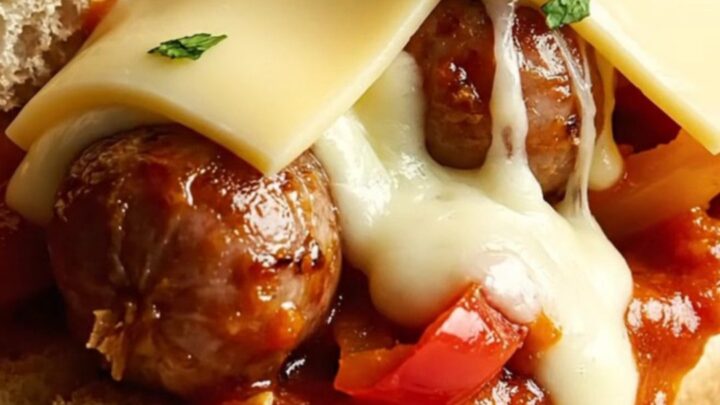
The finished filling is thick, glossy, and cohesive enough to mound on a spoon, with tender chunks of sausage distributed through the melted peppers and sauce. The hoagie rolls are crisp at the cut faces, and the provolone has melted into a smooth blanket over the hot filling with no dry edges. Taste a spoonful for seasoning and adjust salt if needed.
Common mistakes
The most common error is cooking on HIGH to save time: the sausages toughen and the sauce can scorch at the edges before the peppers soften. Lifting the lid repeatedly costs heat and stretches the cook.
Slicing the vegetables too thin turns them to mush; half an inch is the target. Skipping the roll toast is the other frequent misstep, leaving soggy sandwiches. Finally, do not shred the sausages too finely, or the filling loses its hearty texture against the sauce.
How to tell it’s done
The sausages are done when an instant-read thermometer reads 160°F (71°C) in the center of the thickest link, the safe internal temperature for fresh pork sausage. Visually, the links look plump and deeply colored, the peppers have collapsed into the sauce, and the onions are fully translucent.
A fork inserted into a link should slide in with no resistance and the meat should shred easily. If the reading comes up short, recover and continue on LOW, checking again in 30 minutes.
- Ground meat: 160°F (71°C) in the thickest part
- Steaks, chops and roasts: 145°F (63°C) in the thickest part, then a 3-minute rest
Up next · Part 3 of 3
4 variations · storage & make-ahead · 5 answers · printable card
Tips, FAQ & printable recipe (Part 3)← Back to the ingredients (Part 1)