Dinner · Part 2 of 3: Instructions
Slow Cooker Guinea Fowl with Green Cabbage and Bacon Step-by-step instructions
- Prep
- Cook
- Total
- Serves
- 4
Before you start
Before beginning, ensure all ingredients are prepped and ready for the slow cooker. Shred the green cabbage into thin strips to ensure it cooks through evenly. If the guinea fowl pieces are large, ensure they are roughly equal in size so they finish cooking at the same time.
Have your measuring cup ready for the warm poultry broth and clear a clean workspace near your slow cooker. Taking these few minutes to organize your ingredients will make the assembly process seamless and quick.
Ingredients at a glance (4)
- 2 lb guinea fowl pieces
- 1 head green cabbage, shredded
- 4 oz smoked bacon lardons
- 1 cup warm poultry broth
Instructions
Preparation and assembly
- Assemble the potPlace the raw guinea fowl pieces into the bottom of the slow cooker insert. Ensure they are arranged in a single layer if possible to promote even cooking.Look for The poultry is arranged evenly at the base of the slow cooker insert.Tip Patting the meat dry before placing it in the slow cooker helps keep the flavors clean.
- Add vegetables and baconScatter the shredded green cabbage over the guinea fowl. Follow this by evenly distributing the smoked bacon lardons over the top of the cabbage layer.Look for The cabbage forms a bed over the meat with the bacon lardons visible on top.Tip Use a sharp knife to shred the cabbage thinly so it softens uniformly during the long cook time.
At the end of this phase, the slow cooker contains a neat base of raw guinea fowl, topped with a layer of shredded green cabbage and a final scattering of smoked bacon lardons. Everything is positioned to ensure the meat stays moist while the cabbage softens from the heat and the rendered bacon fat.
Braising and heat management
- Add liquid and cookPour the warm poultry broth over the ingredients in the slow cooker. Cover the slow cooker with its lid and set it to cook on the low setting for four hours.Look for The liquid reaches about halfway up the ingredients, providing enough moisture to braise the bird.Safe temperature 165°F (74°C) internal temperature (poultry)Tip Ensure the broth is warm to help jumpstart the cooking process immediately upon closing the lid.
During this phase, the warm broth is added and the slow cooker is sealed. The contents will begin to simmer gently.
By the end, the kitchen should be filled with the savory, smoky aroma of the bacon and poultry. Check that the liquid level remains consistent and that the lid stays firmly closed throughout.
Resting and final service
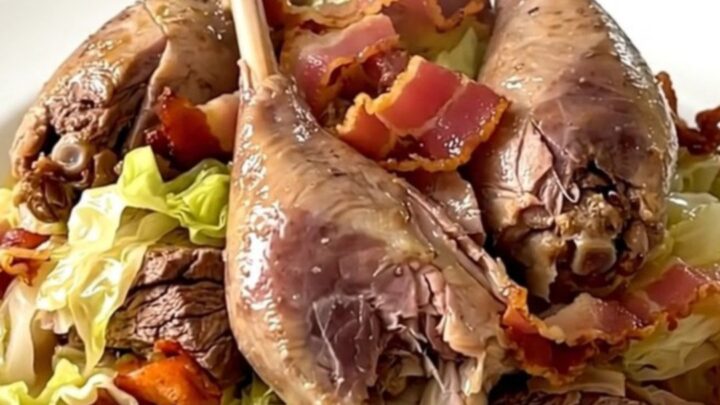
- Finish and serveOnce the cooking time is complete and the poultry has reached an internal temperature of 165°F (74°C), remove the lid. Let the dish rest for 5 minutes before serving to ensure the juices redistribute through the meat.Look for The guinea fowl is tender, the cabbage is wilted and translucent, and the bacon has rendered its smoky fat into the broth.Safe temperature 165°F (74°C) internal temperature (poultry)Tip Serve directly from the slow cooker to keep the dish warm while plating individual portions.
The final stage involves verifying the temperature of the meat and allowing it to rest. The dish is complete when the meat reaches 165°F (74°C) and the cabbage has fully wilted. The final result is a cohesive, tender, and flavorful meal that is ready to be plated directly from the slow cooker.
Common mistakes
A common mistake is using broth that is too cold, which delays the initial heating of the slow cooker and can lead to uneven cooking. Another potential error is overcrowding the slow cooker; while this dish is meant to be layered, ensure there is still enough space for the liquid to circulate.
Additionally, avoid using bacon that is too lean, as the rendered fat is essential for providing moisture and flavor to the cabbage and the guinea fowl throughout the long, slow cooking cycle.
How to tell it’s done
To determine if the guinea fowl is finished, use a digital meat thermometer to check the thickest part of the meat. The poultry is done when it reaches an internal temperature of 165°F (74°C).
The meat should be tender, pulling away from the bone easily if you are using bone-in pieces. The cabbage should be soft, wilted, and translucent, having absorbed the savory juices from the bacon and broth. Always let the meat rest for at least 5 minutes before serving.
- Poultry: 165°F (74°C) in the thickest part
Up next · Part 3 of 3
2 variations · storage & make-ahead · 3 answers · printable card
Tips, FAQ & printable recipe (Part 3)← Back to the ingredients (Part 1)