Dinner · Part 2 of 3: Instructions
Slow-Cooker Gruyère Cream Asparagus Tenderloin Tips Step-by-step instructions
- Prep
- Cook
- Total
- Serves
- 6
Before you start
Before you begin, trim the beef tenderloin tips if needed and pat them dry. Snap off the woody ends of the asparagus and cut the spears into 2-inch pieces if they are very long. Smash the garlic cloves with the flat side of a knife.
Soften the cream cheese by leaving it at room temperature for about 20 minutes. Shred the Gruyère if you bought it in a block. Have your slow cooker ready—you will not need to brown anything, so the prep is minimal.
Ingredients at a glance (8)
- 2 lb beef tenderloin tips
- 1 lb fresh asparagus spears, trimmed
- 6 cloves garlic, smashed
- 8 oz cream cheese, softened
- 1 1/2 cups shredded Gruyère cheese
- 4 slices toasted garlic brioche slices
- kosher salt, to taste
- black pepper, to taste
Instructions
Layer and Load
- Layer the Raw IngredientsPlace the beef tenderloin tips in the bottom of a 6-quart slow cooker. Scatter the asparagus spears and smashed garlic cloves over the beef. Season with kosher salt and black pepper.Look for The beef and asparagus should be evenly distributed in the slow cooker.Tip Trim the woody ends of the asparagus before adding for the best texture.
- Add the CheesesDrop the softened cream cheese in chunks over the beef and asparagus. Sprinkle the shredded Gruyère evenly on top. Do not stir.Look for The cream cheese and Gruyère should cover most of the surface.Tip Softened cream cheese melts more smoothly; let it sit at room temperature for 20 minutes.
At the end of this phase, the slow cooker contains a neat stack of raw ingredients: beef on the bottom, asparagus and garlic on top, and the cream cheese and Gruyère covering everything like a blanket.
The colors are vibrant—the red of the beef, the green of the asparagus, and the pale yellow of the cheese. The aromas are raw and fresh, with the pungent garlic and earthy cheese. There is nothing to do but cover and turn it on.
Slow Cook and Transform
- Slow-Cook the Beef TipsCover the slow cooker and cook on low for 4 hours, or until the beef is fork-tender and the sauce is bubbling. Do not lift the lid during cooking. Let it rest for 3 minutes before slicing.Look for The sauce should be bubbling gently around the edges.Safe temperature 145°F (63°C) internal temperature (steaks, chops and roasts)Tip Cooking on low keeps the beef tender; high heat can toughen it.
- Stir the SauceAfter 4 hours, stir the sauce gently to combine the melted cream cheese and Gruyère into a smooth, creamy gravy. The beef should be tender enough to pull apart with a fork. Let it rest for 3 minutes before slicing.Look for The sauce should be smooth and glossy, with no large lumps of cream cheese.Safe temperature 145°F (63°C) internal temperature (steaks, chops and roasts)Tip Stir gently to avoid breaking up the beef too much.
After 4 hours on low, the slow cooker is bubbling gently. The cream cheese and Gruyère have melted into a smooth, golden sauce that coats the beef and asparagus. The beef is visibly tender, and the sauce has a glossy sheen. The kitchen smells of roasted garlic, melted cheese, and rich beef. The asparagus is tender but still bright green. Stir the sauce gently to combine everything into a cohesive, creamy gravy.
Rest and Serve
- Rest the BeefTurn off the slow cooker and let the beef rest in the warm sauce for at least 3 minutes before serving. This allows the juices to redistribute.Look for The sauce will thicken slightly as it rests.Safe temperature 145°F (63°C) internal temperature (steaks, chops and roasts)Tip Resting the meat ensures tender, juicy bites.
- Serve Over Garlic BriochePlace a slice of toasted garlic brioche on each plate. Ladle the beef, asparagus, and creamy Gruyère sauce over the bread. Serve hot.Look for The brioche should soak up the sauce without getting soggy.Tip For extra richness, rub the brioche with a cut garlic clove before toasting.
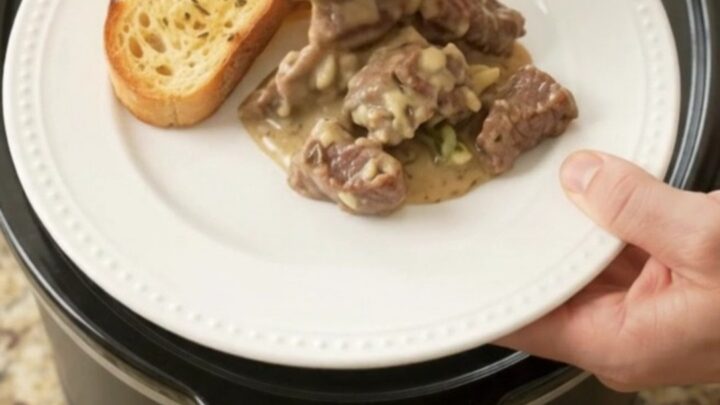
The beef rests in the warm sauce for at least 3 minutes, allowing the juices to settle. The sauce has thickened slightly, clinging to the meat and asparagus. The toasted garlic brioche is ready on plates, and the ladle is poised to scoop up generous portions of beef, asparagus, and creamy sauce. The final dish is a beautiful, steaming pile of comfort, with the brioche soaking up every drop of the rich, cheesy sauce.
Common mistakes
One common mistake is lifting the lid during cooking, which lets out heat and extends the cooking time. Another is using low-fat cream cheese, which can make the sauce grainy.
Also, do not stir the ingredients before cooking—the layering helps the asparagus steam and prevents the cheese from scorching. If the sauce seems thin after 4 hours, let it cook an additional 30 minutes with the lid off to reduce. If it is too thick, stir in a splash of beef broth.
How to tell it’s done
The dish is done when the beef is fork-tender and the sauce is bubbling and smooth. The internal temperature of the beef should reach at least 145°F (63°C) for food safety, but because it has cooked low and slow, it will be far more tender than that.
To check, insert a fork into a piece of beef—it should pull apart easily. The asparagus should be tender but still hold its shape, and the sauce should be thick enough to coat the back of a spoon.
- Steaks, chops and roasts: 145°F (63°C) in the thickest part, then a 3-minute rest
Up next · Part 3 of 3
4 variations · storage & make-ahead · 5 answers · printable card
Tips, FAQ & printable recipe (Part 3)← Back to the ingredients (Part 1)