Dinner · Part 2 of 3: Instructions
Slow-Cooker Garlic Herb Honey Hickory Spare Ribs Step-by-step instructions
- Prep
- Cook
- Total
- Serves
- 6
Before you start
Before you start, make sure your slow cooker is clean and dry. If your spare ribs are in one large rack, you may want to cut them into 2-3 sections to fit better in the cooker.
Smash the garlic cloves: place each clove on a cutting board, lay the flat side of a chef's knife on top, and press down firmly with the heel of your hand until the clove cracks and flattens. Rinse the rosemary sprigs and pat dry. Measure out the barbecue sauce. Have everything ready at the counter so you can layer the ingredients quickly and get the cooker going.
Ingredients at a glance (4)
- 4 lb St. Louis style pork spare ribs
- 10 cloves garlic, smashed
- 4 sprigs fresh rosemary
- 1 1/2 cups honey-hickory barbecue sauce
Instructions
Layer and Sauce
- Layer the Ribs and AromaticsPlace the St. Louis style spare ribs in the bottom of a 6-quart slow cooker, arranging them in a single layer if possible, overlapping slightly if needed. Scatter the smashed garlic cloves and fresh rosemary sprigs evenly over the ribs, tucking some underneath for even flavor.Look for The ribs should be fully covered with garlic and rosemary, with the rosemary sprigs visible.Tip If the ribs are too large, cut the rack into 2-3 sections to fit better.
- Coat with Barbecue SaucePour the honey-hickory barbecue sauce over the ribs, using a spoon or spatula to spread it evenly across the entire surface. Make sure every part of the ribs is coated, including the sides and any exposed meat.Look for The ribs should be completely glazed with a thick, sticky coating of sauce.Tip For extra flavor, brush the sauce onto the meaty side of the ribs before laying them in the cooker.
At this stage, the ribs are nestled in the slow cooker, completely covered with smashed garlic cloves and rosemary sprigs, and glistening under a thick coat of honey-hickory barbecue sauce. The raw meat is pink and marbled, the garlic is sharp and pungent, and the sauce smells sweet and smoky. You should be able to see the sauce pooling around the edges and coating every surface. This is the moment to double-check that the ribs are arranged evenly and the aromatics are distributed, so every bite gets flavor.
Slow-Cook and Tenderize
- Slow-Cook Until TenderCover the slow cooker and cook on LOW for 8 hours, or on HIGH for 4-5 hours, until the meat is fork-tender and pulls away from the bone easily. Avoid opening the lid during cooking to maintain consistent heat and moisture. Let it rest for 3 minutes before slicing.Look for The meat should be deeply browned and the sauce bubbling gently around the edges.Safe temperature 145°F (63°C) internal temperature (steaks, chops and roasts)Tip If the sauce looks too thin at the end, remove the ribs and simmer the sauce on the stovetop to thicken.
- Check for DonenessAfter the cooking time, insert a fork into the thickest part of the meat. The fork should slide in with little resistance, and the meat should be pull-apart tender. If not done, continue cooking in 30-minute increments until tender. Let it rest for 3 minutes before slicing.Look for The meat should shred easily with a fork, and the bones should be clean when lifted.Safe temperature 145°F (63°C) internal temperature (steaks, chops and roasts)Tip For extra caramelization, transfer the ribs to a baking sheet and broil for 2-3 minutes, watching closely.
After hours of slow cooking, the kitchen fills with the rich aroma of garlic and rosemary mingling with barbecue sweetness. The sauce has darkened and thickened, bubbling gently around the edges of the cooker. The meat has pulled back from the bones and looks deeply glazed.
When you press it with a fork, it yields easily, and a piece can be lifted without resistance. The garlic has softened into golden confit, and the rosemary leaves have wilted. Check that the sauce hasn't dried out; if it looks too thick, add a splash of water.
Rest and Serve
- Rest and ServeOnce the ribs are tender, turn off the slow cooker and let the ribs rest in the sauce for 5 minutes. Use a carving fork to lift the ribs out of the cooker, letting excess sauce drip off, and transfer to a serving plate. Spoon additional sauce over the top if desired.Look for The ribs should be glistening with sauce and steaming, with some pieces falling off the bone.Safe temperature 145°F (63°C) internal temperature (steaks, chops and roasts)Tip Let the ribs rest for at least 3 minutes before serving to allow the juices to redistribute.
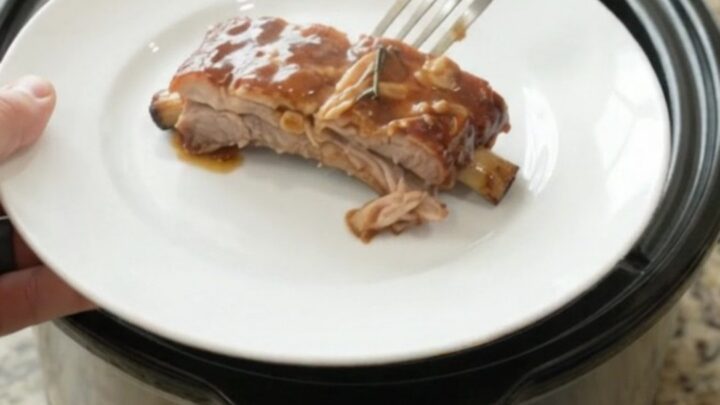
The ribs are out of the slow cooker, resting on a serving plate, with steam rising and sauce dripping from the meat. The surface is sticky and caramelized, with some edges slightly charred from the long cook. The garlic cloves are soft and sweet, and the rosemary has infused the sauce. When you pull at a bone, the meat comes away cleanly, showing the tender, juicy interior. The plate is surrounded by a puddle of glossy sauce, ready to be spooned over the top. The aroma is irresistible—smoky, sweet, and savory.
Common mistakes
One common mistake is lifting the lid too often during cooking. Every time you open the slow cooker, you release heat and moisture, which can extend cooking time and dry out the ribs. Another error is using a sauce that's too thin or too vinegary; it may not create the rich glaze you want.
If the sauce seems thin at the end, remove the ribs and simmer the sauce on the stovetop to reduce and thicken. Also, be careful not to overcook—while ribs are forgiving, leaving them too long can make them mushy and fall apart entirely.
How to tell it’s done
The ribs are done when they are fork-tender: insert a fork into the thickest part of the meat, and it should slide in with little to no resistance. The meat should pull away from the bone easily, and when lifted with a fork, a piece should separate without much effort.
If the meat still feels tough, continue cooking in 30-minute increments until it reaches the desired texture. The internal temperature should be at least 145°F (63°C) for food safety, but because of the long cook time, it will likely be much higher, which is fine.
- Steaks, chops and roasts: 145°F (63°C) in the thickest part, then a 3-minute rest
Up next · Part 3 of 3
4 variations · storage & make-ahead · 5 answers · printable card
Tips, FAQ & printable recipe (Part 3)← Back to the ingredients (Part 1)