Dinner · Part 2 of 3: Instructions
Slow-Cooker Garlic Butter Makhani Lamb Cubes Step-by-step instructions
- Prep
- Cook
- Total
- Serves
- 6
Before you start
Before you start, cut the lamb shoulder into 1-inch cubes if not already cubed. Prepare the spiced tomato-ginger makhani puree (or open a jar).
Mince the garlic and measure the yogurt. Cut the garlic herb butter into small medallions. Have your slow cooker ready. No other prep is needed — this is a true dump-and-go recipe.
Ingredients at a glance (5)
- 2 lb cubed lamb shoulder
- 1 1/2 cups spiced tomato-ginger makhani puree
- 4 cloves garlic, minced
- 1/2 cup plain Greek yogurt
- 4 tbsp garlic herb butter, cut into medallions
Instructions
Layer and Set
- Layer the raw ingredientsPlace the cubed lamb shoulder in the slow cooker insert. Pour the spiced tomato-ginger makhani puree over the lamb, then add the minced garlic. Stir gently to coat the lamb evenly with the puree.Look for The lamb cubes are coated in a deep red-orange sauce with visible garlic pieces.Tip Use a spatula to scrape every bit of puree from the measuring cup.
- Top with yogurt and butterDollop the Greek yogurt over the surface of the lamb and sauce. Place the garlic herb butter medallions on top, spacing them evenly. Do not stir after adding the yogurt and butter.Look for White yogurt dollops and golden butter medallions sit on the red sauce.Tip Leaving the yogurt and butter on top allows them to melt into the sauce during cooking.
At the end of this phase, the slow cooker contains raw lamb coated in a thick red-orange puree, with white yogurt dollops and golden butter medallions on top. The aromatics are pungent and inviting. Everything is ready to cook — no need to stir.
Slow Cook
- Cook low and slowCover the slow cooker and cook on low for 8 hours, or on high for 4 hours, until the lamb is fork-tender and easily shreds. Stir gently halfway through if possible, but avoid over-stirring. Let it rest for 3 minutes before slicing.Look for The sauce is bubbling gently, and the lamb is tender enough to shred with a fork.Safe temperature 145°F (63°C) internal temperature (steaks, chops and roasts)Tip Cooking on low yields the most tender meat. If using high, check at 3 1/2 hours.
After 8 hours on low, the curry is bubbling gently and the sauce has darkened to a rich brick-red.
The lamb is fork-tender, and the yogurt and butter have melted into the sauce, creating a silky, glossy texture. The kitchen smells warmly spiced and buttery.
Rest and Serve
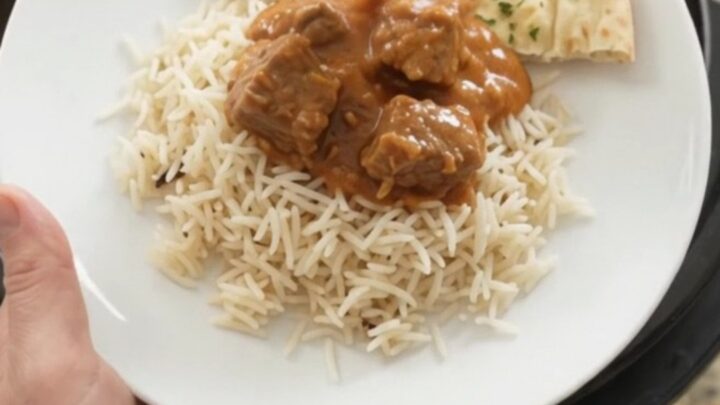
- Finish and serveOnce the lamb is cooked through and tender, remove the slow cooker insert and let it rest for 3 minutes. Serve the curry over steamed basmati rice with warm naan, using a spoon to ladle the sauce generously.Look for The curry is thick, silky, and aromatic with visible steam rising.Tip Let the curry rest briefly to allow the sauce to thicken slightly.
After resting, the curry has thickened slightly and the lamb holds its shape but shreds easily. The sauce coats the back of a spoon. Serve immediately over rice with naan, and watch it disappear.
Common mistakes
A common mistake is over-stirring the curry during cooking, which can break up the lamb too much. Stir gently, if at all. Another pitfall is using lean lamb, which can become dry; choose well-marbled shoulder.
Finally, adding the yogurt too early or stirring it in vigorously can cause it to curdle. Dollop it on top and leave it alone — it will blend in smoothly as it cooks.
How to tell it’s done
The lamb is done when it is fork-tender and easily pulls apart with little resistance. The internal temperature should reach at least 145°F (63°C), but because it cooks for so long, it will be well beyond that.
The sauce should be thick and glossy, with a deep reddish-orange color. If the sauce seems thin, let it cook uncovered for an additional 20–30 minutes to reduce.
- Steaks, chops and roasts: 145°F (63°C) in the thickest part, then a 3-minute rest
Up next · Part 3 of 3
4 variations · storage & make-ahead · 5 answers · printable card
Tips, FAQ & printable recipe (Part 3)← Back to the ingredients (Part 1)