Dinner · Part 2 of 3: Instructions
Slow Cooker French Onion Sausage and Potatoes Step-by-step instructions
- Prep
- Cook
- Total
- Serves
- 4
Before you start
Before beginning, ensure the work surface is clean and the slow cooker insert is dry. Wash the gold potatoes thoroughly under cool running water to remove any dirt, then pat them dry before cutting them into uniform 1-inch cubes.
Slice the yellow onions into consistent half-moon shapes, ensuring they are not too thin so they retain some texture after long cooking.
Have the can of condensed French onion soup and the dried thyme ready to go, minimizing the time spent away from the slow cooker.
Ingredients at a glance (5)
- 1 lb smoked sausage, sliced into coins
- 1 1/2 lb gold potatoes, cut into 1-inch cubes
- 2 cups yellow onions, sliced into half-moons
- 1 tsp dried thyme
- 1 can (10.5 oz) condensed French onion soup
Instructions
Preparation and layering
- Layering the ingredientsPlace the sliced smoked sausage into the bottom of the slow cooker insert. Add the cubed gold potatoes and the sliced onions on top of the sausage in an even layer.Look for The ingredients should form distinct layers within the slow cooker insert.Tip Layering the sausage at the bottom allows it to brown slightly and flavor the potatoes as the fat renders.
The sausage coins, potato cubes, and onion slices should be neatly arranged in the slow cooker. The ingredients should look fresh, with the sausage providing a solid base for the vegetables.
Seasoning and slow cooking
- Seasoning and simmeringSprinkle the dried thyme over the top of the onion layer. Pour the condensed French onion soup over the entire mixture. Cover the slow cooker and set it to low for 6 hours.Look for The soup should cover the ingredients, beginning to create a rich, savory broth as the slow cooker heats up.Tip Do not stir the ingredients before covering; keeping the layers intact helps the potatoes steam perfectly in the onion broth.
After adding the thyme and soup, the ingredients should be mostly submerged. The slow cooker will begin to emit a savory, onion-forward aroma as the soup heats and starts to penetrate the potatoes.
Final check and resting
- Final cooking and servingCheck that the potatoes are fork-tender and the sausage has reached an internal temperature of at least 160°F (71°C). Let the dish rest for 5 minutes before serving to allow the gravy to thicken slightly.Look for The gravy should be thick and glossy, with the potatoes tender enough to be easily pierced with a fork.Safe temperature 160°F (71°C) internal temperature (ground meat)Tip If the gravy is too thin, remove the lid for the final 30 minutes of cooking to help reduce the liquid.
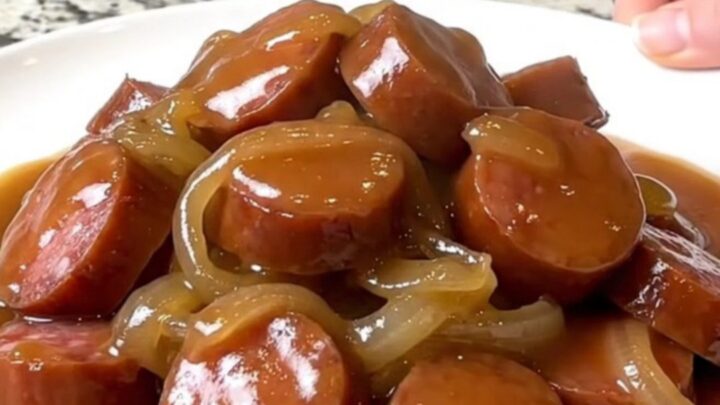
The final dish should have a rich, dark brown color with a thick, glossy gravy. The potatoes should be soft and tender, and the sausage should be plump and hot throughout.
Common mistakes
A common mistake is over-stirring the ingredients before cooking. Keeping the layers intact is vital for the proper steaming of the potatoes. Another error is using a high-heat setting, which can cause the sausage to dry out and the sauce to evaporate too quickly.
Ensure the lid is kept on throughout the cooking process to maintain a consistent temperature and prevent moisture loss. Finally, avoid using potatoes that are cut too small, as they will disintegrate into the sauce over several hours.
How to tell it’s done
The dish is considered done when the potatoes are fork-tender, meaning they offer no resistance when pierced with a fork. The internal temperature of the smoked sausage must reach at least 160°F (71°C) to ensure it is heated through.
The sauce should have reduced into a thick, brown gravy that clings to the sausage and potatoes. If the potatoes are still firm, continue cooking for an additional 30 minutes, checking every 15 minutes thereafter until the desired tenderness is achieved.
- Ground meat: 160°F (71°C) in the thickest part
Up next · Part 3 of 3
2 variations · storage & make-ahead · 3 answers · printable card
Tips, FAQ & printable recipe (Part 3)← Back to the ingredients (Part 1)