Dinner · Part 2 of 3: Instructions
Slow Cooker Duck Legs with Green Olives for an Easy Dinner Step-by-step instructions
- Prep
- Cook
- Total
- Serves
- 4
Before you start
Before beginning, ensure your slow cooker is clean and placed on a stable surface away from the edge of the counter. Gather all ingredients and measure them out. If the green olives are not pitted, remove the pits now. Peel and slice the onion into uniform pieces to ensure even cooking.
Take the duck legs out of the refrigerator about 20 minutes before cooking to bring them closer to room temperature, which helps with more even heat distribution throughout the slow cooking process. Prepare your workspace to ensure a smooth assembly.
Ingredients at a glance (5)
- 4 duck legs
- 1 cup green olives, pitted
- 1 onion, sliced
- 1 tbsp herbes de Provence
- 2 cups tomato pulp
Instructions
Assembly of the duck and aromatics
- Prepare the slow cookerPlace the raw duck legs into the base of the slow cooker, ensuring they are arranged in a single layer if possible to allow for even heat distribution during the long cooking process.Look for The duck legs should be arranged snugly in the bottom of the ceramic insert.Tip Pat the duck skin dry with paper towels before placing into the cooker to help remove excess surface moisture.
- Add aromatics and seasoningsScatter the sliced onions and pitted green olives over the duck legs. Sprinkle the herbes de Provence evenly over the top of the ingredients to ensure every piece is seasoned.Look for The onions and olives should be distributed evenly across the surface of the duck.Tip Use a variety of green olives, such as Castelvetrano or Manzanilla, for different flavor profiles.
The duck legs should be arranged snugly in the slow cooker base. The onions and olives should be well-distributed to ensure their flavors permeate the meat during the braising process. Ensure the herbs are sprinkled evenly for consistent seasoning across all pieces.
Adding the tomato braising liquid
- Pour the tomato saucePour the tomato pulp over the duck legs, olives, and onions. Ensure the tomato pulp covers the ingredients adequately to create a braising liquid that will keep the duck moist while it cooks.Look for The tomato pulp should partially submerge the duck legs, creating a thick sauce base.Tip Use high-quality canned tomato pulp for the best flavor in the final braising liquid.
The tomato pulp should be poured evenly, ensuring it coats the duck legs and fills the gaps between the other ingredients. The cooker should look full but not overflowing, with the tomato base providing the necessary moisture for the long cook.
Braising until tender
- Braise the duckCover the slow cooker and cook on low for 4 to 6 hours, or until the duck reaches an internal temperature of 165°F (74°C). Once finished, remove the duck and let it rest for at least 5 minutes before serving.Look for The duck meat should be very tender and easily pull away from the bone when pierced with a fork.Safe temperature 165°F (74°C) internal temperature (poultry)Tip Cooking on low heat allows the fat to render slowly, resulting in a more tender texture.
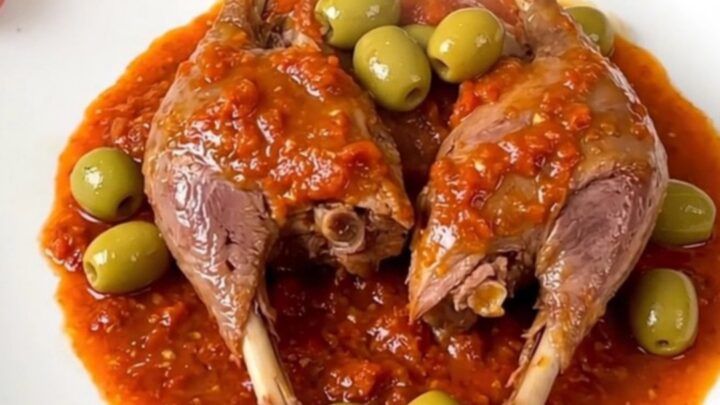
The kitchen will smell savory and aromatic as the duck braises. At the end of the cooking time, the duck should be very tender, and the sauce should have reduced slightly, appearing glossy and rich. Check the temperature before serving.
Common mistakes
A common mistake is overcrowding the slow cooker, which can prevent the meat from cooking evenly. Another error is not using enough liquid, which can lead to the ingredients drying out or burning at the base.
Avoid lifting the lid frequently during the cooking process, as this releases heat and moisture, significantly increasing the cooking time.
Finally, ensure the duck is properly defrosted if you are using frozen legs; cooking from frozen is not recommended as it poses food safety risks and results in uneven textures.
How to tell it’s done
The duck is done when the meat is exceptionally tender and pulls away from the bone with minimal resistance. Use a digital meat thermometer inserted into the thickest part of the leg, avoiding the bone, to confirm it has reached an internal temperature of 165°F (74°C).
The skin will be soft and the sauce should have a glossy, thickened consistency. If the meat still feels firm, continue cooking on low for another 30 minutes and check again. Let the duck rest for 5 minutes after cooking to allow the juices to settle.
- Poultry: 165°F (74°C) in the thickest part
Up next · Part 3 of 3
2 variations · storage & make-ahead · 3 answers · printable card
Tips, FAQ & printable recipe (Part 3)← Back to the ingredients (Part 1)