Dinner · Part 2 of 3: Instructions
Slow Cooker Bordelaise Pollock Fillets for a Quick Dinner Step-by-step instructions
- Prep
- Cook
- Total
- Serves
- 4
Before you start
Before beginning, ensure your slow cooker is clean and positioned on a stable, heat-resistant surface. Have all ingredients measured and the shallots and parsley minced finely. If the fish was frozen, confirm it is completely thawed and patted dry to ensure the best possible texture.
Clear your workspace to allow for quick assembly, as the process involves layering the ingredients directly into the cooker insert. Verify that you have a reliable digital thermometer on hand to check the fish for doneness at the end of the cooking time.
Ingredients at a glance (5)
- 4 fillets pollock fillets
- 2 tbsp minced shallots
- 1 tbsp fresh parsley, minced
- 1/4 cup breadcrumbs
- 1/3 cup dry white wine
Instructions
Layering the fish
- Prepare the slow cookerPlace the fresh pollock fillets in a single layer at the bottom of the slow cooker insert. Ensure the fillets are laid flat to promote even cooking throughout the process.Look for Fish fillets are arranged in a flat layer.Tip Pat the fish dry with a paper towel before placing it in the cooker to remove excess moisture.
The fish is neatly arranged in the slow cooker, creating a stable base for the aromatics. Ensure the fillets are not overlapping significantly, which allows for uniform heat distribution. The surface should be dry and ready for the seasonings, providing a clean start for the poaching process.
Adding aromatics
- Add aromatics and seasoningEvenly scatter the minced shallots and fresh parsley over the top of the fish fillets. Sprinkle the breadcrumbs evenly across the surface to create a light coating.Look for Aromatics and breadcrumbs are distributed over the fish.Tip Use a gentle hand when scattering the breadcrumbs to avoid clumping.
The minced shallots, parsley, and breadcrumbs are distributed evenly across the fillets. The aromatics should be spread to ensure every piece of fish receives flavor.
Check that the breadcrumbs form a light, thin layer rather than a thick pile, as a thin layer will soften perfectly into the poaching liquid.
Final poaching
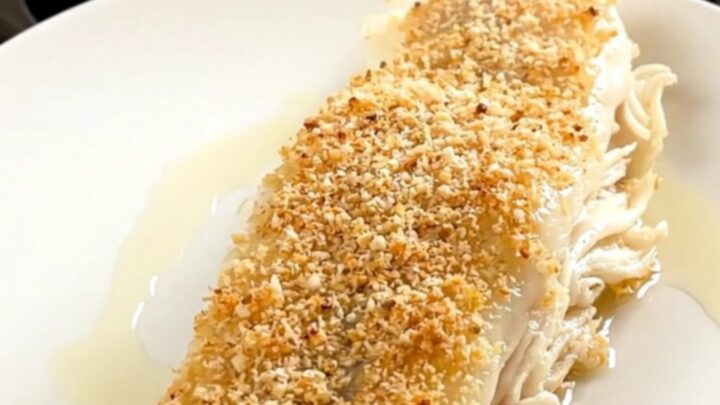
- Add liquid and cookPour the dry white wine over the seasoned fillets. Cover the slow cooker and cook on low heat for 2 hours until the fish reaches an internal temperature of 145°F (63°C).Look for The fish is opaque and flakes easily with a fork.Safe temperature 145°F (63°C) internal temperature (fish)Tip Check the temperature at the thickest part of the fillet.
The wine has been added and the slow cooker is covered. The aroma of simmering shallots and wine should begin to fill the air. The fish is done when it is opaque, flakes easily with a fork, and reaches an internal temperature of 145°F (63°C).
Common mistakes
A common mistake is overcrowding the slow cooker. Ensure the fillets are in a single layer to allow the wine and aromatics to circulate properly. Another error is using too much liquid; the goal is to poach the fish gently, not to boil it in a deep bath of wine.
Finally, failing to check the internal temperature can lead to dry, overcooked fish. Always use a thermometer to confirm the fish has reached the safe temperature of 145°F (63°C).
How to tell it’s done
The fish is perfectly cooked when it reaches an internal temperature of 145°F (63°C) at the thickest point. Visually, the pollock should be opaque throughout and flake easily when gently prodded with a fork.
If the fish still looks translucent in the center, continue cooking for another 10 to 15 minutes. Avoid overcooking, as even in a slow cooker, white fish can become stringy if left for too long after it has reached the target temperature.
- Fish: 145°F (63°C) in the thickest part
Up next · Part 3 of 3
2 variations · storage & make-ahead · 3 answers · printable card
Tips, FAQ & printable recipe (Part 3)← Back to the ingredients (Part 1)