Desserts · Part 2 of 3: Instructions
Slow Cooker Irish Cream Chocolate Bread Pudding Step-by-step instructions
- Prep
- Cook
- Total
- Serves
- 8
Before you start
Before starting, cut the challah into 1-inch cubes and let them sit out to dry slightly if time allows. Grease the slow cooker insert with butter or nonstick spray. Measure out all the ingredients, including the chocolate chips, eggs, cream, Irish cream, and brown sugar.
Have a large mixing bowl and whisk ready. If making the glaze, measure the white chocolate chips and heavy cream into a small saucepan. The slow cooker should be set to LOW before pouring in the custard.
Ingredients at a glance (8)
- 1 loaf challah bread, cut into 1-inch cubes
- 1 1/2 cups semi-sweet chocolate chips
- 5 large eggs
- 2 cups heavy cream
- 3/4 cup Irish cream liqueur
- 1/2 cup packed brown sugar
- 1 cup white chocolate chips
- 1/4 cup heavy cream
Instructions
Layer and Pour
- Layer the bread and chocolateLightly grease the insert of a 6-quart slow cooker with butter or nonstick spray. Place half of the cubed challah in the bottom of the slow cooker, then sprinkle with half of the semi-sweet chocolate chips. Repeat with the remaining challah and chocolate chips, creating two layers.Look for The bread and chocolate should be evenly distributed in the slow cooker.Tip For even custard absorption, use bread that is slightly stale or toast the cubes briefly in a 300°F oven for 5 minutes.
- Whisk the custardIn a large mixing bowl, whisk together the eggs, heavy cream, Irish cream liqueur, and brown sugar until the sugar is dissolved and the mixture is smooth and glossy. The custard should be a uniform caramel color.Look for The custard is ready when no sugar granules remain and the mixture is silky.Tip Whisk thoroughly but not vigorously to avoid incorporating too much air, which can cause a soufflé-like rise.
- Pour the custard over the breadSlowly pour the custard over the bread and chocolate in the slow cooker, making sure to drench all the bread cubes. Use a spatula to gently press down on the bread so it absorbs the custard evenly. Let the mixture sit for 10 minutes while the slow cooker preheats on LOW.Look for The bread should look sodden and the custard should be mostly absorbed.Tip Pressing the bread down helps the custard soak into every cube, ensuring a creamy texture throughout.
The slow cooker is filled with layered challah and chocolate chips, and the custard has been poured over the top.
The bread should look well-saturated, and the custard should be a rich caramel color. The mixture will sit for 10 minutes to allow the bread to absorb the liquid before cooking begins.
Slow Cook and Set
- Slow cook on lowCover the slow cooker with the lid and cook on LOW for 3 hours, until the bread pudding is puffed, golden brown on top, and the custard is set. The internal temperature of the custard should reach 160°F (71°C) to ensure the eggs are fully cooked.Look for The edges will look golden and set, while the center may still be slightly moist but not liquid.Safe temperature 160°F (71°C) internal temperature (egg dishes)Tip Avoid lifting the lid during cooking, as this releases heat and extends the cooking time.
- Check for donenessAfter 3 hours, insert an instant-read thermometer into the center of the bread pudding. It should read at least 160°F (71°C). The top should be golden brown and the bread should feel firm but springy to the touch. If not done, cook for another 15–30 minutes.Look for The thermometer reads 160°F (71°C) and the top is golden.Safe temperature 160°F (71°C) internal temperature (egg dishes)Tip If the top browns too quickly, you can place a clean kitchen towel under the lid to absorb condensation.
- Let the pudding restTurn off the slow cooker and let the bread pudding rest, uncovered, for 10–15 minutes. This allows the custard to set further and makes serving easier.Look for The pudding will firm up slightly as it cools.Tip Resting helps the bread absorb any remaining liquid, giving a more cohesive slice.
After 3 hours on low, the bread pudding should be puffed and golden brown on top. The edges will look set, and a thermometer inserted into the center should read 160°F (71°C). The aroma of Irish cream and chocolate will fill the kitchen, and the top will have a slight crust.
Glaze and Serve
- Make the white chocolate glazeIn a small saucepan over low heat, combine the white chocolate chips and heavy cream. Stir constantly until the chocolate is melted and the mixture is smooth and glossy. Remove from heat.Look for The glaze should be pourable but thick enough to coat a spoon.Tip If the glaze seizes, add a tablespoon of warm cream and stir vigorously to bring it back.
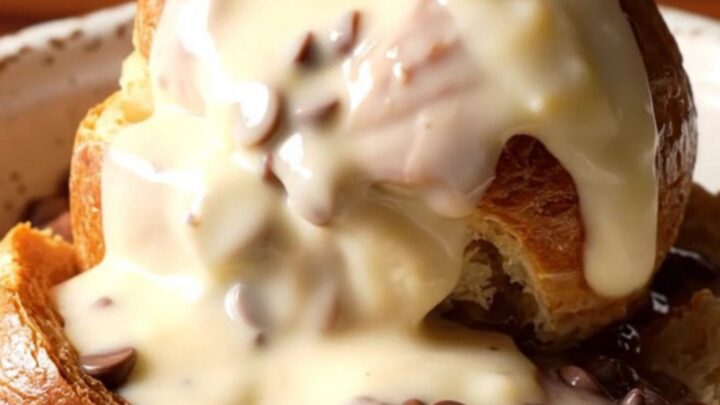
- Spoon and glazeSpoon the warm bread pudding into bowls, making sure to get some of the melted chocolate pockets. Drizzle the warm white chocolate glaze generously over the top of each serving. Serve immediately.Look for The glaze should cascade over the warm pudding, melting slightly into the crevices.Tip For an extra touch, sprinkle a pinch of flaky sea salt over the glaze before serving.
The bread pudding is spooned into bowls and topped with warm white chocolate glaze. The glaze should be pourable and glossy, cascading over the warm pudding. The dessert is ready to serve immediately, with melted chocolate pockets and a silky custard texture.
Common mistakes
One common mistake is lifting the lid during cooking, which lets out heat and can cause the custard to take longer to set. Another is overmixing the custard, which incorporates too much air and can make the pudding puff up and then collapse.
Also, be sure to press the bread down gently after pouring the custard so every cube is soaked. If the top browns too quickly, place a clean towel under the lid to absorb condensation.
How to tell it’s done
The bread pudding is done when the top is golden brown and puffed, and the custard is set around the edges. The center should be firm but springy to the touch, and an instant-read thermometer inserted into the center should read at least 160°F (71°C).
The pudding will continue to set as it rests, so don’t be alarmed if it seems slightly moist in the middle. Let it rest for 10–15 minutes before serving for the best texture.
- Egg dishes: 160°F (71°C) in the thickest part
Up next · Part 3 of 3
4 variations · storage & make-ahead · 5 answers · printable card
Tips, FAQ & printable recipe (Part 3)← Back to the ingredients (Part 1)