Dinner · Part 2 of 3: Instructions
Crockpot Brown Sugar Apricot Dijon Glazed Picnic Ham Step-by-step instructions
- Prep
- Cook
- Total
- Serves
- 12
Before you start
Before you start, make sure your slow cooker is clean and large enough to hold a 6-pound ham. A 6-quart or larger model works best. If your ham is not pre-scored, use a sharp knife to cut a diamond pattern about 1/2 inch deep across the top.
In a small bowl, whisk together the apricot preserves, brown sugar, Dijon mustard, and apple juice until smooth. Have a pastry brush and a pair of tongs ready. No need to preheat the slow cooker—just place the ham inside and brush on the glaze. This recipe is truly dump-and-go.
Ingredients at a glance (5)
- 6 lb boneless smoked picnic ham (scored)
- 1 cup apricot preserves
- 1/2 cup brown sugar
- 3 tbsp Dijon mustard
- 1/2 cup apple juice
Instructions
Glaze and Load
- Prepare the Glaze and HamIn a small bowl, stir together the apricot preserves, brown sugar, Dijon mustard, and apple juice until well combined. Place the scored boneless smoked picnic ham into the slow cooker. Using a pastry brush, generously brush the glaze all over the ham, making sure to work it into the diamond scores.Look for The ham should be completely coated with a thick, glossy layer of glaze.Tip If the preserves are very thick, warm them slightly to make brushing easier.
- Brush the Glaze Over the HamContinue brushing the glaze over the ham, using all of it, until the surface is sticky and well covered. The glaze will pool slightly in the bottom of the slow cooker, which is fine—it will become the basting liquid as the ham cooks.Look for Every scored diamond should be filled with glaze.Tip Use a silicone brush to get into the cuts without tearing the ham.
At the end of this phase, the ham should be fully coated in a thick, glossy glaze. The glaze will be sticky and slightly thick, with the preserves and brown sugar fully incorporated. The slow cooker is loaded and ready to go. You should see the diamond scores filled with glaze, and the bottom of the slow cooker will have a thin layer of glaze. The ham is ready to cook.
Slow Cook and Baste
- Slow-Cook on LowCover the slow cooker and cook the ham on LOW for 5 hours, until the ham is fork-tender and the internal temperature registers at least 145°F (63°C) when checked with an instant-read thermometer inserted into the thickest part, avoiding the bone if present. Let it rest for 3 minutes before slicing.Look for The glaze will be bubbling and caramelizing around the edges of the ham.Safe temperature 145°F (63°C) internal temperature (steaks, chops and roasts)Tip Do not lift the lid during the first 4 hours to keep the heat steady.
- Baste the Diamond ScoresAfter 4 hours, carefully remove the lid and use a baster or spoon to scoop the bubbling golden apricot pan juices from the bottom of the slow cooker. Drizzle the juices over the ham, focusing on the diamond scores, then re-cover and continue cooking for the remaining hour.Look for The pan juices should be thick, glossy, and deeply caramelized.Tip Basting keeps the surface moist and builds the sticky glaze.
- Check for Fork-TendernessAt the 5-hour mark, test the ham by inserting a fork into the thickest part. The fork should slide in with little resistance, and the meat should be tender enough to shred easily. If the ham is not yet fork-tender, continue cooking in 30-minute increments, basting again, until it reaches the desired tenderness and temperature. Let it rest for 3 minutes before slicing.Look for The ham should be deeply glazed and the meat pulls apart easily.Safe temperature 145°F (63°C) internal temperature (steaks, chops and roasts)Tip Smoked ham is already fully cooked, so the goal is heating through and tenderizing.
After 5 hours on low, the ham will be fork-tender and deeply glazed. The glaze will have darkened and caramelized, with bubbling golden juices pooling around the ham. The aroma will be intensely sweet and savory. When you insert a fork, it should slide in easily, and the meat will be tender but still intact. The internal temperature should read 145°F (63°C) or higher.
Rest and Carve
- Rest the HamOnce the ham is fork-tender and has reached 145°F (63°C), remove the slow cooker insert or transfer the ham to a cutting board. Let the ham rest for at least 3 minutes before carving. This allows the juices to redistribute and makes slicing easier.Look for The ham will be very tender; handle gently to avoid breaking it apart.Safe temperature 145°F (63°C) internal temperature (steaks, chops and roasts)Tip Resting is essential for whole-cut meats to keep the slices moist.
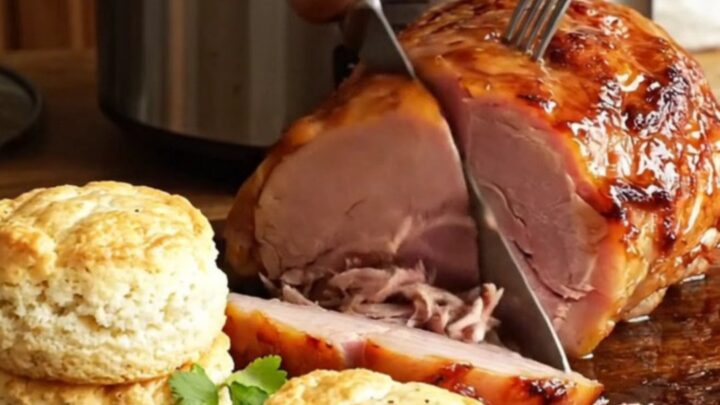
- Carve and ServeUsing a sharp carving knife, slice the ham into thick, juicy pieces. Arrange the slices on a wooden board or serving platter. Spoon some of the remaining pan juices over the top if desired. Serve warm with biscuits, if you like.Look for The slices should be moist, glazed, and slightly sticky.Tip For clean slices, use a long, thin knife and slice against the grain.
The ham has rested and is ready to carve. The slices should be thick, juicy, and coated with sticky glaze. The meat will be tender enough to pull apart, but slicing will give you beautiful, presentable pieces. The pan juices will be thick and caramelized, perfect for spooning over the slices. The ham is ready to serve warm, ideally with biscuits.
Common mistakes
One common mistake is lifting the lid too often to check on the ham. Every time the lid is lifted, heat escapes, which can extend cooking time. Resist the urge to peek for the first 4 hours.
Another mistake is skipping the resting period—letting the ham rest for at least 3 minutes after cooking allows the juices to redistribute, making the meat moister and easier to slice.
Also, be careful not to over-brush the glaze; you want a thick coating, but too much will just pool at the bottom and may burn. Finally, don't skip the scoring—it's key for flavor penetration and that beautiful presentation.
How to tell it’s done
The ham is done when it is fork-tender and the internal temperature reaches at least 145°F (63°C) when measured with an instant-read thermometer inserted into the thickest part, avoiding any bone. The glaze should be thick, sticky, and caramelized, with bubbling juices in the bottom of the slow cooker.
The meat should easily pull apart with a fork, but still hold its shape for slicing. If the ham is not yet tender, continue cooking on low in 30-minute increments, basting again, until it reaches the desired texture and temperature.
- Steaks, chops and roasts: 145°F (63°C) in the thickest part, then a 3-minute rest
Up next · Part 3 of 3
4 variations · storage & make-ahead · 5 answers · printable card
Tips, FAQ & printable recipe (Part 3)← Back to the ingredients (Part 1)