Dinner · Part 2 of 3: Instructions
Slow Cooker Apple Stuffing Chicken for an Easy Weeknight Dinner Step-by-step instructions
- Prep
- Cook
- Total
- Serves
- 4
Before you start
Before you begin, ensure you have measured all your ingredients accurately to streamline the assembly process. Peel and dice your apples into uniform pieces so they cook through at the same rate.
Ensure the slow cooker is positioned on a flat, heat-resistant surface away from any wall outlets or clutter. Having your ingredients prepped and ready to go in bowls near your slow cooker will make the layering step quick and efficient, allowing you to get the meal started in just a few minutes.
Ingredients at a glance (4)
- 4 whole boneless skinless chicken breasts
- 2 cups diced red apples
- 3 cups dry herb stuffing cubes
- 1 cup apple cider
Instructions
Assembly
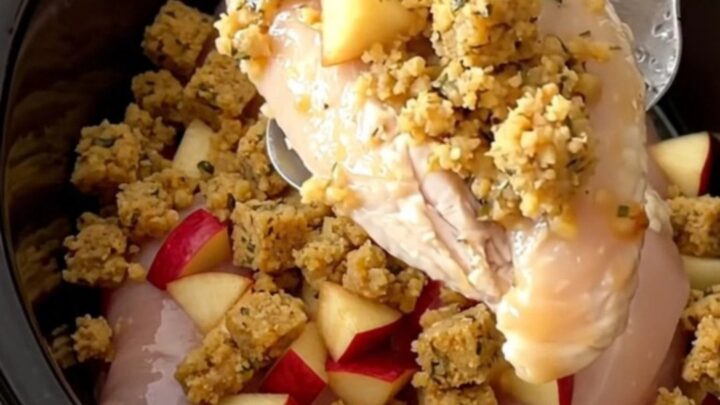
- Layer the ingredientsPlace the raw boneless skinless chicken breasts into the bottom of the slow cooker insert. Scatter the diced red apples evenly over the chicken, then pour the dry herb stuffing cubes over the apples. Finally, pour the apple cider over the top to moisten the stuffing.Look for Ensure the ingredients are evenly distributed.Tip Layering the chicken first ensures it cooks directly in the juices.
At the start, you will see the raw chicken breasts neatly arranged at the bottom of the insert, topped with the diced apples, herb stuffing, and the apple cider. The ingredients should be layered evenly to ensure that the flavors meld together during the cooking process. Everything should look clean and ready for the slow, gentle heat.
Slow Cooking
- Slow cookCover the slow cooker with its lid. Cook on low heat for 4 hours, or until the chicken is cooked through and tender.Look for The stuffing should be moist and the apples tender.Tip Keep the lid closed throughout the cooking process to maintain consistent heat.
During the cooking phase, the slow cooker will work to break down the connective tissues in the chicken while the stuffing absorbs the juices from the apples and the cider.
You will smell a savory, herb-forward aroma filling the kitchen. The stuffing on top will become soft and moist, and the apples will soften significantly as they release their natural sweetness into the pot.
Finishing and Resting
- Final check and restCheck that the internal temperature of the thickest part of the chicken breasts reaches 165°F (74°C) using a meat thermometer. Once reached, remove the chicken and let it rest for at least 5 minutes before serving.Look for The chicken should be opaque and juices should run clear.Safe temperature 165°F (74°C) internal temperature (poultry)Tip Resting the meat helps it retain moisture after slow cooking.
By the end, the chicken will be perfectly cooked and tender, ready to be served. The stuffing should have achieved a soft, cohesive texture, and the apples should be tender and integrated into the dish.
After checking the temperature, allow the chicken to rest for a few minutes so the juices redistribute, ensuring every bite is as moist and flavorful as possible.
Common mistakes
Avoid lifting the lid frequently during the cooking process, as this releases heat and steam, significantly increasing the total cooking time and potentially leading to uneven results.
Additionally, do not overstuff the slow cooker; allow enough room for the stuffing to expand as it absorbs the apple cider. Finally, ensure the chicken is placed at the bottom so it cooks in the juices, rather than on top of the stuffing where it might dry out.
How to tell it’s done
The chicken is done when it is opaque throughout and the internal temperature reaches 165°F (74°C) when measured with a food thermometer in the thickest part of the breast. It should be tender enough to pull apart easily with a fork. Always verify the temperature before serving to ensure food safety and the best possible texture for your meal.
- Poultry: 165°F (74°C) in the thickest part
Up next · Part 3 of 3
2 variations · storage & make-ahead · 3 answers · printable card
Tips, FAQ & printable recipe (Part 3)← Back to the ingredients (Part 1)