Dinner · Part 2 of 3: Instructions
Slow-Cooked Korean Gochujang Short Ribs with Asian Pear Step-by-step instructions
- Prep
- Cook
- Total
- Serves
- 4
Before you start
Before you begin, ensure you have all your ingredients measured and ready. The beef short ribs should be removed from the refrigerator about 30 minutes before you start to take the chill off, which helps with even cooking.
Ensure your slow cooker is clean and positioned on a level, heat-resistant surface. Have your serving dishes and garnish ingredients, such as the sliced scallions and toasted sesame seeds, prepared ahead of time so the final assembly is quick and stress-free when the timer goes off.
Ingredients at a glance (10)
- 4 lb bone-in English-cut beef short ribs
- 1 Asian pear, grated
- 90 g Gochujang chili paste
- 120 ml soy sauce
- 45 ml toasted sesame oil
- 8 garlic cloves, minced
- 1 cup radish chunks
- Steamed jasmine rice, for serving
- Toasted sesame seeds, for serving
- Scallions, sliced, for serving
Instructions
Sauce preparation
- Prepare the aromatics and sauceUsing a box grater, grate the Asian pear into a bowl. Add the Gochujang chili paste, soy sauce, toasted sesame oil, and minced garlic cloves. Whisk the mixture until the chili paste is fully incorporated into the liquid components, creating a smooth, glossy marinade for the beef.Look for The sauce should be smooth and uniform in color.Tip Ensure the garlic is finely minced to distribute the flavor evenly throughout the braising liquid.
The sauce should have a vibrant, deep red color from the Gochujang. The texture should be thick enough to coat the back of a spoon. Ensure the pear is finely grated so it melds into the sauce rather than remaining in large chunks, as this consistency is key to a smooth and uniform glaze after the long cooking process.
Layering the slow cooker
- Layer the slow cookerPlace the bone-in short ribs into the base of the slow cooker, ensuring they are arranged in an even layer. Add the radish chunks around the meat. Pour the prepared Gochujang sauce mixture directly over the ribs and radishes, ensuring every piece of meat is thoroughly coated.Look for The meat should be snugly packed in the cooker.Tip Do not overcrowd the cooker too much; if the ribs don't fit, layer them carefully to ensure even heat distribution.
The ribs should be arranged in a single layer at the bottom of the slow cooker to ensure they cook evenly. The radishes should be nestled around the meat to absorb the cooking liquid. The entire assembly should look organized and fully covered by the sauce, which will begin to bubble and release aromas as the cooker heats up.
Slow-cooking and finishing
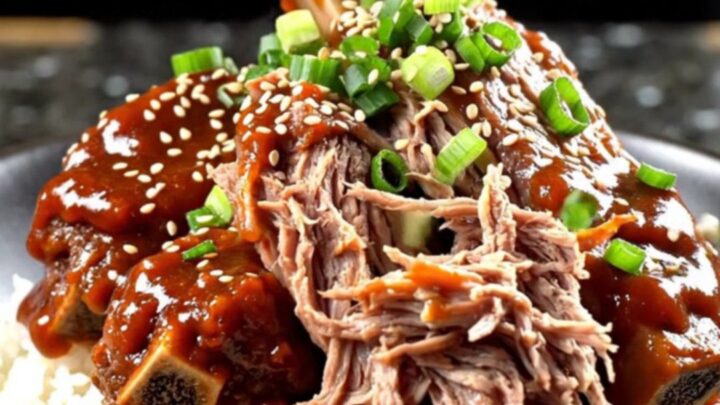
- Slow cook and serveCover the slow cooker and cook on the low setting for 8 hours. The enzymes from the pear will tenderize the meat, while the sauce thickens. Once finished, ensure the meat has reached an internal temperature of at least 145°F (63°C). Let the meat rest for 5 minutes before serving over jasmine rice, garnished with toasted sesame seeds and sliced scallions.Look for The meat should be extremely tender and slide off the bone easily.Safe temperature 145°F (63°C) internal temperature (steaks, chops and roasts)Tip If the sauce is too thin after 8 hours, remove the lid for the final 30 minutes of cooking to allow it to reduce further.
After eight hours, the kitchen should smell rich and savory. The meat will be very soft and should easily pull away from the bone when poked with a fork.
The sauce will have thickened into a glossy, sticky glaze that clings to the beef. Check that the radishes are tender and that the sauce has reduced to your preferred consistency.
Common mistakes
A common mistake is using a cut of meat that is too lean. Short ribs require a certain amount of fat and connective tissue to become tender; if you choose a lean cut, the meat may become dry and stringy instead of succulent. Another error is failing to properly coat the ribs with the marinade.
Ensure that every piece is thoroughly covered, as this seasoning is responsible for the final flavor profile. Finally, avoid lifting the lid frequently, as this releases heat and moisture, significantly increasing the cooking time.
How to tell it’s done
The short ribs are considered done when they are fork-tender and begin to pull away from the bone with minimal pressure. The internal temperature of the thickest part of the meat should reach at least 145°F (63°C).
Because this is a slow-cooked dish, the meat will likely be well beyond this temperature, which is perfectly acceptable and desired for the fall-off-the-bone texture. Let the meat rest for at least 5 minutes before serving to allow the juices to redistribute throughout the fibers.
- Steaks, chops and roasts: 145°F (63°C) in the thickest part, then a 3-minute rest
Up next · Part 3 of 3
2 variations · storage & make-ahead · 3 answers · printable card
Tips, FAQ & printable recipe (Part 3)← Back to the ingredients (Part 1)