Desserts · Part 2 of 3: Instructions
Silky Amalfi Lemon Meringue Tart with Torched Peaks Step-by-step instructions
- Prep
- Cook
- Total
- Serves
- 8
Before you start
Before beginning, ensure all ingredients are at room temperature unless otherwise specified. Have your 9-inch tart shell ready and fully cooled if baking it from scratch.
Organize your whisk, saucepan, and piping equipment. Clear sufficient space in your refrigerator for the tart to sit undisturbed for the required three hours of chilling time, ensuring the surface is level.
Ingredients at a glance (8)
- 200 ml fresh lemon juice
- 4 lemons worth of lemon zest
- 4 eggs
- 180 g sugar
- 150 g cold butter
- 1 9-inch baked sweet pastry shell (store-bought or made ahead)
- 4 egg whites
- 200 g sugar
Instructions
Curd Preparation
- Prepare the lemon curdIn a saucepan, combine the lemon juice, lemon zest, sugar, and eggs. Whisk constantly over medium heat until the mixture thickens into a silky curd. Remove from heat and whisk in the cold butter until fully incorporated and smooth. Pour the mixture into the baked sweet pastry shell.Look for The mixture should coat the back of a spoon cleanly.Safe temperature 160°F (71°C) internal temperature (egg dishes)Tip Whisk constantly to prevent curdling.
The curd should be thick, smooth, and glossy. It should coat the back of a spoon without running off. Ensure the texture is completely uniform before removing it from the heat and incorporating the cold butter. The vibrant yellow color and citrus aroma should be prominent at this stage.
Chilling Phase
- Chill the tartPlace the assembled tart in the refrigerator to chill for at least 3 hours. This allows the curd to set firmly, creating the perfect texture for slicing. Ensure the tart is kept away from strong odors in the fridge during this time.Look for The curd should feel set and firm to the touch.Tip Cover loosely if storing for longer than 3 hours.
The tart must remain in the refrigerator until the curd is firm to the touch. This chilling phase is crucial for the structural integrity of the dessert. Once chilled, the curd should be cool and stable, providing the necessary base for the meringue to be piped on without sliding or losing shape.
Final Torch and Serve
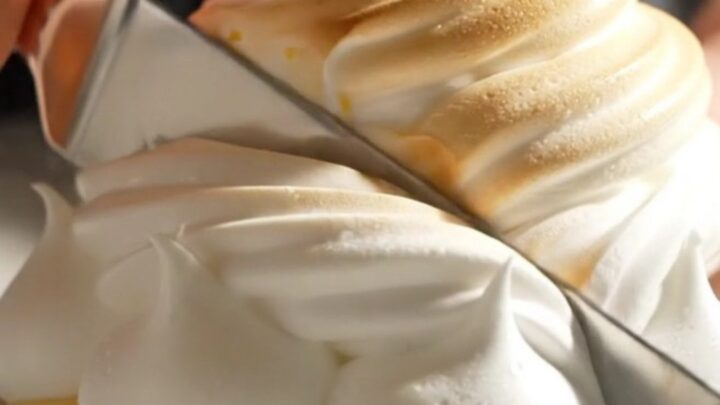
- Prepare meringue and serveWhip the egg whites and sugar until stiff, glossy peaks form. Transfer to a piping bag and pipe decorative peaks over the chilled lemon tart. Use a butane torch to carefully brown the tips of the meringue until golden. Slice the tart into wedges and serve immediately.Look for The meringue should be glossy and hold its shape perfectly.Tip Move the torch constantly to avoid burning the delicate peaks.
The meringue peaks should be perfectly golden brown after torching. The overall presentation should look professional, with clean lines and a vibrant contrast between the torched meringue and the bright lemon curd.
The tart is ready to be sliced and served immediately after the final torching step.
Common mistakes
A common mistake is rushing the curd preparation. If the heat is too high, the eggs may scramble, resulting in a grainy texture. Always keep the heat at a moderate level and whisk continuously.
Another error is failing to chill the tart for the full three hours; if not properly set, the curd will not hold its structure when the tart is sliced, leading to a messy presentation.
How to tell it’s done
The curd is done when it has thickened enough to coat the back of a spoon and has reached an internal temperature of 160°F (71°C) to ensure the eggs are fully cooked.
The meringue is ready when it holds stiff, glossy peaks that do not droop when the whisk is lifted. The final tart is finished when the meringue is golden brown and the curd is set.
- Egg dishes: 160°F (71°C) in the thickest part
Up next · Part 3 of 3
2 variations · storage & make-ahead · 3 answers · printable card
Tips, FAQ & printable recipe (Part 3)← Back to the ingredients (Part 1)