Dinner · Part 2 of 3: Instructions
Sheet Pan Chicken Sausage with Butternut Squash Step-by-step instructions
- Prep
- Cook
- Total
- Serves
- 4
Before you start
Before you start, heat the oven to 425°F (220°C) so it's fully hot when the pan goes in. Line a sheet pan with parchment paper to keep the food from sticking and make cleanup easy.
Slice the chicken sausage into 1/2-inch coins, peel and cube the butternut squash into 1-inch pieces, and cut the red onion into wedges.
In a small bowl, whisk together the maple syrup, Dijon mustard, and whole grain mustard. Have the fresh sage leaves washed and dried. Everything should be prepped and ready before you begin assembling the pan.
Ingredients at a glance (10)
- 1 1/2 lb chicken sausage (about 5 links), sliced into 1/2-inch coins
- 1 medium butternut squash (about 2 lb), peeled and cubed
- 1 large red onion, cut into wedges
- 2 tbsp olive oil
- 3 tbsp pure maple syrup
- 2 tbsp Dijon mustard
- 1 tbsp whole grain mustard
- 12 fresh sage leaves
- 1/2 tsp kosher salt
- 1/4 tsp black pepper
Instructions
Assemble and Sauce
- Prepare the Pan and VegetablesHeat the oven to 425°F (220°C). Line a sheet pan with parchment paper. In a small bowl, whisk together the maple syrup, Dijon mustard, and whole grain mustard to make the maple mustard sauce. On the prepared pan, spread the sausage coins, butternut squash cubes, and red onion wedges in a single even layer. Drizzle with olive oil and sprinkle with salt and pepper. Toss gently to coat.Look for Vegetables and sausage are evenly coated and spread in one layer.Tip Keep the sausage and vegetables in a single layer so they roast, not steam.
- Drizzle the Maple Mustard SauceDrizzle the maple mustard sauce evenly over the sausage and vegetables. Use a spatula or your hands to toss everything again, making sure the sauce coats all pieces. Spread everything back into an even layer.Look for The pan looks glistening with the sauce.Tip Don't oversauce; you want a light coating, not a pool of liquid.
- Add the Sage LeavesScatter the fresh sage leaves over the top of the sausage and vegetables. Some can be tucked under the pieces, but most should sit on top so they crisp up during roasting.Look for Sage leaves are scattered evenly across the pan.Tip Tuck a few sage leaves under the sausage to keep them from burning.
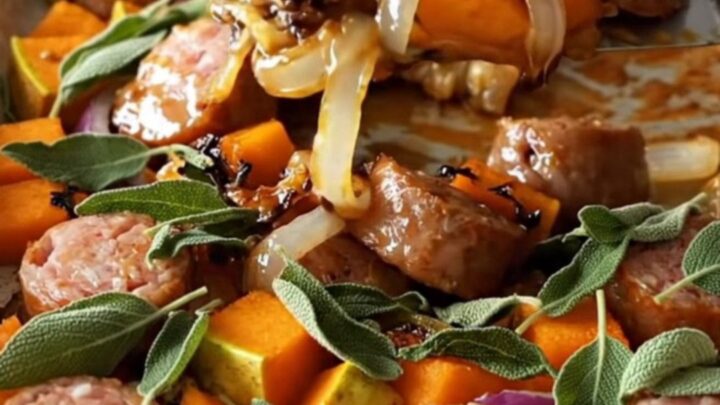
The pan is full with sausage, squash, and onion in a single layer. The maple mustard sauce is drizzled evenly, and the sage leaves are scattered on top. The raw ingredients look glossy and well coated, with no dry spots. The oven is preheated and ready.
Roast to Perfection
- Roast Until Golden and Cooked ThroughPlace the pan in the oven and roast for 20-25 minutes, until the sausage is browned and cooked through (internal temperature of 160°F / 71°C), the squash is tender when pierced with a fork, and the onion edges are caramelized. The sage leaves should be crisp but not burnt.Look for The edges of the squash and onion are golden, and the sausage is browned.Safe temperature 160°F (71°C) internal temperature (ground meat)Tip If the sage leaves start to burn, cover them loosely with foil.
- Check for Doneness and RestRemove the pan from the oven and check that the sausage has reached 160°F (71°C) on an instant-read thermometer. Let the pan rest for 2-3 minutes before serving. This allows the juices to settle and the sage to crisp further.Look for The sausage is firm, and the vegetables are tender.Safe temperature 165°F (74°C) internal temperature (poultry)Tip Resting keeps the sausage juicy.
After 20-25 minutes, the sausage is browned and the squash is tender. The edges of the onion are caramelized and the sage leaves are crisp. The kitchen smells sweet and savory. The internal temperature of the sausage reads 160°F (71°C).
Rest and Serve
- Serve from the PanUse a metal spatula to lift portions of the sausage, squash, and onion onto plates. Spoon any pan juices over the top and garnish with the crispy sage leaves. Serve hot.Look for The portions lift easily with the spatula.Tip The crispy sage leaves add a nice texture—don't skip them.
The pan has rested for a few minutes, allowing the juices to settle. The sausage is juicy, the squash is tender, and the sage is crunchy. Portions lift easily with a spatula and the dish is ready to serve.
Common mistakes
One common mistake is overcrowding the pan, which steams the food instead of roasting it. Use a large sheet pan and keep everything in a single layer, leaving a little space between pieces. Another mistake is cutting the squash into uneven chunks, which leads to some pieces being undercooked while others turn to mush.
Take the time to cut them uniformly. Also, be careful not to over-sauce: too much maple mustard sauce can pool and make the dish soggy. A light drizzle is enough. Finally, don't forget the sage leaves — they add a lot of flavor and texture, but they can burn quickly, so watch them near the end.
How to tell it’s done
The dish is done when the sausage is browned and has reached an internal temperature of 160°F (71°C) on an instant-read thermometer. The butternut squash should be tender when pierced with a fork — it should offer little resistance but not turn to mush.
The red onion wedges should be soft and caramelized at the edges, with some charred spots. The sage leaves should be crisp and brittle, not chewy or burnt. If the sage is browning too quickly, you can remove it or cover it loosely with foil while the rest finishes.
- Ground meat: 160°F (71°C) in the thickest part
- Poultry: 165°F (74°C) in the thickest part
Up next · Part 3 of 3
4 variations · storage & make-ahead · 5 answers · printable card
Tips, FAQ & printable recipe (Part 3)← Back to the ingredients (Part 1)