Breakfast · Part 2 of 3: Instructions
Sausage Gravy Biscuit Breakfast Bake: One Pan, 50 Minutes Step-by-step instructions
- Prep
- Cook
- Total
- Serves
- 8
Before you start
Before anything touches the oven, set up the whole dish in order. Take the biscuit dough, the gravy and the cheddar out so they are ready to use, and grease the baking dish thoroughly, paying attention to the corners where the bake tends to catch.
Brown the sausage first and let it drain while the other components are prepared; hot crumbles scatter more evenly than clumps. Cut each biscuit into eight even wedges while the dough is still cold from the refrigerator, since cold dough holds its layers and rises with more lift.
Ingredients at a glance (7)
- 1 lb raw breakfast sausage, casings removed if needed
- 1 can refrigerated biscuit dough (8 biscuits), store-bought or made ahead
- 2 cups peppery country gravy, store-bought or made ahead
- 4 large eggs
- 1/2 tsp coarsely ground black pepper, plus more to taste
- 2 cups shredded cheddar cheese
- Neutral oil, to taste, for greasing the baking dish
Instructions
Build the base
- Heat the oven and grease the dishPosition a rack in the center of the oven and heat it to 375°F (190°C). Rub a 9x13-inch ceramic or glass baking dish with a thin film of neutral oil, covering the corners well. A lightly greased dish keeps the biscuit quarters from sticking where the gravy thins out along the edges.Look for The oven should read 375°F (190°C) on a separate thermometer before the dish goes in.Tip Ceramic dishes hold heat evenly and keep the edges from drying out during the bake.
- Brown the sausageCrumble the raw breakfast sausage into a large skillet set over medium heat. Cook, breaking it into small crumbles with a spatula, until no pink remains and it reaches an internal temperature of 160°F (71°C), 8 to 10 minutes. Drain the rendered fat and let the crumbles cool for a couple of minutes.Look for The crumbles should be deep brown at the edges with no pink centers anywhere.Safe temperature 160°F (71°C) internal temperature (ground meat)Tip Small, even crumbles distribute better between the biscuit quarters than large chunks.
- Quarter the biscuit doughOpen the can of refrigerated biscuit dough and cut each biscuit into 8 even wedges with a sharp knife or kitchen scissors. Work quickly while the dough is cold, since chilled dough is easier to cut cleanly and rises with more lift in the oven than dough that has been handled warm.Look for Each wedge should hold a visible layered edge from the round of dough.Tip Scissors give cleaner cuts than a knife and stop the layers from compressing.
- Whisk the gravy and eggsWhisk the eggs in a glass pitcher or large measuring cup until completely smooth, then add the peppery country gravy and the black pepper. Whisk until the mixture looks uniform, glossy and pourable, with no streaks of egg white left. It should fall from the whisk in a slow ribbon.Look for No visible egg white streaks should remain in the pale, pepper-flecked mixture.Tip A pitcher with a spout pours the mixture between the biscuit pieces without disturbing them.
By the end of this phase the oven is at 375°F (190°C), the greased 9x13-inch dish is waiting on the counter, and the sausage is fully browned to 160°F (71°C) with deep brown edges and no pink anywhere, drained of its rendered fat. The biscuit quarters are cut into even wedges that still show their layers, and the gravy and egg mixture is smooth, pale and pepper-flecked, falling from the whisk in a slow ribbon with no streaks of egg white.
Assemble the bake
- Layer the biscuits and sausageScatter the quartered biscuit dough evenly across the greased baking dish, leaving a little breathing room between the pieces so they can puff. Spread the drained sausage crumbles over and between the quarters, letting some fall to the bottom so every scoop of the finished bake carries both biscuit and sausage.Look for The biscuit quarters should sit in a fairly even single layer, not stacked in piles.Tip Tuck a few crumbles under the dough so they stay moist through the long bake.
- Pour the gravy overPour the gravy and egg mixture slowly and evenly over the biscuit quarters and sausage, starting in the middle and working toward the corners. Give the dish a gentle shake or two so the liquid settles into every gap. Some of the biscuit tops should still peek above the surface.Look for The liquid should come about three-quarters of the way up the biscuit pieces.Tip Pouring in two passes lets the first liquid soak in before the rest is added.
- Top with cheddarShower the shredded cheddar evenly over the whole dish, covering the exposed biscuit tops and the gravy alike. Spread it edge to edge so the corners get the same coverage as the center. The cheese will melt into the gravy as it bakes and form a golden blanket over the puffed biscuits.Look for No bare pools of gravy should show through the cheese layer before baking.Tip Grate the cheddar fresh; coated shreds melt less smoothly into the gravy.
The assembled dish should look abundant and even from above: biscuit quarters spread in a single layer with visible gaps between them, sausage crumbles scattered over and between the dough, the gravy and egg mixture settled into every corner and coming about three-quarters of the way up the biscuit pieces, and a full blanket of cheddar covering the surface edge to edge with no bare pools of gravy showing through.
Shake the dish gently once more and check the corners, which are the easiest place for the liquid to miss.
Bake and serve
- Bake until puffed and setBake in the center of the 375°F (190°C) oven for 30 to 35 minutes, until the biscuits are puffed and deep golden and the gravy has thickened around them. Check the center with an instant-read thermometer: the eggs are fully cooked when the bake reads 160°F (71°C) in the middle.Look for The biscuits should be golden, never burnt, and the cheese blistered at the edges.Safe temperature 160°F (71°C) internal temperature (egg dishes)Tip If the cheese colors too fast, tent the dish loosely with foil for the last 10 minutes.
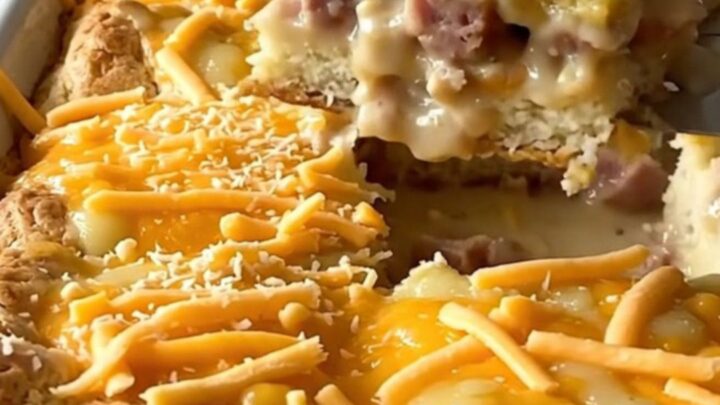
- Rest and serve in squaresSet the dish on a wire rack and let it rest for 5 to 10 minutes so the gravy firms up around the biscuits. Slide a spatula under a neat square of biscuit, sausage and gravy, lift it out centered, and serve straight away while the cheese is still glossy and the biscuits are warm.Look for A lifted square should hold together cleanly with the gravy clinging to it.Tip Cut between biscuit quarters rather than through them for the neatest portions.
Coming out of the oven, the bake should be at its best: biscuits puffed high and deep golden, the cheddar melted into the gravy with light blistering at the edges, and the surface looking cohesive and fully set rather than glossy.
A thermometer in the center reads 160°F (71°C), the eggs are fully cooked, and the gravy has thickened enough to cling to a spatula. After a five-to-ten-minute rest, a neat square of biscuit, sausage and gravy lifts out centered and holds together, with the cheese still glossy and the biscuit tender inside its crust.
Common mistakes
The most common mistake is under-browning the sausage before it goes into the dish. Pale crumbles stay gray and bland under the gravy, so cook them until deep brown at the edges and drain the fat well, since excess grease will pool around the biscuits and keep their bottoms from setting. Cutting the biscuit dough too large is another trap: whole or halved biscuits stay doughy in the center while the edges over-bake, so quarter each round into eight even wedges.
How to tell it’s done
The bake is done when three signs line up. First, the biscuit quarters are puffed well above the surface and colored an even, deep golden brown, never pale and never burnt at the peaks.
Second, the cheddar has melted into the gravy and blistered lightly at the edges, with no glossy patches of uncooked mixture in the center of the dish. Third, and most important, an instant-read thermometer inserted into the middle of the bake reads 160°F (71°C), which confirms the eggs in the gravy are fully cooked through.
- Ground meat: 160°F (71°C) in the thickest part
- Egg dishes: 160°F (71°C) in the thickest part
Up next · Part 3 of 3
4 variations · storage & make-ahead · 5 answers · printable card
Tips, FAQ & printable recipe (Part 3)← Back to the ingredients (Part 1)