Dinner · Part 2 of 3: Instructions
Sausage and Onion Bake with Sweet Caramelized Onions Step-by-step instructions
- Prep
- Cook
- Total
- Serves
- 4
Before you start
Before starting, gather all ingredients and equipment. Preheat the oven to 400°F (204°C) to ensure a hot cooking environment. Peel the onions, cut them in half from stem to root, and then slice them into thick, even half-moons.
Slicing them too thin will cause them to burn before the sausages cook through. Retrieve the raw sausages from the refrigerator, ensuring they remain cold until the moment they go into the oven for food safety.
Ingredients at a glance (2)
- 3 large sweet onions, sliced
- 1 lb fresh sausages
Instructions
Prepping the Sheet Pan
- Prep and Lay the OnionsSpread the sliced sweet onions evenly across the rimmed baking sheet. Arrange them in a flat, uniform layer to create a bed for the sausages. Slicing them to an even thickness ensures they cook at the same rate and caramelize beautifully in the oven without any pieces burning.Look for The onions are evenly distributed across the baking sheet.Tip Cut the onions into uniform half-inch slices so they roast evenly.
- Arrange the SausagesPlace the fresh sausages directly on top of the onion bed, spacing them evenly across the sheet pan. Leaving space between each sausage allows the hot oven air to circulate freely, which helps the skins brown and crisp beautifully. Do not prick the sausage casings, as keeping them intact preserves the flavorful juices inside.Look for Sausages are evenly spaced on top of the onions.Tip Keeping the sausages on top of the onions helps baste them with dripping fat.
At the end of this initial phase, the sheet pan is fully prepared for the oven. The onions are sliced into thick, uniform half-moons and spread evenly across the pan. The raw sausages sit proudly on top of the onion bed, properly spaced to ensure even heat distribution. There should be no crowded areas, and the ingredients should look fresh, organized, and ready for roasting.
Mid-Way Roasting and Tossing
- Roast and TossTransfer the baking sheet to the preheated oven and roast. Carefully remove the pan from the oven and use tongs to turn the sausages over. Toss the onions in the rendered pan drippings, spreading them back out around the sausages. Return the sheet pan to the oven to continue roasting.Look for The onions should begin to soften and turn golden.Tip Tossing the onions in the rendered fat halfway through prevents them from drying out.
At this halfway mark, the kitchen is filled with a savory, mouthwatering aroma. The sausages have begun to brown on one side, and their rendered fat has pooled onto the baking sheet.
The onions have softened significantly, turning translucent with golden edges. After turning the sausages and tossing the onions in the rich pan drippings, the entire mixture looks beautifully glossy and partially caramelized.
Final Caramelization and Resting
- Finish Cooking and Verify TemperatureRoast until the onions are deeply caramelized and the sausages are browned and sizzling. Insert an instant-read thermometer into the center of the thickest sausage to ensure it reaches a safe internal temperature of 160°F (71°C). Remove the pan from the oven and let it rest for five minutes before serving.Look for Sausages are deeply browned and onions are tender and dark golden.Safe temperature 160°F (71°C) internal temperature (ground meat)Tip Letting the sausages rest for a few minutes allows the juices to redistribute.
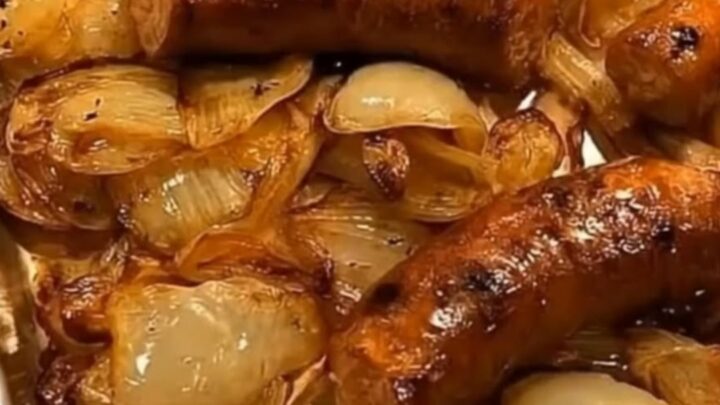
At the completion of the final roasting phase, the sausages are deeply browned, sizzling, and plump, with a slight crispness to their skins. The onions have transformed into a tender, sweet, jammy bed of dark golden-brown goodness, concentrated in flavor. A puff of steam rises when the sausages are cut, and the internal temperature has safely reached 160 degrees Fahrenheit (71 degrees Celsius).
Common mistakes
One common mistake is slicing the onions too thin, which causes them to burn and turn bitter before the sausages are fully cooked. Another error is crowding the baking sheet; if the sausages and onions are packed too tightly, they will steam instead of roast, resulting in soggy onions and pale, rubbery sausages.
Additionally, do not prick the sausages before cooking. Pricking the casings lets all the flavorful juices and fat escape onto the pan too quickly, leaving the sausages dry and tough.
How to tell it’s done
The sausages are perfectly done when the skins are taut, browned, and slightly blistered, and the onions are soft, sweet, and caramelized to a rich golden-brown color. To guarantee food safety, always use an instant-read meat thermometer inserted into the center of the thickest sausage.
The internal temperature must register at least 160°F (71°C) for pork or beef sausages. Once this temperature is achieved, remove the pan from the oven and let the dish rest for five minutes to lock in the juices.
- Ground meat: 160°F (71°C) in the thickest part
Up next · Part 3 of 3
2 variations · storage & make-ahead · 3 answers · printable card
Tips, FAQ & printable recipe (Part 3)← Back to the ingredients (Part 1)