Dinner · Part 2 of 3: Instructions
San Diego Carne Asada Burrito with Crispy Fries Step-by-step instructions
- Prep
- Cook
- Total
- Serves
- 1
Before you start
Before any heat goes on, set up the whole station, because assembly moves fast once the tortilla is warm. Thaw or cut the shoestring fries and have the frying oil ready. Take the marinated steak out of the refrigerator at the last moment — it can sit out for at most 30 minutes before it hits the grill.
Set out the cheddar, drained pico de gallo, guacamole, sour cream and salsa in separate bowls, plus a clean board, a sharp knife, tongs, an instant-read thermometer and a wide spatula.
Ingredients at a glance (8)
- 6 oz skirt steak, marinated carne asada style
- 1 cup crispy shoestring french fries
- 1/2 cup shredded cheddar
- 1/3 cup pico de gallo, well drained
- 1/3 cup fresh guacamole, store-bought or made ahead
- 2 tbsp sour cream
- 1 large flour tortilla (14-inch), steamed
- Smoky red roasted habanero salsa, store-bought or made ahead, for serving
Instructions
Grill, slice and fry
- Grill the carne asadaPat the marinated skirt steak dry and let it sit at room temperature for no more than 30 minutes. Grill over a hot, lightly oiled flame, turning once, until charred outside and cooked through, reaching an internal temperature of at least 145°F (63°C). Move it to a clean board and let it rest at least 3 minutes before slicing.Look for Deep charred edges with a juicy, fully cooked center and no pink near the middle.Safe temperature 145°F (63°C) internal temperature (steaks, chops and roasts)Tip Skirt steak is thin, so two to three minutes per side is usually enough over a very hot fire.
- Slice the steak thinWith a sharp knife, cut the rested steak across the grain into thin ribbons, then chop any longer pieces into bite-size shreds. Gather the slices on the board so the juices redistribute into the meat rather than onto the tortilla. Keep the steak within easy reach of the assembly station, since the next few moves happen quickly once the tortilla is warm and the fries are hot.Look for Even, tender ribbons with visible char on the edges and no large chunks.Tip Cutting against the grain shortens the muscle fibers, which keeps every bite easy to chew.
- Fry the shoestring potatoesHeat oil in a deep skillet or countertop fryer to 375°F (190°C) and fry the shoestring potatoes in small batches until golden and crisp, two to three minutes per batch. Drain on a paper-towel-lined plate and season lightly with salt. Alternatively, air-fry or bake frozen shoestring fries until they are firm and dry on the surface. Work in batches so the oil temperature never drops and the fries stay crisp.Look for Pale golden fries that snap when bitten, with no bend and no greasy sheen.Tip Shoestring cuts stay crisp inside a burrito far better than thick fries, which steam and soften.
At the end of this phase the two hot components are ready and waiting. The steak shows deep char on the edges, has rested at least 3 minutes and reads at least 145°F (63°C), and the slices fall into tender ribbons with no chewy, uncut grain.
The fries are pale gold, audibly crisp and drained dry on paper towels, with no greasy shine. Check before moving on: if the fries have softened at all, return them to hot oil or a 400°F surface for thirty seconds — a limp fry ruins the texture that defines this burrito.
Steam, layer, roll and sear
- Steam the tortillaWarm the 14-inch flour tortilla directly over a low flame or in a covered skillet with a few drops of water until it is supple and steamed through, about 30 to 60 seconds per side. It should bend fully without cracking or springing back. Lay it flat on a clean surface, ready for layering. A properly steamed tortilla is the difference between a tight torpedo roll and a burrito that splits at the fold.Look for A glossy, pliable tortilla that drapes over your hand without cracking.Tip Stack warm tortillas under a clean towel while working so none of them dries out.
- Layer cheese, steak and friesScatter the shredded cheddar in a horizontal band across the lower third of the warm tortilla, slightly off-center. Pile the sliced steak over the cheese, then top with the hot shoestring fries. Keep the filling in a tight, even line and leave the edges clear by about two inches. The cheese sits directly on the tortilla so it melts against the heat and helps glue the seam shut later.Look for A dense, even band of filling with cheese starting to soften from the heat below.Tip Overfilling is the most common failure; a tight roll needs clear borders on every side.
- Add pico, guacamole and sour creamSpoon the drained pico de gallo down the center of the filling, then add the guacamole in dollops and finish with the sour cream. Spread the cold elements gently so they sit inside the line rather than spilling toward the edges. These cool layers against the hot steak and fries are what make a California burrito taste layered rather than uniform, so take ten extra seconds to place them deliberately.Look for Bright green and red accents visible along the top of the filling line.Tip Draining the pico well keeps the tortilla from turning soggy during the sear.
- Roll tight and sear on the flat-topFold the two side edges in, then roll the tortilla away from you into a tight torpedo, tucking as you go. Place it seam-side down on a 400°F (204°C) flat-top or cast-iron skillet and sear for 90 seconds per side, pressing gently with a wide spatula, until the tortilla is deep golden and crisp on both faces and the cheese inside has melted completely.Look for A uniformly bronzed, crackly exterior with the roll holding a firm cylinder shape.Tip Resist pressing hard; a light touch compresses the filling without squeezing out the guacamole.
This phase ends with the burrito fully formed and seared. The tortilla draped without cracking when it was steamed, the filling sat in a tight line with clear borders, and the roll closed into a firm torpedo with the seam down. After 90 seconds per side at 400°F, the exterior is uniformly deep golden and crackly, the roll feels dense when lifted with the spatula, and melted cheddar is visible at the seam. Press lightly: it should give slightly and spring back.
Slice, sauce and serve
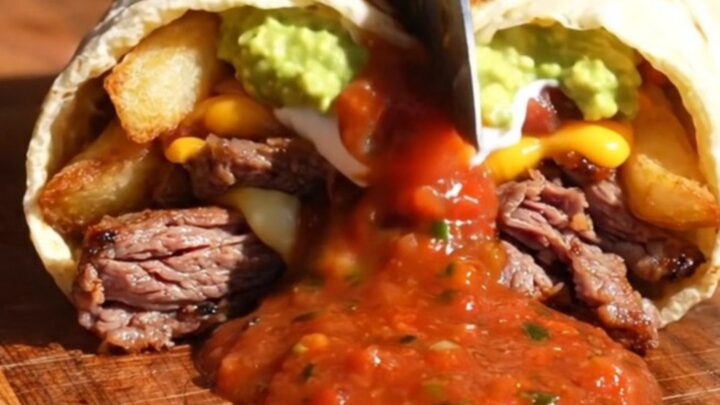
- Slice and pour the salsaTransfer the seared burrito to a cutting board and let it sit for one minute so the molten filling settles. Slice it cleanly in half on the bias with a serrated knife, using one firm stroke rather than a sawing motion. Arrange the halves cut-side up, spoon the smoky red roasted habanero salsa generously over the steaming steak-and-fry core, and serve immediately while the exterior is still crisp.Look for A clean cross-section showing charred steak, golden fries, melted cheddar and green guacamole.Tip A serrated knife and one confident stroke keep the fries from being pushed out of the fill.
The finish is quick but worth checking. After a one-minute rest on the board, the knife goes through in a single bias stroke and the two halves hold their shape, revealing a clean cross-section: charred steak ribbons, intact golden fries, a continuous band of melted cheddar and pockets of green guacamole.
The red habanero salsa pools into the steaming core rather than running off the plate. The exterior should still crackle when pressed with a fork; if it has softened, the rest ran long.
Common mistakes
The three failures show up again and again. Overfilling is the first: more than the listed amounts makes the roll impossible to seal, and it bursts on the flat-top.
The second is wet filling — undrained pico de gallo or watery guacamole steams the tortilla from the inside and softens the sear, so drain the pico well and keep every element inside the filling line. The third is a lazy sear: a griddle below 400°F warms the burrito instead of crisping it, and a rushed 30-second pass leaves pale spots.
How to tell it’s done
The burrito is done when three checks all pass. First, the steak: it must have reached at least 145°F (63°C) on an instant-read thermometer and rested at least 3 minutes before slicing — thin skirt steak hits this quickly over a hot fire. Second, the exterior: the tortilla should be deep golden and crackly on both seared faces, with the cheddar inside fully melted and no pale, soft spots.
- Steaks, chops and roasts: 145°F (63°C) in the thickest part, then a 3-minute rest
Up next · Part 3 of 3
4 variations · storage & make-ahead · 5 answers · printable card
Tips, FAQ & printable recipe (Part 3)← Back to the ingredients (Part 1)