Desserts · Part 2 of 3: Instructions
Salted Caramel Molten Chocolate Cakes Step-by-step instructions
- Prep
- Cook
- Total
- Serves
- 2
Before you start
Before beginning, ensure all ingredients are measured and ready. Preheat your oven to 425°F (218°C) well in advance, as the high heat is essential for the structure of the cake. Prepare your ramekins by brushing the interiors with a thin layer of softened butter to prevent sticking.
Take the salted caramel truffles out of the freezer only when you are ready to assemble the cakes to ensure they stay solid during the insertion process. Prepare a cooling rack and have your serving plates ready nearby for immediate plating.
Ingredients at a glance (7)
- 4 oz bittersweet chocolate (60% cocoa), melted
- 4 tbsp butter, melted
- 2 large eggs
- 1/4 cup brown sugar
- 2 frozen salted caramel truffles
- flaky sea salt, for serving
- creme fraiche, for serving
Instructions
Batter Preparation
- Prepare the BatterIn a medium mixing bowl, whisk together the melted bittersweet chocolate and melted butter until smooth. Add the brown sugar and eggs, whisking vigorously until the mixture is fully combined and glossy.Look for The batter should be smooth, thick, and have a glossy, uniform dark appearance.Tip Ensure the melted chocolate has cooled slightly before adding the eggs to prevent them from scrambling.
The batter should be perfectly smooth and glossy. When lifted with a whisk, it should fall in a thick, continuous ribbon. Ensure there are no streaks of butter or sugar visible, as a homogenous mixture is crucial for the final texture. If the batter appears too thin, it may need to be chilled for a few minutes before assembly to help it hold the weight of the truffle.
Assembly and Filling
- Assemble the CakesGrease two ramekins generously. Pour half of the chocolate batter into each ramekin. Place one frozen salted caramel truffle into the center of each ramekin, then cover with the remaining batter, ensuring the truffle is completely submerged.Look for The batter should completely encase the truffle so it does not leak during the initial baking phase.Tip Using frozen truffles helps them maintain their structure and prevents them from melting too quickly during the baking process.
The truffle must be placed exactly in the center of the ramekin. When covering with the remaining batter, ensure no air pockets are trapped around the truffle, as these can cause the cake to bake unevenly.
Check that the ramekins are filled to the same level to ensure consistent baking times for both cakes. The surface of the batter should be smoothed over with a spatula for a professional appearance.
Baking and Plating
- Bake and ServePreheat the oven to 425°F (218°C). Bake the cakes for 12 minutes. Remove from the oven, allow to rest for one minute, then carefully invert each cake onto a plate. Sprinkle with flaky sea salt and serve immediately with a dollop of creme fraiche. To ensure the eggs are cooked through to a safe temperature, they must reach 160°F (71°C).Look for The edges of the cake should be set and firm, while the center remains soft to the touch.Safe temperature 160°F (71°C) internal temperature (egg dishes)Tip Running a thin knife around the edge of the ramekin before flipping helps the cake release cleanly.
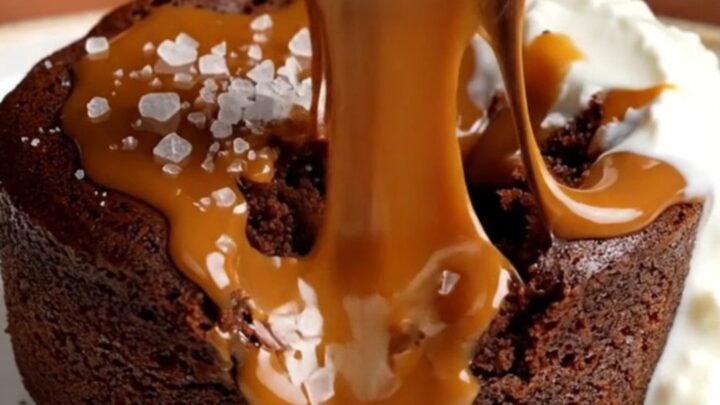
The cakes will rise slightly and the surface will look matte and set. The aroma of rich, dark chocolate should fill the kitchen. Once inverted, the cake should release smoothly from the ramekin. The final result should be a warm, dark cake that yields easily to a fork, releasing the molten salted caramel core that blends seamlessly with the surrounding chocolate.
Common mistakes
A common mistake is using chocolate with a low cocoa percentage, which can make the cake too sweet and prevent the rich, dark flavor profile from shining. Another error is failing to fully submerge the salted caramel truffle; if the truffle is exposed to the surface, it may leak out during the baking process.
Finally, do not ignore the resting time. Letting the cakes sit in the ramekins for one minute before inverting allows the structure to stabilize slightly, ensuring they don't collapse when flipped.
How to tell it’s done
The cakes are done when the edges are firm and have pulled slightly away from the sides of the ramekins, while the center still jiggles slightly when the ramekin is gently shaken.
The internal temperature of the egg-based batter must reach 160°F (71°C) to be safe for consumption. Do not overbake, or the center will lose its molten, lava-like consistency and become fully firm, which will ruin the intended textural experience of the dessert.
- Egg dishes: 160°F (71°C) in the thickest part
Up next · Part 3 of 3
2 variations · storage & make-ahead · 3 answers · printable card
Tips, FAQ & printable recipe (Part 3)← Back to the ingredients (Part 1)