Dinner · Part 2 of 3: Instructions
Root Beer BBQ Spare Ribs: Easy Slow Cooker Dinner Step-by-step instructions
- Prep
- Cook
- Total
- Serves
- 6
Before you start
Before you start, pat the ribs dry with paper towels. If they are in a rack, you can leave them whole or cut them into individual ribs — cutting them makes serving easier later.
Dice the onion and have all ingredients measured and ready. There's no need to sear the ribs; the slow cooker does all the work. Make sure your slow cooker is at least 6 quarts to accommodate the ribs comfortably.
Ingredients at a glance (4)
- 4 lb St. Louis style pork spare ribs
- 1 1/2 cups root beer
- 1 large sweet onion, diced
- 2 cups thick Kansas City style BBQ sauce
Instructions
Layer and Sauce
- Layer the Ribs and AromaticsPlace the St. Louis style spare ribs in the bottom of a 6-quart slow cooker, arranging them in a single layer if possible, cutting to fit if needed. Scatter the diced sweet onion evenly over the ribs. Pour the root beer around the meat, being careful not to rinse the onions off the top.Look for The ribs should be mostly submerged in the root beer, with onions scattered over the top.Tip If the ribs are too long, use kitchen shears to cut the rack in half so they fit comfortably.
- Pour the BBQ SaucePour the thick Kansas City style BBQ sauce over the ribs and onions, spreading it gently with a spoon to coat the meat as much as possible. Do not stir, as that can break up the ribs.Look for The sauce should form a thick, glossy layer over the ribs.Tip Use a good-quality sauce with a thick consistency so it clings to the meat.
The ribs are nestled in the slow cooker with onions scattered on top, and the root beer and BBQ sauce cover them in a glossy, dark layer. The aroma is sweet and tangy, with a hint of spice.
The sauce should be thick enough to coat the meat, and the onions are visible but mostly submerged. This is the stage where the magic begins.
Slow Cook and Tenderize
- Slow Cook Until TenderCover the slow cooker and cook on low for 8 to 10 hours, or on high for 4 to 5 hours, until the meat is fork-tender and nearly falling off the bone. The internal temperature of the pork should reach at least 145°F (63°C), but for fall-apart texture, cook until it exceeds 190°F (88°C). Let it rest for 3 minutes before slicing.Look for The meat will shrink back from the bones and a fork will twist easily with little resistance.Safe temperature 145°F (63°C) internal temperature (steaks, chops and roasts)Tip Low and slow is best for spare ribs; the longer time allows the collagen to break down.
- Rest the RibsOnce the ribs are tender, turn off the slow cooker. Use tongs to carefully transfer the ribs to a cutting board. Let them rest for at least 3 minutes before slicing or serving. This allows the juices to redistribute and the meat to set.Look for The ribs will be very tender; handle gently to keep them intact.Tip Resting is crucial for whole cuts of meat; resist the urge to cut immediately.
After hours of simmering, the kitchen smells like a barbecue joint. The sauce has reduced and darkened, and the ribs are glistening, with the meat visibly shrinking from the bones. A gentle poke with a fork shows the meat is pull-apart tender. The sauce is bubbling lazily around the edges, thick and sticky.
Rest and Serve
- Skim and Thicken the SauceWhile the ribs rest, skim off any excess fat from the surface of the sauce in the slow cooker. If the sauce is too thin, transfer it to a saucepan and simmer over medium heat for 5-10 minutes, or until it thickens slightly.Look for The sauce should coat the back of a spoon.Tip Skimming the fat gives a cleaner, more intense flavor.
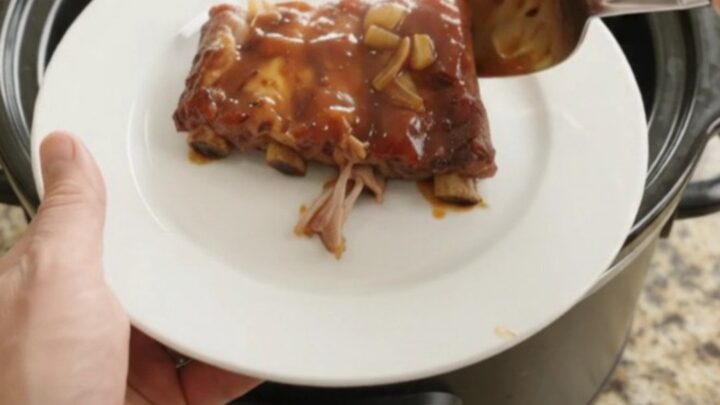
- Serve the RibsCut the ribs between the bones into individual or double-rib portions. Arrange them on a platter or individual plates. Spoon the thickened sauce and caramelized onions over the top. Serve hot.Look for The ribs should be glistening with sauce and the onions soft and sweet.Tip For a neater presentation, use a sharp knife to slice between the bones.
The ribs have rested, and the sauce has been skimmed and thickened. When you cut between the bones, the meat holds together but is clearly fork-tender. The onions are soft and sweet, and the sauce clings to every piece. Serve immediately, with extra sauce spooned over the top.
Common mistakes
One common mistake is not cooking the ribs long enough. Spare ribs need time to break down the collagen; if they're still tough, they need more time. Another mistake is using too much liquid — the ribs should be submerged but not swimming.
Also, avoid lifting the lid during cooking, as that releases heat and extends the cooking time. Finally, don't skip the resting step; it allows the juices to redistribute, keeping the meat moist.
How to tell it’s done
The ribs are done when the meat is fork-tender and easily pulls away from the bone. The internal temperature should reach at least 145°F (63°C), but for the best fall-apart texture, aim for 190°F (88°C) or higher.
To test, insert a fork into the thickest part of the meat — it should twist easily with no resistance. The sauce will have darkened and thickened, and the onions will be soft and caramelized.
- Steaks, chops and roasts: 145°F (63°C) in the thickest part, then a 3-minute rest
Up next · Part 3 of 3
4 variations · storage & make-ahead · 5 answers · printable card
Tips, FAQ & printable recipe (Part 3)← Back to the ingredients (Part 1)