Desserts · Part 2 of 3: Instructions
Rich Chocolate Crumble Cake with Coconut Cream Filling Step-by-step instructions
- Prep
- Cook
- Total
- Serves
- 8
Before you start
Before you begin the assembly, ensure you have all your components ready. The cake layers must be completely cool, as any residual warmth will cause the coconut cream to melt and lose its structure.
Have your cake stand, a sharp knife for leveling if necessary, and a cake server ready.
Clear enough space in your refrigerator to accommodate the cake stand, as the final chilling step is crucial for the perfect slice. Ensure your workspace is clean, organized, and free of distractions to focus on the precise assembly required for this delicate dessert.
Ingredients at a glance (3)
- 1 batch chocolate cake base, store-bought or made ahead
- 1 cup chocolate crumble, store-bought or made ahead
- 2 cups coconut cream, chilled
Instructions
Cooling the cake base
- Prepare the cake baseEnsure the chocolate cake base is fully baked and cooled completely to room temperature. A cooled cake is essential for maintaining the structure when adding the filling and ensures the cream does not melt prematurely during assembly.Look for The cake should be completely cool to the touch.Tip Use a wire rack to speed up the cooling process for the cake layers.
The cake base should be completely cool and firm. If you press gently on the center, it should feel stable and not yield easily. Ensure the edges are clean and the surface is level so the filling will sit evenly.
Spreading the coconut cream
- Assemble the fillingPlace the bottom layer of the chocolate cake on your serving stand. Spread the chilled coconut cream evenly over the surface, creating a thick and generous layer. Gently place the second cake layer on top, pressing down very lightly to secure the assembly without squishing the cream filling out the sides.Look for The cream should be spread to the very edges of the cake layer.Tip Keep the coconut cream in the refrigerator until the very last second before spreading.
The coconut cream should be thick and spread evenly across the cake layer. It should reach just to the edges but not overflow. The layer should look uniform and smooth, providing a solid foundation for the second cake piece.
Adding the crumble and chilling
- Add crumble and finishSprinkle the prepared chocolate crumble generously over the top of the cake. Press the crumble lightly so it adheres to the top surface. Chill the assembled cake for at least thirty minutes before serving to allow the flavors to meld and the structure to firm up properly for clean slicing. If using a custard-based filling, ensure the internal temperature reaches 160°F (71°C) during the initial preparation to cook the eggs through.Look for The top of the cake should be fully covered with a thick layer of crumble.Safe temperature 160°F (71°C) internal temperature (egg dishes)Tip Cover the cake loosely with plastic wrap while chilling to prevent it from absorbing fridge odors.
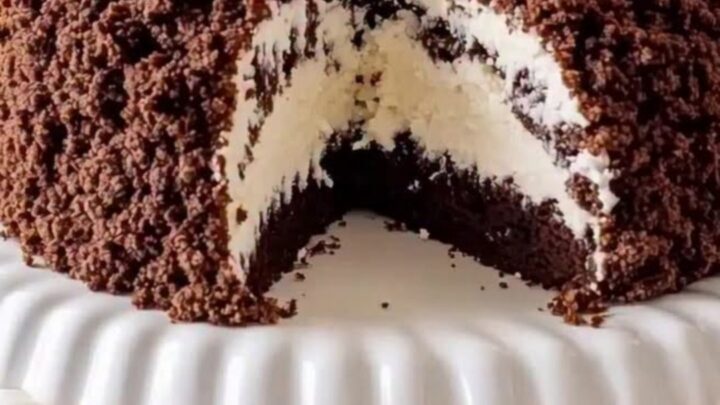
The top should be generously covered with chocolate crumble. The entire cake should feel cold and firm after the required chilling time. It should look like a cohesive, beautiful dome ready to be sliced and served on a plate.
Common mistakes
A common mistake is assembling the cake while the layers are still warm, which leads to a messy, collapsed center rather than a distinct layer of cream. Another frequent error is using a coconut cream that is too thin, which lacks the structural integrity to hold the top cake layer.
Ensure you use the thickest part of the coconut cream. Avoid over-pressing the cake during assembly, as this will force the filling out the sides and ruin the intended visual presentation of the layers.
How to tell it’s done
The cake is considered done when it has been properly assembled and chilled for the recommended time. You can tell it is ready to serve when the structure feels firm to the touch and the coconut cream center holds its position without bulging or leaking.
The egg-based filling must be cooked to an internal temperature of 160°F (71°C) to ensure safety. The visual cue of a stable, chilled cake that slices cleanly is the ultimate indicator of success for this recipe.
- Egg dishes: 160°F (71°C) in the thickest part
Up next · Part 3 of 3
2 variations · storage & make-ahead · 3 answers · printable card
Tips, FAQ & printable recipe (Part 3)← Back to the ingredients (Part 1)