Dinner · Part 2 of 3: Instructions
Pork Belly Al Pastor Tacos with Charred Pineapple Step-by-step instructions
- Prep
- Cook
- Total
- Serves
- 4
Before you start
Set up the whole station before the pan gets hot, because the sear moves fast. Pull the marinated pork from the refrigerator 30 minutes before cooking — no longer — so the slices cook evenly from edge to center.
Drain the slices on a rack for a moment so the surface is damp, not dripping; excess marinade burns before the char can form. Slice the white onion finely, chop the cilantro, set out the salsa and cut the limes.
Ingredients at a glance (12)
- 1 1/2 lb pork belly, sliced 1/4 inch thick
- 3 guajillo chiles, stemmed and seeded
- 2 tbsp achiote paste
- 1/2 cup pineapple juice
- 3 tbsp white vinegar
- 4 garlic cloves, peeled
- 2 fresh pineapple rings, cut 1/2 inch thick
- 24 small corn tortillas, served in doubles
- 1/2 cup minced white onion
- 1/2 cup chopped cilantro
- 1/2 cup spicy red árbol chile salsa
- 2 limes, cut into wedges, for serving
Instructions
Marinate the Pork
- Rehydrate the guajillosPull the stems and seeds from the guajillo chiles, then toast them in a dry skillet over medium heat, pressing flat with a spatula for 20 to 30 seconds a side until they smell raisiny and fragrant and the skin turns slightly glossy. Cover them with hot tap water and soak 10 minutes until supple.Look for The chiles bend without cracking and the kitchen smells fruity and smoky, never burnt.Tip Toast briefly — scorched chiles turn the whole marinade bitter, and there is no fixing that later.
- Blend the achiote marinadeDrain the softened chiles and drop them into a blender with the achiote paste, pineapple juice, white vinegar and garlic. Blend a full minute, scraping down once, until the sauce is completely smooth with no flecks of skin — a coarse marinade will never coat the thin pork slices evenly.Look for The marinade pours like thin tomato sauce, brick red and glossy, with no visible grit.Tip Reserve 1/4 cup of the marinade in a separate bowl before it touches raw pork, for drizzling at the table.
- Marinate the pork bellyPat the sliced pork belly dry, then turn it through the marinade in a glass or ceramic dish, coating every slice. Press plastic wrap onto the surface and refrigerate for at least 1 hour, or up to overnight for deeper flavor. Always marinate in the refrigerator, never on the counter.Look for Each slice is evenly brick-red with no pale patches showing through the coating.Tip Longer marinating tenderizes the pineapple's enzymes work; past 8 hours the surface turns slightly mushy, so 1 to 4 hours is the sweet spot.
By the end of this phase the pork belly slices are evenly coated brick-red, with no pale patches, and have rested refrigerated at least an hour.
The marinade itself should be completely smooth — pour it against the light and look for flecks of chile skin; any grit means blend another 30 seconds. The rehydrated guajillos should have tasted raisiny and fragrant when toasted, never burnt, because scorched chiles cannot be corrected later.
Sear and Char
- Heat the cast-iron panSet a cast-iron grill pan over high heat and let it preheat 5 to 6 minutes, until a drop of water skitters and evaporates instantly and the ridges just begin to smoke. A properly hot pan is the entire difference between caramelized, crackly-edged pork and steamed, gray slices.Look for Faint wisps of smoke rise off the ridges and the pan radiates heat from a hand held above it.Tip No grill pan? A heavy cast-iron skillet works; the flat surface sears even harder, so shorten the second side by 30 seconds.
- Sear the pork bellyLift the pork from the marinade, letting excess drip off, and lay the slices on the hot pan without crowding. Grill 3 minutes per side, flipping once, until the edges char, the fat renders and the surface caramelizes. Cook to 145°F (74°C) at the thickest point, then transfer to a board and let the pork rest at least 3 minutes before dicing. Work in batches so the pan stays hot between rounds.Look for Deep mahogany grill marks, lacy crackled fat at the edges and a loud, steady sizzle.Safe temperature 145°F (63°C) internal temperature (steaks, chops and roasts)Tip Crowding drops the pan temperature and the pork steams in its own marinade — patience beats a full pan every time.
- Rest and check the porkConfirm doneness with an instant-read thermometer: pork belly is safe and juicy at 145°F (74°C). Let it rest at least 3 minutes so the juices settle and the fat firms to a crisp bite instead of a greasy one while you grill the pineapple.Look for The thermometer reads at least 145°F (74°C) at the thickest point of each slice.Safe temperature 145°F (63°C) internal temperature (steaks, chops and roasts)Tip Resting on a board, not a paper towel, keeps the underside from steaming soft. Tent loosely with foil if the pineapple takes a while.
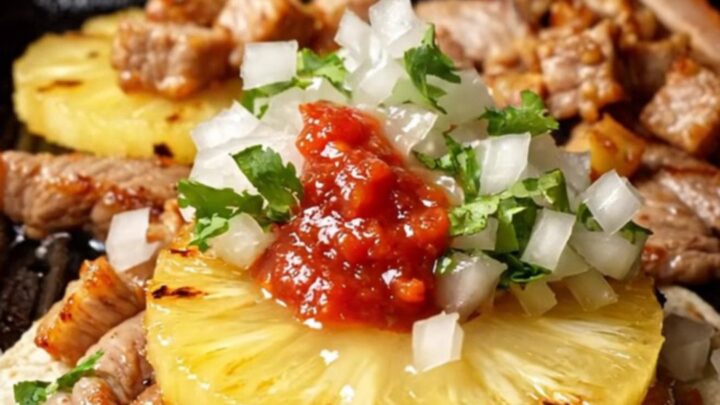
- Char the pineappleLay the 1/2-inch pineapple rings directly on the same hot pan and grill 3 minutes per side, pressing gently with a spatula. The sugars should blacken in spots and the fruit soften at the edges while staying juicy at the center. Move to the board with the pork.Look for Dark char stripes across both faces and a deep caramel smell, with the rings still holding their shape.Tip Do not move the rings before the 3-minute mark — the char needs uninterrupted contact with the hot metal to build.
This phase ends with sound as much as sight: a loud, steady sizzle throughout, never a quiet simmer. The pork slices show deep mahogany grill marks, lacy crackled fat at the edges and no gray, steamed patches. Every slice reads at least 145°F (74°C) on an instant-read thermometer at its thickest point, and the meat has rested on the board at least 3 minutes to let juices settle and fat firm up.
Build the Tacos
- Warm the tortillasHeat a dry comal or skillet over medium-high and warm the corn tortillas in pairs, 20 to 30 seconds a side, until pliable with faint toasted spots. Stack them two per taco and wrap the stack in a clean kitchen towel so they steam softly and stay flexible at the table.Look for The tortillas puff slightly, bend without cracking and smell lightly of toasted corn.Tip Doubles are the taqueria standard: the first tortilla soaks up juices while the second keeps everything intact.
- Build the tacosDice the rested pork and the charred pineapple into bite-size pieces. Spoon the mixture onto the doubled tortillas, then shower with minced white onion, chopped cilantro and a spoonful of spicy árbol chile salsa. Squeeze fresh lime over the top and serve immediately, with the reserved marinade on the side.Look for Steam rises off the filling, the lime brightens the smell instantly and the edges still crackle when bitten.Tip Dress the tacos seconds before eating — lime and salt soften the crackly pork surface fast, and the crisp texture is half the point.
The final phase ends with everything hot and everything crisp. The doubled tortillas are pliable, lightly freckled and steaming softly inside their towel wrap. The diced pork and pineapple are piled while still hot, the fat edges still crackling when pressed with a fork, and the toppings go on in the last seconds — onion for bite, cilantro for freshness, the árbol salsa for heat and the lime squeezed right at the table.
Common mistakes
The most common failure is a pan that is not hot enough: below a hard sizzle, pork belly releases fat and liquid faster than it can render, and the slices steam gray instead of searing mahogany.
Preheat the full 5 to 6 minutes and never crowd the pan — batches win. The second mistake is moving food too early; the char needs uninterrupted contact for the full 3 minutes, so leave the pork and pineapple alone until the timer says flip.
How to tell it’s done
The pork is done when it reads at least 145°F (74°C) at the thickest point of every slice on an instant-read thermometer, with deeply charred grill marks and visibly rendered, crackled fat along the edges.
After the thermometer check, let the meat rest at least 3 minutes on the board — the juices redistribute and the fat firms from greasy to crisp. The pineapple is done when both faces show dark char spots and the flesh yields to gentle pressure while staying juicy.
- Steaks, chops and roasts: 145°F (63°C) in the thickest part, then a 3-minute rest
Up next · Part 3 of 3
4 variations · storage & make-ahead · 5 answers · printable card
Tips, FAQ & printable recipe (Part 3)← Back to the ingredients (Part 1)