Dinner · Part 2 of 3: Instructions
Pistachio Crusted Halibut with Blood Orange Beurre Blanc Step-by-step instructions
- Prep
- Cook
- Total
- Serves
- 4
Before you start
Before starting, ensure that all ingredients are measured and ready to go. The fish should be taken out of the refrigerator about 15 minutes before cooking so it reaches a more uniform temperature, which helps with even roasting.
Prepare your food processor and have a baking sheet or skillet ready to receive the fish. Mince the shallots finely to ensure they melt into the sauce, and cube the cold butter so it is ready to be whisked in at the final moment.
Ingredients at a glance (9)
- 1 cup shelled roasted pistachios
- 2 tbsp fresh parsley, chopped
- 1 tsp lemon zest
- 2 tbsp olive oil
- 4 halibut fillets (6 ounces each)
- 2 tbsp Dijon mustard
- 1/2 cup blood orange juice
- 1 tbsp shallots, minced
- 1 stick cold butter, cubed
Instructions
Crust preparation
- Prepare the pistachio crustIn a food processor, pulse the shelled roasted pistachios, fresh parsley, lemon zest, and two tablespoons of olive oil until the mixture resembles a coarse, vibrant green meal. Be careful not to over-process, as this will turn the nuts into a paste rather than a crunchy topping. Transfer the mixture to a shallow bowl for easy application.Look for The mixture should be uniformly green and slightly crumbly with a tactile, coarse texture.Tip Keep the mixture in the refrigerator if not using immediately to maintain the freshness of the herbs.
The pistachio mixture should look like a vibrant, coarse sand with visible bits of green and bright lemon zest. When you pinch a small amount, it should hold together slightly but remain crumbly. The aroma should be fresh and nutty, with the lemon zest providing a clean, citrusy lift that suggests the brightness to come.
Coating the halibut
- Season and crust the fishPat the four halibut fillets dry with paper towels to ensure the mustard adheres well. Using a pastry brush, coat the top of each fillet evenly with the Dijon mustard. Firmly press the pistachio mixture onto the mustard-coated side of each fillet, ensuring a thick, even layer that covers the entire surface.Look for The mustard layer should be thin but cover the fish surface completely, with the nuts adhered firmly.Tip Press down gently with your fingers to make sure the crust stays attached during the cooking process.
Each fillet should be completely dry before applying the mustard to ensure the crust adheres evenly. Once the mustard is applied, the pistachio layer should cover the fish without any gaps. The fish should look like it is wearing a thick, textured green coat, ready for the oven heat to turn it golden and crunchy.
Roasting and finishing
- Roast and prepare the saucePlace the crusted halibut in a skillet and roast in a 400°F oven for approximately 8 minutes, or until the fish reaches an internal temperature of 145°F (63°C) and flakes easily with a fork. Meanwhile, in a small saucepan, simmer the blood orange juice and minced shallots until reduced by half. Remove from heat and whisk in the cold butter one cube at a time until the sauce is velvety and emulsified.Look for The fish should be opaque and flake easily when tested with a fork, while the sauce should be glossy and thickened.Safe temperature 145°F (63°C) internal temperature (fish)Tip Whisk the cold butter into the reduced juice off the heat to prevent the sauce from breaking or separating.
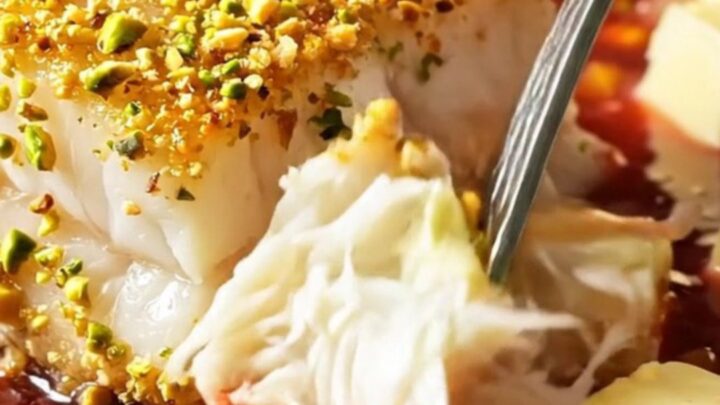
The fish should come out of the oven with a toasted, fragrant crust and a moist, pearly white interior. The sauce in your saucepan should be reduced to a syrupy consistency before the butter is added.
Once emulsified, the sauce will look like a vibrant, ruby-colored velvet that is smooth and glossy, perfectly ready to be drizzled over the fish.
Common mistakes
A common mistake is using warm butter for the sauce, which will cause it to separate rather than emulsify. Always keep the butter in the refrigerator until the exact moment you are ready to whisk it into the reduced juice.
Another error is over-processing the pistachio crust; if the nuts turn into a paste, the texture will be dense rather than crunchy. Pulse the ingredients carefully, monitoring the texture after every few seconds to maintain a coarse, crumbly consistency.
How to tell it’s done
The halibut is perfectly cooked when it reaches an internal temperature of 145°F (63°C). At this stage, the fish will be opaque throughout and will flake easily when gently pressed with a fork.
The pistachio crust should be a deep, toasted green, and the blood orange sauce should be glossy and thick enough to coat a spoon. If the fish is still translucent in the center, return it to the oven for an additional minute.
- Fish: 145°F (63°C) in the thickest part
Up next · Part 3 of 3
2 variations · storage & make-ahead · 3 answers · printable card
Tips, FAQ & printable recipe (Part 3)← Back to the ingredients (Part 1)