Desserts · Part 2 of 3: Instructions
Pennsylvania Chocolate Cake with Glossy Fudge Frosting Step-by-step instructions
- Prep
- Cook
- Total
- Serves
- 12
Before you start
Before beginning the assembly, ensure both cake layers are completely cooled to room temperature. Prepare the workspace with a clean cake stand or a flat serving platter, an offset spatula for smoothing the frosting, and a sharp knife for cutting.
Have all ingredients measured and ready, and make sure the kitchen environment is not overly warm, as this can affect the consistency of the fudge frosting and make it harder to achieve that smooth, glossy finish on the exterior of the cake.
Ingredients at a glance (2)
- 2 layers baked chocolate sponge cake, made ahead
- 2 cups glossy fudge frosting, prepared
Instructions
Layering the base
- Prepare the cake structurePlace one layer of the chocolate sponge cake onto the cake stand. Carefully spread a portion of the glossy fudge frosting over the top of the first layer, ensuring an even distribution to act as the internal filling.Look for The surface of the sponge should be fully coated with a smooth layer of frosting.Tip Ensure the cake layers are completely cooled before frosting to prevent the fudge from melting or sliding off the sides.
At the end of this phase, the first layer should be securely anchored to the cake stand with a thin layer of frosting acting as a glue. The filling should be applied evenly to the edges, creating a stable foundation for the second layer. Check that the frosting is spread to the very edge of the sponge to ensure a consistent appearance once the cake is fully assembled.
Frosting the exterior
- Stack and frost the exteriorPosition the second sponge layer directly on top of the frosted first layer. Use the remaining glossy fudge frosting to cover the top and sides of the entire cake, smoothing it out with a spatula for a professional, polished appearance.Look for The frosting should look shiny and uniform across the entire surface of the cake.Tip Use a warm, dry offset spatula to achieve the signature glossiness of the fudge frosting as you finish the outer layer.
By the end of this phase, the entire cake should be encased in a smooth, glossy coat of fudge frosting. The sides should be vertical and sharp, and the top should be level. Check for any air bubbles or uneven patches in the frosting, and smooth them out with the spatula while the fudge is still pliable and shiny before it begins to set firm.
Slicing for service
- Final set and serviceAllow the finished cake to set in a cool place for at least one hour. Ensure the internal temperature of the egg-based frosting reaches 160°F (71°C) during the preparation of the frosting base to ensure safety. Use a sharp, warm knife to cut a tall, generous slice, then transfer it carefully to a white plate using a cake server.Look for The slice should hold its shape, revealing distinct, moist layers without crumbling.Safe temperature 160°F (71°C) internal temperature (egg dishes)Tip Clean your knife between slices to ensure that every serving looks as clean and decadent as the first one.
The cake is ready for service when it has rested and the frosting feels firm to the touch. The final checkpoint involves checking that the slices are tall and hold their structure when transferred to a plate.
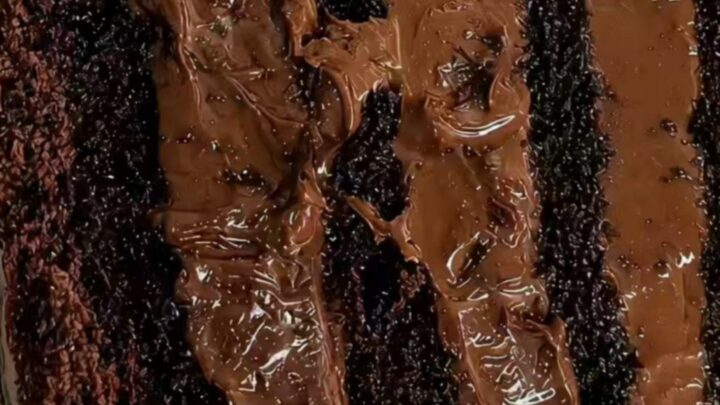
Each slice should clearly display the contrast between the dark, moist sponge layers and the rich, decadent fudge frosting, indicating it is ready to be served to guests.
Common mistakes
A common mistake is attempting to frost the cake while the sponge layers are still warm, which causes the frosting to melt and slide. Another error is neglecting to let the cake rest after assembly, which makes it nearly impossible to cut clean, sharp slices.
Avoid over-handling the frosting once it is applied, as this can dull the shine and create streaks; instead, use long, confident strokes with an offset spatula for the most professional appearance.
How to tell it’s done
The cake is considered properly assembled when the frosting is uniform, smooth, and holds its shape at room temperature. The layers should be distinct and moist.
When slicing, the knife should glide through the sponge without significant resistance. For food safety, ensure the egg-based frosting was cooked to 160°F (71°C) during its preparation to ensure it is safe for consumption.
- Egg dishes: 160°F (71°C) in the thickest part
Up next · Part 3 of 3
2 variations · storage & make-ahead · 3 answers · printable card
Tips, FAQ & printable recipe (Part 3)← Back to the ingredients (Part 1)