Dinner · Part 2 of 3: Instructions
Pastel Azteca: Mexican Tortilla Lasagna with Melted Oaxaca Cheese Step-by-step instructions
- Prep
- Cook
- Total
- Serves
- 6
Before you start
Gather everything before the first tortilla hits the skillet, because assembly moves fast once the layers start. Warm the chicken tinga so it spreads like a sauce rather than clumping, and stir the guajillo sauce until it pours smoothly. Grate the Oaxaca and Chihuahua cheese, measure the corn and crema into separate bowls, and rinse and dry the cilantro. Butter or oil the baking dish only lightly, since the sauce layer prevents sticking on its own.
Ingredients at a glance (7)
- 12 corn tortillas (6-inch), lightly toasted
- 2 cups roasted red guajillo sauce, store-bought or made ahead
- 3 cups shredded chicken tinga, made ahead
- 1 cup sweet corn kernels (fresh or thawed frozen)
- 1 cup Mexican crema (or sour cream thinned with a splash of milk)
- 3 cups shredded Oaxaca and Chihuahua cheese, mixed
- Fresh cilantro leaves, for serving
Instructions
Toast and organize
- Toast the tortillasSet a dry skillet or comal over medium heat and warm the tortillas in a single layer, about 30 seconds per side, until they soften, puff slightly and pick up faint golden blisters. Stack them on a plate as they finish so the steam keeps them pliable for layering.Look for Look for light browning spots and a warm, toasty corn smell; the tortillas should bend without cracking.Tip Toasting is what keeps the layers distinct instead of gummy, so do not skip it even on a busy night.
- Heat the chicken tinga throughWarm the chicken tinga gently in a small saucepan over medium-low heat, stirring now and then, until it is steaming hot all the way through and reaches 165°F (74°C) on an instant-read thermometer. Stir the guajillo sauce until smooth. Have the corn, crema and grated Oaxaca and Chihuahua cheese in separate bowls beside the baking dish, ready to layer in order.Look for The tinga should be steaming and loose enough to spoon, and the sauce should pour in a smooth ribbon.Safe temperature 165°F (74°C) internal temperature (poultry)Tip Grating the cheese fresh from a block gives a far better melt than pre-shredded bags coated in anti-caking starch.
Phase one ends with a stack of warm, pliable, lightly blistered tortillas and every filling component within arm's reach of the baking dish. The tortillas should smell toasty and corn-sweet, bending easily without cracking at the fold.
The tinga should be steaming hot and spoonable, the guajillo sauce smooth and pourable, and the cheese fluffy from fresh grating. Check that the baking dish is on the counter, the oven is heating, and nothing needs to be fetched mid-assembly; once layering starts, the process should be uninterrupted from first tortilla to last handful of cheese.
Assemble the layers
- Build the base layerSpread a thin layer of guajillo sauce over the bottom of a 9x13-inch baking dish, then cover it with one third of the toasted tortillas, overlapping them to form an even sheet like lasagna noodles. The sauce underneath keeps the first layer from sticking and scorching.Look for The dish bottom should be fully sauced with no dry patches, and the tortillas should overlap slightly with no gaps.Tip Tear a few tortillas in half to fill the corners neatly; an even base slices far better at the table.
- Add chicken and sauceSpoon half of the hot chicken tinga over the tortillas and spread it edge to edge, then ladle on about a third of the remaining guajillo sauce so every bite carries that roasted chile flavor. Keep the layer even so the casserole bakes at the same rate across the pan.Look for Aim for full coverage without pools of sauce; the surface should look coated, not flooded.Tip Pull the tinga into small shreds as you spread it so the layers knit together when the cheese melts through.
- Layer corn and cremaScatter half of the sweet corn over the chicken, then drizzle half of the Mexican crema across the top in thin ribbons. The corn brings little pops of sweetness and the crema softens the chile heat, so spread them both out rather than dumping them in the center.Look for The crema ribbons should be visible across the whole surface, thin enough to seep into the layer below.Tip Drizzle the crema from a spoon held high; thin streaks distribute better than thick dollops ever will.
- Repeat the layersBuild a second round exactly like the first: another third of the tortillas, the rest of the chicken tinga, more guajillo sauce, the remaining corn and the rest of the crema. Finish with the final third of tortillas pressed down gently so the layers sit compact and even.Look for At this point the dish should look layered and sauced but still dry on top, with no cheese yet.Tip Press the top tortillas lightly with the back of a spoon; firm layers now mean clean, tall squares later.
- Blanket with cheesePile all three cups of the shredded Oaxaca and Chihuahua cheese over the top tortilla layer and spread it to the very edges of the dish. Covering the corners completely protects the exposed tortillas from drying out and gives every square a golden, stretchy lid.Look for No tortilla should peek through; the cheese layer should look thick, even and generous.Tip Reserve a small handful of cheese and add it in the last five minutes of baking for extra-browned spots on top.
By the end of assembly, the dish holds two complete rounds of tortillas, chicken, sauce, corn and crema, capped by a final tortilla layer under a thick, even blanket of shredded cheese that reaches every corner.
Press the top gently: the layers should feel compact but springy, with no dry tortilla peeking through the cheese and no puddles of sauce visible at the edges. The surface should look uniformly cheesy and ready for the oven. If any corner is bare, scatter a little more cheese there now; exposed tortilla edges brown hard and dry during the bake.
Bake, rest and serve
- Bake until bubblingHeat the oven to 375°F (190°C) and bake the casserole on the center rack for about 20 minutes, until the cheese has melted completely, the edges bubble vigorously and the top turns golden brown in places. Rotate the dish halfway through for even browning if the oven runs uneven.Look for Listen for steady bubbling at the edges and look for browned patches across the cheese; the center should wobble as one molten mass.Tip Switch to broil for the final minute if the cheese is melted but still pale; watch it the whole time.
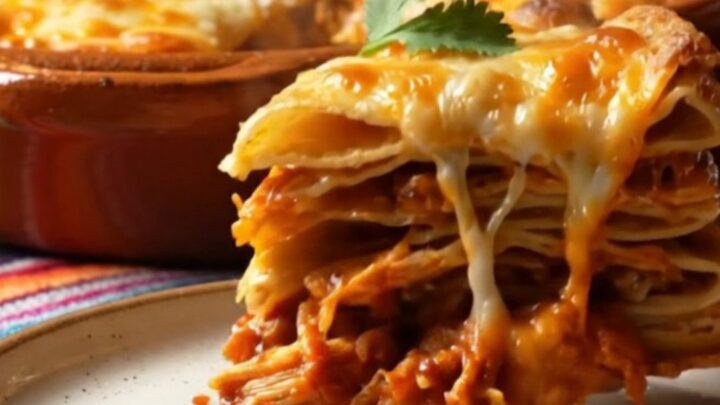
- Rest, garnish and sliceLet the pastel azteca rest in the dish for about 10 minutes so the molten cheese settles and the layers hold together. Scatter fresh cilantro leaves over the top, then cut into generous squares with a sharp knife, lifting each piece out with a spatula so the cheese stretches.Look for After resting, the first slice should hold its shape with distinct layers and a long, glossy cheese pull.Tip Wipe the knife between cuts for picture-clean squares; the stretchy Oaxaca drags and tears otherwise.
Out of the oven, the pastel azteca should be bubbling at the edges, golden brown in spots across the top, and visibly molten when the dish is nudged. The cheese should look glossy, not matte or chalky, and the aroma should be roasted chile, toasted corn and browned butter all at once.
Give it the full ten-minute rest before garnishing with cilantro and slicing; a knife should slide through with slight resistance and each square should lift out tall, layered and stretching cheese in long sheets from plate to spatula.
Common mistakes
The most common failure is skipping the toasting step, which leaves the tortillas to absorb sauce and turn the whole dish into a soft, indistinct mass. Another is over-saucing: flooding each layer with guajillo sauce makes the bottom soggy and the corners loose, so coat rather than soak.
Piling the filling in the center instead of spreading it edge to edge gives you thick middles and dry corners. Using only pre-shredded cheese can produce a dull, matte top rather than a golden, bubbling one.
How to tell it’s done
The casserole is done when the cheese is fully melted, glossy and browned in patches, and the sauce bubbles steadily around the edges of the dish, not just at the corners. The center should wobble as one cohesive, molten mass when the dish is nudged, with no dry or unmelted spots on the surface. The chicken tinga is heated to 165°F (74°C) before it goes into the pan, so the twenty-minute bake only needs to heat the dish through and melt the cheese.
- Poultry: 165°F (74°C) in the thickest part
Up next · Part 3 of 3
4 variations · storage & make-ahead · 5 answers · printable card
Tips, FAQ & printable recipe (Part 3)← Back to the ingredients (Part 1)