Dinner · Part 2 of 3: Instructions
Parmesan Garlic Bacon Cheeseburger Lasagna with Creamy Béchamel Step-by-step instructions
- Prep
- Cook
- Total
- Serves
- 8
Before you start
Before beginning the cooking process, organize all ingredients and tools to ensure a smooth assembly. Measure out the pre-made béchamel and cheeses, and mince the fresh garlic. Cook the bacon until crispy, crumble it into small pieces, and set it aside.
Ensure the seasoned ground beef is ready for the skillet. Finally, grease your deep 9x13-inch baking dish lightly with a bit of oil or butter to prevent the bottom pasta layer from sticking.
Ingredients at a glance (7)
- 12 lasagna sheets
- 1 1/2 lb seasoned ground beef
- 8 slices bacon, cooked and crumbled
- 4 cloves garlic, minced
- 2 cups creamy béchamel, store-bought or made ahead
- 3 cups mozzarella cheese, shredded
- 1 cup Parmesan cheese, grated
Instructions
Preparing the Pasta and Beef
- Brown the Seasoned BeefHeat a large skillet over medium-high heat. Add the seasoned ground beef, breaking it apart with a wooden spoon. Cook the beef until it is completely browned and reaches a safe internal temperature of 160°F (71°C), about 8 to 10 minutes. Drain the excess fat thoroughly and set the beef aside.Look for The beef should be deeply browned with no pink remaining.Safe temperature 160°F (71°C) internal temperature (ground meat)Tip Drain the beef in a colander to ensure no excess grease remains.
- Boil the PastaBring a large pot of salted water to a boil. Add the lasagna sheets and cook according to the package instructions until just al dente, about 8 to 10 minutes. Drain the pasta carefully and lay the sheets flat on parchment paper to prevent them from sticking.Look for The pasta should be tender but still have a slight bite.Tip Do not overcook the pasta as it will cook further in the oven.
At the end of this initial phase, the seasoned ground beef should be fully browned, fragrant, and completely drained of excess grease. The lasagna sheets should be cooked to a perfect al dente texture, drained carefully, and laid flat so they do not stick together, ready to be layered with the other components.
Assembling the Layers
- Assemble the Lasagna LayersPreheat the oven to 375°F (190°C). Spread a thin layer of the creamy béchamel over the bottom of a deep 9x13-inch baking dish. Place three cooked lasagna sheets on top. Layer with one-third of the browned seasoned ground beef, one-third of the crumbled bacon, a sprinkle of minced garlic, grated Parmesan, and shredded mozzarella cheese, followed by a drizzle of béchamel. Repeat this layering process twice more.Look for The layers should be evenly distributed across the dish.Tip Save a portion of bacon and mozzarella for the very top layer.
After completing the assembly phase, the baking dish should be neatly filled to near the top with even, level layers of pasta, beef, bacon, garlic, and cheese.
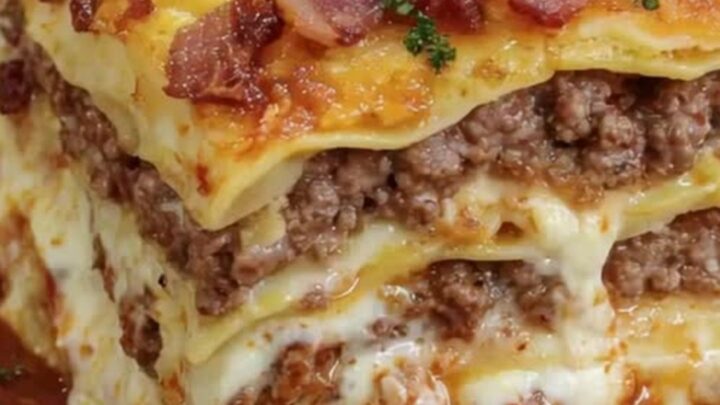
The ingredients should be distributed uniformly across each layer, with a final blanket of creamy béchamel, shredded mozzarella, grated Parmesan, and crispy bacon pieces covering the top surface completely.
Baking and Resting
- Bake the LasagnaTop the final layer of pasta with the remaining creamy béchamel, the remaining shredded mozzarella, grated Parmesan, and the rest of the crumbled bacon. Cover the baking dish loosely with aluminum foil. Bake in the preheated oven for 30 minutes, then remove the foil and bake for an additional 15 minutes until the cheese is bubbling and golden-brown.Look for The cheese should be melted, golden, and bubbling at the edges.Tip Letting it bake uncovered at the end creates a delicious crispy crust.
- Rest and ServeRemove the lasagna from the oven and place it on a heatproof board. Let the lasagna rest undisturbed for 15 to 20 minutes before slicing. This allows the layers to set, ensuring clean slices that hold their shape when served. Cut into neat squares and serve warm.Look for The lasagna should feel firm and set when sliced.Tip Use a sharp chef's knife and wipe the blade clean between cuts.
When the baking phase is complete, the lasagna should be bubbling vigorously around the edges, with a beautifully browned, golden-crust top. The cheese should be completely melted and slightly caramelized in spots, and the entire dish should feel solid and set when gently nudged, filling the kitchen with an irresistible aroma of baked cheese and smoky bacon.
Common mistakes
A common mistake is assembling the lasagna while the beef is still piping hot, which can cause the cheese to melt prematurely and slide around, leading to messy, unstable layers. Allow the cooked beef to cool slightly before building.
Another frequent error is slicing the lasagna immediately after removing it from the oven. Without a proper resting period, the molten cheese and sauce will run, causing the beautiful layers to collapse into a disorganized heap on the plate.
How to tell it’s done
The lasagna is perfectly done when the internal temperature reaches 165°F (74°C) in the center, ensuring all ingredients are thoroughly heated and fused.
The top should display a deep golden-brown color with crispy edges, and the sauce should bubble actively at the sides of the dish. Inserting a knife into the center should meet very little resistance, indicating the pasta sheets are perfectly tender throughout.
- Ground meat: 160°F (71°C) in the thickest part
Up next · Part 3 of 3
3 variations · storage & make-ahead · 4 answers · printable card
Tips, FAQ & printable recipe (Part 3)← Back to the ingredients (Part 1)