Dinner · Part 2 of 3: Instructions
Parmesan French Onion Turkey Cutlets: One-Pot Crockpot Dinner Step-by-step instructions
- Prep
- Cook
- Total
- Serves
- 4
Before you start
Before starting, pat the turkey cutlets dry with paper towels. Thinly slice the onions—about 1/4-inch thick. Soften the cream cheese by leaving it at room temperature for 30 minutes. Grate the Parmesan cheese.
Have the chicken broth and fresh thyme ready. No need to pre-cook anything; the slow cooker does all the work. Set out a 6-quart slow cooker and plug it in. This recipe is designed to be assembled in minutes and left to cook.
Ingredients at a glance (6)
- 1 1/2 lb boneless turkey breast cutlets
- 2 large sweet Vidalia onions, thinly sliced
- 6 sprigs fresh thyme
- 1/2 cup low-sodium chicken broth
- 8 oz cream cheese, softened
- 1/2 cup freshly grated Parmesan cheese
Instructions
Layer and Set
- Layer the Turkey and OnionsPlace the turkey breast cutlets in a single layer in the bottom of a 6-quart slow cooker. Scatter the sliced Vidalia onions over the turkey, then tuck the fresh thyme sprigs among the onions. Pour the chicken broth evenly over everything.Look for The onions should cover the turkey completely, and the broth should pool around the edges.Tip Use thin-cut turkey cutlets so they cook evenly and stay tender.
- Add the Cream Cheese and ParmesanPlace the block of softened cream cheese in the center of the slow cooker on top of the onions. Sprinkle the grated Parmesan evenly over the cream cheese and the rest of the mixture.Look for The cream cheese will look like a white mound; the Parmesan creates a snowy layer.Tip Soften the cream cheese beforehand so it melts into the sauce more smoothly.
The slow cooker is filled with raw turkey, onions, thyme, broth, cream cheese, and Parmesan. The cream cheese sits in the center like a white island, and the Parmesan is scattered on top. Nothing is mixed—that's fine. The aroma is raw and fresh, with the scent of onion and thyme. Before moving on, make sure the turkey is in a single layer so it cooks evenly.
Slow-Cook and Transform
- Slow-Cook Until TenderCover the slow cooker and cook on LOW for 4 to 5 hours, or on HIGH for 2 1/2 to 3 hours, until the turkey is cooked through and tender. The sauce will be bubbling and slightly thickened.Look for The sauce will be bubbly and the onions will look translucent and soft.Safe temperature 165°F (74°C) internal temperature (poultry)Tip Resist lifting the lid during cooking—each peek adds 20 minutes of cook time.
- Check the Turkey's TemperatureInsert an instant-read thermometer into the thickest part of a turkey cutlet. The turkey is safe to eat when it registers at least 165°F (74°C). If not yet done, cover and cook for another 15 to 20 minutes, then check again.Look for The thermometer should read 165°F (74°C) or higher.Safe temperature 165°F (74°C) internal temperature (poultry)Tip The turkey will be fork-tender and easily shreddable when done.
After a few hours, the slow cooker is bubbling gently. The cream cheese has melted into the broth, creating a creamy, pale sauce. The onions have softened and turned golden, and the turkey is tender.
The kitchen smells of savory, buttery onions and herbs. The sauce is thin but will thicken as it rests. Check the turkey's temperature to ensure it has reached 165°F (74°C).
Finish and Serve
- Stir the Sauce Until SmoothGently stir the sauce with a wooden spoon to combine the melted cream cheese and Parmesan into a velvety sauce. Discard the thyme sprigs. Taste and adjust seasoning with salt and black pepper if desired.Look for The sauce should be smooth, creamy, and coat the back of a spoon.Tip If the sauce seems thin, cook uncovered on HIGH for 10 to 15 minutes to reduce.
- Serve Over Rice or Mashed PotatoesSpoon the turkey and sauce over steamed rice, mashed potatoes, or crusty bread. Garnish with additional fresh thyme if desired, and serve hot.Look for Each serving should have a generous ladle of sauce and a few onion ribbons.Tip The sauce soaks into rice beautifully—don't skimp on it.
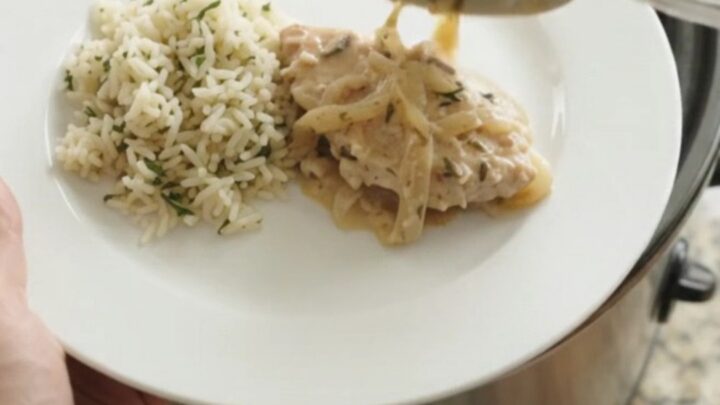
The sauce is smooth, velvety, and coats the turkey and onions. The thyme sprigs are removed, and the dish is ready to plate. The turkey is fork-tender and glistens with sauce. The onions are sweet and jammy. The aroma is rich and comforting. Serve immediately over rice or mashed potatoes, with extra sauce spooned over the top.
Common mistakes
A common mistake is lifting the lid to check on the food, which lets heat escape and lengthens cooking time. Trust the slow cooker and wait until the minimum time has passed. Another mistake is using cold cream cheese, which can clump instead of melting.
Always soften it first. Also, avoid overcooking the turkey, as it can become dry and stringy. Stick to the recommended time and check the temperature early. Finally, don't skip stirring the sauce at the end—it ensures a smooth, uniform texture.
How to tell it’s done
The turkey is done when an instant-read thermometer inserted into the thickest part reads 165°F (74°C). The meat should be tender enough to pull apart with a fork. The onions will be soft and translucent, and the sauce will be bubbly and slightly thickened.
If the sauce looks thin, cook uncovered on HIGH for 10 to 15 minutes to reduce. The dish is ready when the cream cheese is fully melted and the sauce is smooth and creamy.
- Poultry: 165°F (74°C) in the thickest part
Up next · Part 3 of 3
4 variations · storage & make-ahead · 5 answers · printable card
Tips, FAQ & printable recipe (Part 3)← Back to the ingredients (Part 1)