Dinner · Part 2 of 3: Instructions
Golden Brown Butter Scallops with Crispy Pancetta Step-by-step instructions
- Prep
- Cook
- Total
- Serves
- 4
Before you start
Before you start, take the scallops out of the refrigerator and let them sit at room temperature for 15 minutes—this helps them cook evenly. Pat them bone-dry with paper towels, pressing gently to remove all surface moisture.
Dice the pancetta, juice the lemon, and mince the chives. Set up your skillet and have an instant-read thermometer ready. The entire cooking process moves quickly, so have all ingredients within reach.
Ingredients at a glance (6)
- 12 jumbo dry-pack U-10 sea scallops
- 1 tsp kosher salt, or to taste
- 3 oz Italian pancetta, diced
- 4 tbsp clarified butter
- 1 lemon, juiced
- 1 tbsp fresh chives, minced
Instructions
Prep and Crisp
- Dry and season the scallopsPat the scallops bone-dry on paper towels, pressing gently to remove all surface moisture. Season both sides with kosher salt just before cooking—do not salt ahead, as salt draws out moisture and ruins the crust.Look for The scallops should feel tacky, not wet, and the salt should cling to the surface.Tip The drier the surface, the deeper the golden crust. Use fresh paper towels if the first ones become soaked.
- Crisp the pancettaPlace the diced pancetta in a large stainless steel skillet. Cook over medium heat, stirring occasionally, until the pancetta is crisp and the fat has rendered, 3 to 4 minutes. Transfer the crispy pancetta to a plate, leaving the fat in the skillet.Look for The pancetta should be deeply browned and crisp, and the rendered fat should be golden.Tip Use a slotted spoon to remove the pancetta, letting excess fat drip back into the skillet.
The scallops are patted dry and seasoned, and the pancetta is crisped and set aside. The skillet holds golden rendered fat, ready for the clarified butter. The kitchen smells of savory, salty pancetta, and the texture contrast is set: crisp pancetta, tender scallops.
Sear and Baste
- Heat the clarified butterAdd the clarified butter to the skillet with the rendered pancetta fat. Heat over high heat until the butter shimmers and reaches 475°F (246°C) on an instant-read thermometer—it should be just at the smoking point.Look for The butter will shimmer and a wisp of smoke will rise from the surface.Tip If the butter smokes heavily, lower the heat slightly; if it does not smoke at all, increase the heat.
- Sear the scallops undisturbedCarefully place the scallops in the hot butter, leaving space between each. Sear undisturbed for 90 seconds, without moving or flipping, until a deep golden-brown crust forms on the bottom.Look for The edges will look caramelized and the scallops will release easily from the pan.Tip If a scallop resists when you try to lift it, it is not ready to flip—wait a few more seconds.
- Flip and baste with brown butterFlip the scallops and add the lemon juice to the skillet. Tilt the pan slightly and use a spoon to baste the scallops with the foaming brown butter for 30 seconds. Continue cooking until the scallops reach 145°F (63°C) in the center.Look for The butter will foam and turn nutty brown, and the scallops will feel firm but springy to the touch.Safe temperature 145°F (63°C) internal temperature (shellfish)Tip Keep the heat high to maintain the foam; if the butter begins to burn, reduce to medium-high.
The butter is shimmering at 475°F, and the scallops are searing undisturbed. The first side turns deep golden brown, and after flipping, the butter foams as you baste.
The lemon juice sizzles and the aroma turns nutty and bright. The scallops are nearly done, with a crisp crust and a custardy center.
Finish and Serve
- Finish with pancetta and chivesRemove the skillet from the heat. Sprinkle the crispy pancetta and minced chives over the scallops, spooning a little of the brown butter on top. Serve immediately.Look for The pancetta should be crisp, the chives bright green, and the butter glossy.Tip Serve the scallops with a spoonful of the brown butter from the pan for extra flavor.
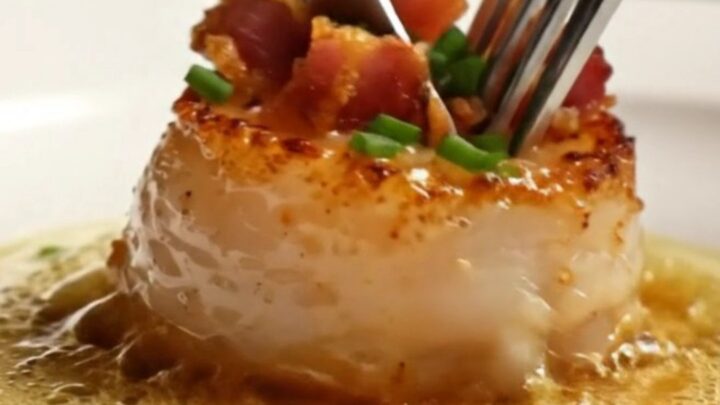
The scallops are finished with crispy pancetta and chives, and a spoonful of brown butter is drizzled over the top. The plate is glossy and fragrant, with golden crusts, savory bits, and fresh green chives. Serve immediately to enjoy the contrast of textures at its peak.
Common mistakes
The most common mistake is overcrowding the pan, which lowers the temperature and causes the scallops to steam instead of sear. Leave at least an inch between each scallop.
Another mistake is moving the scallops too soon—let them sear undisturbed for the full 90 seconds. Also, avoid salting the scallops too early, as salt draws out moisture. Finally, don't skip the bone-dry patting; even a little moisture will ruin the crust.
How to tell it’s done
The scallops are done when they reach an internal temperature of 145°F (63°C) in the center. The exterior should be deeply golden and crisp, while the interior should be opaque but still moist and tender.
To check, insert an instant-read thermometer sideways into the thickest part of a scallop. If you don't have a thermometer, look for a firm but springy texture—the scallop should yield slightly to the touch, not feel hard or rubbery.
- Shellfish: 145°F (63°C) in the thickest part
Up next · Part 3 of 3
4 variations · storage & make-ahead · 5 answers · printable card
Tips, FAQ & printable recipe (Part 3)← Back to the ingredients (Part 1)