Desserts · Part 2 of 3: Instructions
Rich Oreo Earthquake Cake for Decadent Dessert Lovers Step-by-step instructions
- Prep
- Cook
- Total
- Serves
- 12
Before you start
Before beginning, gather all ingredients and measure them accurately onto the kitchen counter. Set the cream cheese out at room temperature for at least 30 minutes to soften fully.
Preheat the oven to 350°F (175°C) and lightly grease the 9x13-inch baking dish. Have your electric hand mixer, mixing bowls, offset spatula, and an instant-read digital thermometer within easy reach.
Ingredients at a glance (5)
- 1 box chocolate cake mix, prepared according to package directions
- 8 oz cream cheese, softened
- 1/4 cup heavy cream
- 1/2 cup fudge sauce, warmed
- 15 sandwich cookies, crushed
Instructions
Base Batter Preparation
- Prepare the Cake BasePreheat the oven to 350°F (175°C). Grease a 9x13-inch baking dish with cooking spray or butter. Prepare the chocolate cake mix according to the package directions with eggs, oil, and water. Pour the smooth batter into the prepared dish and spread it evenly toward all four corners using an offset spatula.Look for The batter should be completely smooth, glossy, and evenly distributed in the pan.Tip Spread the batter level to ensure the cake bakes uniformly under the heavier fillings.
The chocolate cake batter should appear rich, dark, and glossy without any pockets of dry flour. It must be spread into an even, level layer across the bottom of the greased pan, reaching all corners cleanly so the base bakes at an even rate under the weight of the cream.
Cream Swirl Assembly
- Prepare and Swirl the CreamIn a medium mixing bowl, beat the softened cream cheese and heavy cream with an electric hand mixer until entirely smooth, lump-free, and creamy. Drop large dollops of the cream mixture across the surface of the raw chocolate cake batter, then gently draw a knife through to marble the cream swirl through the cake.Look for Clear white ripples and ribbons should wind distinctly through the dark chocolate batter.Tip Do not overmix, or the cream will blend into the batter rather than creating pockets.
The cream mixture must be beaten until velvety and smooth, showing no lumps. When dolloped and swirled with a knife, pronounced white ribbons should weave through the dark chocolate background, forming a beautiful marbling pattern across the entire pan.
Baking and Topping
- Bake and Finish with ToppingsBake the cake at 350°F (175°C) for 40 to 45 minutes until the cake reaches an internal temperature of at least 160°F (71°C) for the egg components and a toothpick inserted into the cake crumb comes out clean. Remove from the oven, immediately drizzle warm fudge sauce over the top, scatter the crushed sandwich cookies evenly, and let rest 10 minutes before slicing.Look for The edges should be set and pulling slightly away from the pan with gooey center pockets.Safe temperature 160°F (71°C) internal temperature (egg dishes)Tip Scatter the crushed cookies right after the fudge so they adhere firmly to the surface.
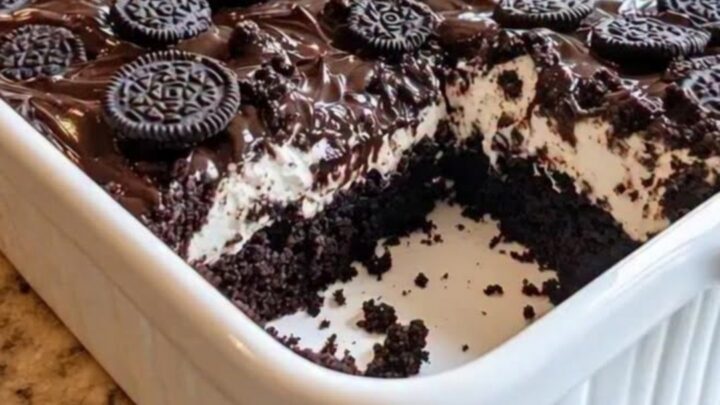
The baked cake should smell intensely chocolatey, puffed slightly with cratered crevices where the cream has settled.
The glossy fudge drizzle will coat the top with a mirror-like shine, and the crushed sandwich cookies should form an abundant, crunchy layer across the surface.
Common mistakes
Avoid overworking the cream mixture into the cake batter; aggressive stirring will blend the two components into a single light-brown layer rather than creating distinct, marbled ribbons.
Do not leave the cake in the oven past the target time, as prolonged baking dries out the rich crumb. Lastly, scatter the sandwich cookies promptly after drizzling the warm fudge so they adhere properly without softening prematurely.
How to tell it’s done
The cake is done when the edges look firm, slightly cracked, and pull gently away from the sides of the pan. A digital probe thermometer inserted into the cake crumb must register at least 160°F (71°C) to ensure the egg-containing batter is fully cooked and safely set.
A toothpick inserted into the cake portions should come out with moist crumbs, while the cream cheese pockets will remain pleasantly soft and gooey.
- Egg dishes: 160°F (71°C) in the thickest part
Up next · Part 3 of 3
2 variations · storage & make-ahead · 3 answers · printable card
Tips, FAQ & printable recipe (Part 3)← Back to the ingredients (Part 1)