Dinner · Part 2 of 3: Instructions
One-Pan Skillet Lasagna with Savory Ground Beef Bolognese Step-by-step instructions
- Prep
- Cook
- Total
- Serves
- 4
Before you start
Before starting, gather all ingredients and equipment. Chop the onion and mince the garlic. Measure the tomato puree, Italian herbs, mozzarella, and parsley. Have the lasagna sheets ready.
Make sure the skillet is large enough to hold the sheets in a single layer. If using a glass lid, ensure it fits well. Prep everything in advance so the cooking process goes smoothly.
Ingredients at a glance (8)
- 1 lb ground beef (85% lean)
- 2 cups tomato puree
- 3 cloves garlic, minced
- 1 medium onion, finely chopped
- 2 tsp dried Italian herbs
- 5 uncooked dry lasagna pasta sheets
- 1 1/2 cups shredded mozzarella cheese
- 1/4 cup fresh parsley, chopped
Instructions
Browning and Simmering
- Brown the Beef and Build the SauceHeat a large skillet over medium-high heat. Add the ground beef and cook, breaking it up with a spatula, until browned and no longer pink, about 5 to 7 minutes. Add the onion and garlic, and cook until softened, about 2 minutes. Stir in the tomato puree and Italian herbs. Bring the sauce to a simmer, then reduce the heat to medium-low.Look for The beef is browned and the sauce is bubbling gently.Safe temperature 160°F (71°C) internal temperature (ground meat)Tip Use a large skillet to avoid crowding; the sauce should coat the beef.
- Simmer the SauceLet the sauce simmer uncovered for 8 to 10 minutes, stirring occasionally, until it thickens slightly and the flavors meld. The sauce should be thick enough to coat the back of a spoon.Look for The sauce has thickened and is aromatic.Tip If the sauce seems too thick, add a splash of water or broth.
The ground beef is browned and crumbly, with no pink remaining. The onion and garlic are softened and fragrant. The tomato sauce is bubbling gently and has thickened slightly. The aroma is rich and savory, with herbal notes. The sauce coats the back of a spoon, ready for the pasta.
Cooking the Pasta
- Add the Lasagna SheetsPress the uncooked lasagna sheets into the simmering sauce, one at a time, using a spatula to fully submerge them. Make sure they are in a single layer, overlapping slightly if needed. Cover the skillet with a glass lid.Look for The lasagna sheets are submerged in the sauce.Tip Break the sheets if needed to fit your skillet.
- Cook the Lasagna SheetsKeep the skillet covered and cook over medium-low heat for 12 minutes, or until the lasagna sheets are tender and have absorbed most of the sauce. Check occasionally to ensure the sauce doesn't dry out; add a few tablespoons of water if needed.Look for The pasta is tender and the sauce is mostly absorbed.Tip Use a fork to test a sheet; it should be al dente.
The skillet is covered, and steam is visible around the lid. The sauce is bubbling gently, and the lasagna sheets are submerged. After 12 minutes, the sheets are tender and have absorbed much of the sauce. The surface looks slightly dry in spots, but the sauce is still moist underneath.
Melting the Cheese and Serving
- Top with Mozzarella and ParsleyRemove the lid and sprinkle the shredded mozzarella evenly over the lasagna. Scatter the chopped parsley on top. Cover the skillet again and cook for 3 minutes, until the cheese is completely melted and bubbly.Look for The cheese is fully melted and the edges are golden.Tip For a golden top, broil for 1 to 2 minutes after melting, if desired.
- Serve the Skillet LasagnaLift a slice of the lasagna with a spatula, letting the cheese pull and stretch, and place it onto serving plates. Spoon any remaining sauce from the skillet over the top. Serve hot, garnished with extra parsley if desired.Look for The lasagna holds together and the cheese stretches.Tip Use a wide spatula to lift clean slices.
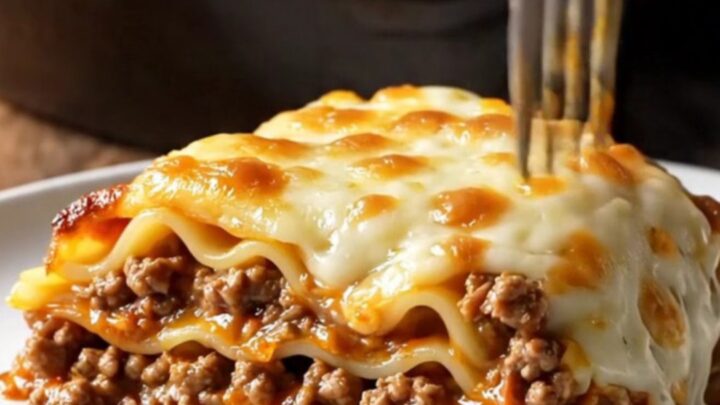
The mozzarella is completely melted, forming a golden, bubbling layer. The parsley is scattered on top, adding fresh green color.
When lifted with a spatula, the lasagna holds together and the cheese stretches into long strands. The edges are slightly crisp, and the aroma is irresistibly cheesy.
Common mistakes
Avoid using a skillet that is too small; the lasagna sheets need room to lie flat. Do not skip covering the skillet while the pasta cooks, as the steam is essential for softening the sheets.
If the sauce becomes too dry before the pasta is tender, add a few tablespoons of water and continue cooking. Finally, resist the urge to stir the lasagna once the sheets are added, as this can break the pasta.
How to tell it’s done
The dish is done when the lasagna sheets are tender and have absorbed most of the sauce, and the mozzarella is fully melted and bubbly. To check the pasta, insert a fork into a sheet; it should be al dente with no hard center.
The ground beef must reach an internal temperature of 160°F (71°C) to be safe. The cheese should be completely melted and lightly golden at the edges.
- Ground meat: 160°F (71°C) in the thickest part
Up next · Part 3 of 3
4 variations · storage & make-ahead · 5 answers · printable card
Tips, FAQ & printable recipe (Part 3)← Back to the ingredients (Part 1)