Breakfast · Part 2 of 3: Instructions
One-Pan Egg Toast Sandwich with Cheese Pull Step-by-step instructions
- Prep
- Cook
- Total
- Serves
- 2
Before you start
Before starting, gather all ingredients and equipment. Crack the eggs into a bowl and chop the parsley. Cut the bread slices diagonally to create triangles. Have the cheese ready to sprinkle.
Place a nonstick skillet on the stove and ensure a spatula is nearby. This recipe moves quickly once the eggs hit the pan, so having everything within reach makes the process smooth.
Ingredients at a glance (5)
- 4 large eggs
- 2 tbsp fresh parsley, chopped
- 1 tbsp butter
- 4 slices white bread, cut diagonally into triangles
- 1/2 cup shredded mozzarella cheese
Instructions
Prepare the Egg Base
- Whisk the EggsIn a mixing bowl, crack the eggs and add the chopped parsley. Whisk until the yolks and whites are fully combined and the mixture is slightly frothy. Set aside.Look for The eggs are a uniform yellow with flecks of green.Tip Whisking thoroughly ensures an even, tender omelet base.
- Melt the ButterPlace a nonstick skillet over medium heat and add the butter. Let it melt and foam until the sizzling subsides, tilting the pan to coat the bottom evenly.Look for The butter is melted and bubbling but not browning.Tip Medium heat prevents the butter from burning before the eggs go in.
The eggs are whisked with parsley and poured into a buttered skillet over medium heat. The edges begin to set while the center remains moist. The bread triangles are arranged in a diamond pattern, pressing gently so they adhere.
The cheese is sprinkled over the top, starting to melt and look glossy. The skillet should have a gentle sizzle, and the aroma of butter and eggs fills the air.
Fold and Toast
- Pour in the EggsPour the whisked egg mixture into the skillet, tilting to spread it into a thin, even layer that covers the entire bottom. Let it cook undisturbed for about 1 minute, until the edges start to set.Look for The edges are set and the center is still moist but beginning to firm.Tip Do not stir the eggs; they need to form a cohesive omelet base.
- Arrange the BreadImmediately place the 4 bread triangles onto the wet omelet surface, with the pointed ends facing outward and the wide edges meeting in the center. Press gently so the bread adheres to the egg.Look for The bread sticks to the egg base without sliding.Tip Work quickly so the egg doesn't fully set before the bread is placed.
- Add the CheeseSprinkle the shredded mozzarella evenly over the bread triangles and the exposed egg surface. The cheese will melt and help bind the sandwich together.Look for The cheese begins to melt and look glossy.Tip Use a cheese that melts well for the best stretch.
The bread triangles are folded together to form a sealed pocket. The sandwich is pressed gently and cooked until the bottom is golden brown. Flipping carefully, the other side toasts to a deep buttery crisp.
The cheese melts into the crevices, and the egg sets completely. The kitchen smells of toasted bread and melted cheese, and the crust is visibly crunchy.
Slice and Serve
- Fold and PressUsing a spatula, fold the bread triangles together into a sealed pocket, pressing gently so the edges stick. Cook for 2-3 minutes per side, until the bread is golden brown and crispy and the egg is fully set.Look for The bread turns deep golden and crisp, and the cheese is melted and gooey.Safe temperature 160°F (71°C) internal temperature (egg dishes)Tip Press firmly but gently to seal the edges without squeezing out the filling.
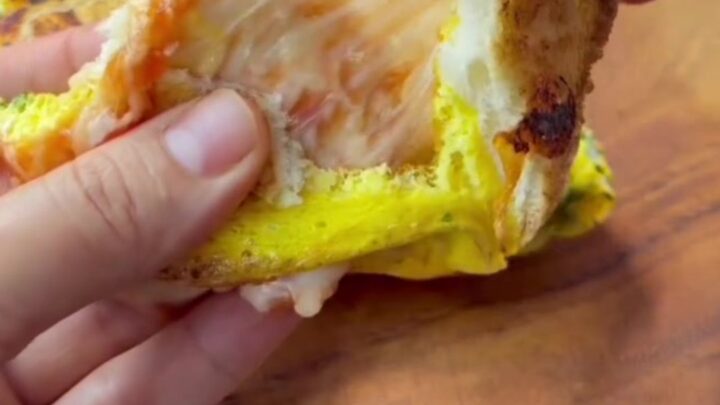
- Slice and ServeTransfer the sandwich to a cutting board. Slice diagonally to reveal the cheese pull, then serve hot.Look for The cheese stretches as the sandwich is pulled apart.Tip Slice with a serrated knife for a clean cut without crushing the crust.
The sandwich is transferred to a cutting board and sliced diagonally. The knife cuts through the crispy crust, and the cheese pulls apart in long, gooey strings. The interior shows a tender, set egg layer with melted cheese. The sandwich is hot and ready to serve immediately, with the cheese still stretchy and the bread perfectly crisp.
Common mistakes
A common mistake is pouring the eggs into a pan that's too hot, causing them to set too quickly and not bind to the bread properly. Another is adding the bread too late, so the egg is already firm and the bread won't stick.
Pressing too hard when folding can squeeze out the filling. Also, avoid flipping too early; wait until the bottom is golden and set before turning.
How to tell it’s done
The sandwich is done when the bread is golden brown and crispy on both sides, and the egg is fully set with no raw or wet areas. The cheese should be completely melted and gooey. If using a thermometer, the internal temperature of the egg should reach 160°F (71°C). Cut into the sandwich to check that the egg is firm and the cheese stretches.
- Egg dishes: 160°F (71°C) in the thickest part
Up next · Part 3 of 3
4 variations · storage & make-ahead · 5 answers · printable card
Tips, FAQ & printable recipe (Part 3)← Back to the ingredients (Part 1)