Desserts · Part 2 of 3: Instructions
Molten Dulce de Leche Skillet Lava Cake Step-by-step instructions
- Prep
- Cook
- Total
- Serves
- 4
Before you start
Before starting, measure all ingredients and have them at room temperature where possible. Butter the skillet generously and set it aside. Freeze the dulce de leche dollop at least 30 minutes ahead, or up to overnight, so it’s solid when added to the batter.
Preheat the oven to 400°F (200°C) with a rack in the center. Have a heatproof bowl and a saucepan ready for melting the butter and dulce de leche. This ensures the batter comes together quickly and the cake bakes without delay.
Ingredients at a glance (11)
- 5 tbsp unsalted butter, plus more for the skillet
- 100 g dulce de leche, for melting
- 1/2 cup granulated sugar
- 2 large eggs
- 2 large egg yolks
- 1 tsp vanilla extract
- 1/2 cup all-purpose flour
- 1/4 tsp fine salt
- 1/4 cup dulce de leche, frozen in a dollop
- vanilla bean ice cream, for serving
- flaky sea salt, for serving
Instructions
Make the Batter
- Melt and Mix the BaseHeat the oven to 400°F (200°C). Butter a 6-inch cast-iron skillet generously. In a heatproof bowl set over simmering water, melt the butter with 100 g dulce de leche, stirring until silky and smooth. Remove from heat and let cool slightly.Look for The mixture is glossy and fully combined, with no streaks of butter or caramel.Tip If the dulce de leche is very thick, warm it gently with the butter to ease mixing.
- Whisk in Sugar and EggsWhisk the granulated sugar into the butter mixture until dissolved. Add the whole eggs, egg yolks, and vanilla extract. Whisk vigorously for about 1 minute until the mixture is pale, ribbony, and slightly thickened.Look for The batter falls from the whisk in a thick ribbon that slowly disappears.Tip Whisking thoroughly incorporates air, helping the cake rise and stay tender.
- Fold in Dry IngredientsSprinkle the flour and salt over the batter. Fold gently with a rubber spatula until just combined, with no dry streaks. Do not overmix.Look for The batter is smooth and uniform, but still airy.Tip Overmixing develops gluten and makes the cake tough; fold only until the flour disappears.
At the end of this phase, the batter is smooth, glossy, and slightly thickened from whisking. The melted butter and dulce de leche mixture should be silky, and when you lift the whisk, the batter falls in a ribbon that slowly disappears.
The flour is folded in just until no streaks remain. The batter is ready to be layered in the skillet.
Bake the Skillet Cake
- Layer the Batter and FillingPour half of the batter into the prepared skillet. Place the frozen dollop of dulce de leche in the center. Pour the remaining batter over the top, covering the dollop completely.Look for The filling is hidden under the batter, with no caramel visible on the surface.Tip Freezing the filling dollop helps it stay intact during baking, creating a distinct lava center.
- Bake Until Edges Are SetPlace the skillet in the oven and bake at 400°F (200°C) for 13 minutes, until the edges are firm and puffed, and the center is moist and glossy but not fully set. The center should have a slight wobble when gently shaken.Look for The top is golden, the edges are set, and the center moves like a soft custard.Safe temperature 160°F (71°C) internal temperature (egg dishes)Tip Bake time may vary slightly; start checking at 12 minutes. The center will continue to set as it rests.
After 13 minutes in the oven, the cake’s edges are puffed and golden, while the center remains moist and glossy. The top is a deep golden brown, and the cake smells of caramel and butter. Gently shake the skillet — the center should have a slight wobble. The kitchen is filled with a warm, sweet aroma.
Serve with Ice Cream
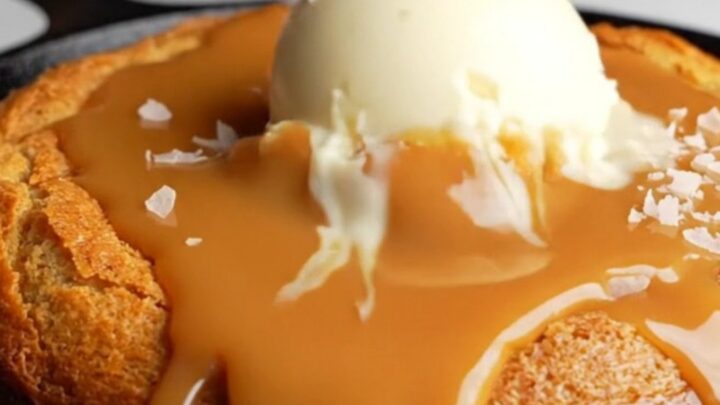
- Top and Serve ImmediatelyRemove the skillet from the oven. Let rest for 2 minutes. Top with a scoop of vanilla bean ice cream and a sprinkle of flaky sea salt. Serve directly from the skillet, spooning out portions that reveal the molten caramel center.Look for The ice cream begins to melt over the warm cake, and the caramel lava flows when spooned.Tip For the best contrast, serve while the cake is warm and the center is molten.
The cake is topped with cold vanilla ice cream and a sprinkle of flaky sea salt. When you spoon into it, the warm caramel lava flows out, contrasting with the cold ice cream. The texture is tender and moist, with a rich, caramel flavor. Serve immediately for the best experience.
Common mistakes
A common mistake is overbaking, which results in a fully set center and no lava. Start checking at 12 minutes and trust the wobble test. Another issue is using a runny dulce de leche for the filling; if it’s too thin, it will dissolve into the batter, so freeze it well.
Also, avoid overmixing the batter after adding flour, as this can make the cake tough. Finally, don’t skip buttering the skillet — it ensures the cake releases easily and creates a nice crust.
How to tell it’s done
The cake is done when the edges are puffed and firm to the touch, and the top is golden brown. The center should look moist and glossy, with a slight wobble when you gently shake the skillet.
To be safe, insert an instant-read thermometer into the center of the cake (not the caramel filling) — it should read at least 160°F (71°C). Let the cake rest for 2 minutes before serving; this allows the center to set slightly while remaining molten.
- Egg dishes: 160°F (71°C) in the thickest part
Up next · Part 3 of 3
4 variations · storage & make-ahead · 5 answers · printable card
Tips, FAQ & printable recipe (Part 3)← Back to the ingredients (Part 1)