Desserts · Part 2 of 3: Instructions
Molten Chocolate Peanut Butter Skillet Lava Cake Step-by-step instructions
- Prep
- Cook
- Total
- Serves
- 2
Before you start
Before starting, make sure the peanut butter is frozen into a sphere (or a small scoop shape) for at least 2 hours. Preheat the oven to 400°F (200°C) and butter two mini cast iron skillets.
Measure all ingredients and chop the chocolate so everything is ready to go. Set up a double boiler or a heatproof bowl over simmering water. Have a baking sheet ready to place the skillets on for easy handling.
Ingredients at a glance (9)
- 150 g dark chocolate (70% cacao), chopped
- 100 g unsalted butter, plus more for the skillet
- 1/2 cup granulated sugar
- 2 large eggs
- 2 large egg yolks
- 40 g all-purpose flour
- 1/4 cup creamy peanut butter, frozen into a sphere
- Sea salt flakes, for topping, to taste
- Vanilla ice cream, for serving
Instructions
Melt and Mix
- Melt the Chocolate BaseSet a double boiler or a heatproof bowl over a pot of gently simmering water. Add the chopped dark chocolate and butter. Stir occasionally until completely melted and glossy. Remove from heat and let cool slightly.Look for The mixture should be smooth, shiny, and fully combined with no lumps.Tip Make sure the water doesn't touch the bottom of the bowl to avoid overheating the chocolate.
- Whisk in Sugar and EggsWhisk the granulated sugar into the chocolate mixture until fully incorporated. Add the eggs and egg yolks one at a time, whisking well after each addition until the batter is thick and glossy.Look for The batter should be shiny and fall slowly from the whisk in a thick ribbon.Tip Whisk vigorously to incorporate air, which helps create a light, cakey exterior.
- Fold in the FlourSprinkle the all-purpose flour over the batter and fold with a rubber spatula until just combined. Do not overmix; a few streaks are fine.Look for The batter should be uniform with no dry flour visible, but still airy.Tip Overmixing can develop gluten, making the cake tough instead of tender.
The chocolate and butter should be completely melted and glossy. After whisking in the sugar and eggs, the batter should be thick, shiny, and fall from the whisk in a ribbon. When you fold in the flour, the batter should be smooth with no lumps. The aroma is rich and chocolatey, and the texture is like a thick pudding.
Assemble the Skillets
- Prepare the SkilletsGenerously butter the inside of two mini cast iron skillets (about 5 inches each). Divide half of the chocolate batter evenly between the skillets, spreading it to cover the bottom.Look for The batter layer should be even and reach about 1/4 inch up the sides.Tip Buttering well ensures the cake releases easily and creates a crisp edge.
- Add the Frozen Peanut ButterPlace a frozen sphere of creamy peanut butter (about 2 tablespoons each) in the center of each skillet, pressing it gently into the batter.Look for The peanut butter ball should sit centered and be partially surrounded by batter.Tip Freezing the peanut butter keeps it from melting during baking, creating a distinct molten layer.
- Cover with Remaining BatterSpoon the remaining batter over the peanut butter, covering it completely. Smooth the tops with a spatula.Look for The batter should fully encase the peanut butter with no gaps showing.Tip Make sure the peanut butter is sealed in; otherwise it may leak out during baking.
The skillets are buttered and the first layer of batter is spread evenly. The frozen peanut butter sphere sits in the center, and the remaining batter covers it completely. The tops are smooth and the batter is level. The skillets are ready for the oven, and the peanut butter is still frozen solid.
Bake and Serve
- Bake the Lava CakesPreheat the oven to 400°F (200°C). Place the skillets on a baking sheet and bake for exactly 13 minutes. The edges should be firm and puffed while the center still moves gently when the skillet is shaken.Look for The tops will look set around the edges, and the center will have a slight wobble.Safe temperature 160°F (71°C) internal temperature (egg dishes)Tip Bake time is critical; overbaking will solidify the center. Start checking at 12 minutes.
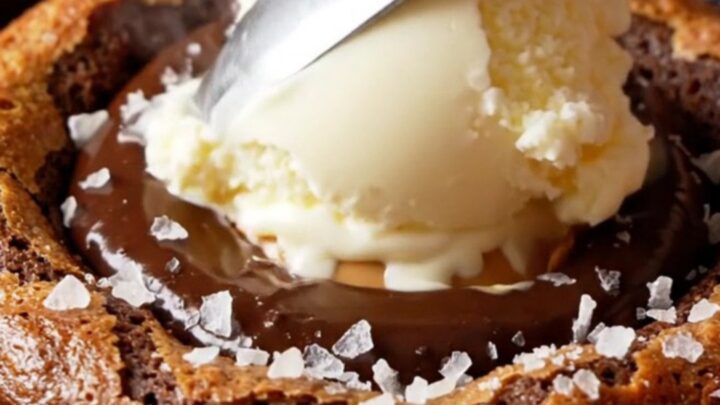
- Rest and GarnishRemove from the oven and let rest for 5 minutes. Sprinkle with sea salt flakes and top with a scoop of cold vanilla ice cream.Look for The cake should be slightly puffed and the ice cream will begin to melt on contact.Tip The rest allows the cake to set slightly, making it easier to scoop while still molten inside.
After 13 minutes, the edges are puffed and set, while the center wobbles gently. The kitchen smells of warm chocolate and toasted peanut butter.
After resting, the cakes are topped with sea salt and vanilla ice cream. When you break into the cake, a river of molten chocolate and peanut butter flows out, and the ice cream melts into the hot fudge.
Common mistakes
Overbaking is the most common mistake—it will turn the center into a solid cake instead of a lava flow. Start checking at 12 minutes and trust the jiggle test. Another issue is not freezing the peanut butter enough; if it’s too soft, it will melt into the batter and you’ll lose the distinct layer.
Also, make sure to cover the peanut butter completely with batter, or it may leak out during baking. Finally, don’t skip the rest time—it helps the cake firm up enough to hold its shape when you dig in.
How to tell it’s done
The lava cakes are done when the edges are firm and puffed, and the center still has a slight jiggle when you gently shake the skillet. The top should look set, but a toothpick inserted near the center should come out with moist crumbs, not raw batter.
Because the eggs are fully cooked in the cake (the internal temperature reaches 160°F/71°C), it’s safe to eat. Letting the cakes rest for 5 minutes allows the center to set slightly while remaining molten.
- Egg dishes: 160°F (71°C) in the thickest part
Up next · Part 3 of 3
4 variations · storage & make-ahead · 5 answers · printable card
Tips, FAQ & printable recipe (Part 3)← Back to the ingredients (Part 1)