Desserts · Part 2 of 3: Instructions
Molten Biscoff Skillet Lava Cake Step-by-step instructions
- Prep
- Cook
- Total
- Serves
- 6
Before you start
Preheat the oven to 400°F (200°C). Butter an 8-inch cast iron skillet generously. Measure all ingredients. Freeze the Biscoff spread for the filling in a small, flat-bottomed container or on a parchment-lined plate until solid, at least 1 hour ahead.
Crush the Biscoff cookies into coarse crumbs. Set out the eggs and butter to come to room temperature if time allows.
Ingredients at a glance (12)
- 1/2 cup unsalted butter
- 1/2 cup Biscoff spread (for the batter)
- 1/2 cup packed brown sugar
- 2 large eggs
- 2 egg yolks
- 1 tsp vanilla extract
- 1/2 cup all-purpose flour
- 1/2 cup crushed Biscoff cookies (about 6 cookies)
- 1/2 cup Biscoff spread, frozen in a dollop
- Vanilla bean ice cream, for serving
- Crushed Biscoff cookies, for garnish, to taste
- Warm Biscoff spread, for drizzling, to taste
Instructions
Melt and Mix
- Melt and MixIn a heatproof bowl, melt the butter and 1/2 cup Biscoff spread together until glossy. Whisk in the brown sugar, eggs, egg yolks, and vanilla until pale and thick.Look for The mixture should be smooth and glossy, with the sugar fully dissolved.Tip Melt the butter and spread gently to avoid overheating the eggs later.
- Fold Dry IngredientsFold the flour and crushed Biscoff cookies into the wet mixture until just combined. Do not overmix; the batter should be thick but smooth.Look for No streaks of flour remain, and the batter is cohesive.Tip Use a spatula to fold gently, preserving the air you've whipped in.
The butter and Biscoff spread should be fully melted and glossy. When you whisk in the sugar and eggs, the mixture should become pale and slightly thickened. The dry ingredients should be folded in until no streaks remain, and the batter should be smooth and cohesive.
Assemble and Bake
- Assemble the SkilletPour half of the batter into a buttered 8-inch skillet. Place the frozen dollop of Biscoff spread in the center, then cover with the remaining batter, spreading to the edges.Look for The frozen spread is completely hidden by the batter.Tip Ensure the frozen dollop is centered for an even lava flow.
- Bake Until Set EdgesBake at 400°F (200°C) for 13 minutes, until the outer edges are set and puffed, while the center remains moist and tender.Look for The edges are golden and the center gives slightly when gently pressed.Safe temperature 160°F (71°C) internal temperature (egg dishes)Tip Start checking at 12 minutes; ovens vary.
The batter should be evenly spread in the skillet, hiding the frozen dollop completely. As it bakes, the edges will rise and turn golden, while the center remains soft.
The kitchen will fill with a warm, spiced aroma. The surface should look set, with a slight jiggle in the center when gently shaken.
Top and Serve
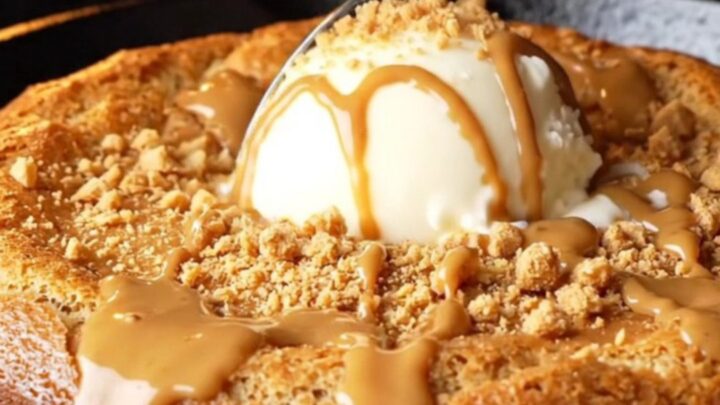
- Top and ServeImmediately top the warm cake with scoops of vanilla bean ice cream, a sprinkle of crushed Biscoff cookies, and a drizzle of warm Biscoff spread. Scoop into the center to reveal the molten lava.Look for The center flows out as you scoop, mixing with the ice cream.Tip Serve right away while the contrast between warm cake and cold ice cream is at its peak.
The cake should be warm and the center should flow out as soon as you scoop into it. The ice cream will begin to melt slightly, mixing with the warm cookie butter lava. The crushed cookies add a crunchy texture. Serve immediately, straight from the skillet.
Common mistakes
A common mistake is overbaking, which results in a fully cooked cake with no lava center. Start checking at 12 minutes and remember the center will continue to cook from residual heat.
Another pitfall is not freezing the filling enough; if it's not solid, it will melt into the batter and you'll lose the distinct lava effect. Use a spatula to spread the batter gently, and avoid overmixing.
How to tell it’s done
The cake is done when the edges are set and puffed, and the center is still soft but not liquid. The internal temperature of the cake should reach at least 160°F (71°C) in the center to ensure the eggs are fully cooked.
A toothpick inserted near the edge should come out clean, but the center will still be moist. Let it cool for 2-3 minutes before serving.
- Egg dishes: 160°F (71°C) in the thickest part
Up next · Part 3 of 3
4 variations · storage & make-ahead · 5 answers · printable card
Tips, FAQ & printable recipe (Part 3)← Back to the ingredients (Part 1)