Desserts · Part 2 of 3: Instructions
Layered Chocolate Caramel Cream Dessert Step-by-step instructions
- Prep
- Cook
- Total
- Serves
- 8
Before you start
Before beginning, ensure that the chocolate cake is fully prepared and cooled, as warm cake will cause the whipped cream to deflate and lose its structure. Gather all ingredients and equipment, ensuring the caramel sauce is at a pourable consistency.
If the caramel is too stiff, warm it gently in the microwave or a small saucepan. Have the glass casserole dish ready on a clean workspace. Preparing the workspace in advance allows for a smooth assembly process, ensuring that the final result is as beautiful as it is delicious.
Ingredients at a glance (5)
- 1 package chocolate cake, pre-baked and cubed
- 2 cups heavy cream, whipped
- 1/2 cup caramel sauce
- 1/4 cup crushed toffee
- 4 ounces dark chocolate squares
Instructions
Cake Foundation
- Assemble the BasePlace the cubed chocolate cake into the bottom of a glass casserole dish, spreading it out evenly to create a solid foundation for the subsequent layers of cream and caramel.Look for The cake should be cut into bite-sized cubes for even distribution.Tip Ensure the cake is completely cooled before assembly to prevent the whipped cream from melting.
The cake cubes should form a uniform, level layer at the bottom of the dish. There should be no large gaps between the cubes, ensuring a stable base that will support the layers of cream and caramel without shifting during service.
Cream and Caramel layering
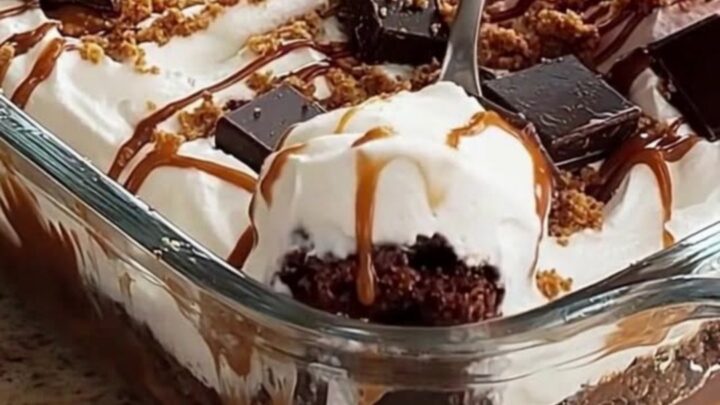
- Layer Cream and CaramelSpread the whipped cream over the cake layer using a spatula to smooth the surface. Drizzle the caramel sauce generously over the whipped cream, creating a marbled effect.Look for The caramel should be drizzled in a decorative pattern over the white cream.Tip Use a warm spoon to help the caramel sauce drizzle more easily if it is too thick.
The whipped cream must be spread evenly over the cake, covering it completely to the edges of the dish. The caramel sauce should be drizzled in a way that creates distinct ribbons, avoiding a completely blended look for better texture.
Final Garnishing
- Add Final Toppings and Cook EggsSprinkle the crushed toffee over the caramel layer. Carefully place the dark chocolate squares on top of the dessert. If using a custard base containing eggs, ensure the mixture reaches 160°F (71°C) during the preparation of the cream component to ensure the eggs are cooked through. Chill the assembled dish for at least one hour before serving.Look for The toppings should be evenly spaced for an attractive presentation.Safe temperature 160°F (71°C) internal temperature (egg dishes)Tip Chilling allows the flavors to meld and the dessert to set firmly for clean scooping.
The toffee and chocolate squares should be distributed evenly across the top. The surface should look polished and deliberate. After chilling, the dessert should feel firm to the touch, indicating that it is ready to be portioned and served.
Common mistakes
A common mistake is using cake that is still warm, which will compromise the integrity of the whipped cream and result in a messy dish. Another error is failing to whip the cream to the correct consistency; if it is too soft, the layers will bleed into one another.
Ensure that the caramel is not overly hot when drizzled, as this can also cause the cream to melt. Finally, do not skip the chilling time, as it is vital for the structure and final flavor profile of the dessert.
How to tell it’s done
This dessert does not require traditional cooking, as the components are assembled ready-to-eat. The dish is considered done when the layers are neatly stacked and the entire casserole has been chilled for at least one hour.
Chilling is essential for the dessert to set properly, ensuring that the whipped cream is firm and the flavors have had adequate time to meld together.
The final product should look clean, with distinct layers visible through the glass dish and a glistening, appetizing appearance on the surface. If a custard base is used, ensure it reaches 160°F (71°C).
- Egg dishes: 160°F (71°C) in the thickest part
Up next · Part 3 of 3
2 variations · storage & make-ahead · 3 answers · printable card
Tips, FAQ & printable recipe (Part 3)← Back to the ingredients (Part 1)