Breakfast · Part 2 of 3: Instructions
Jammy Soy-Marinated Eggs for Effortless Meal Prep Step-by-step instructions
- Prep
- Cook
- Total
- Serves
- 4
Before you start
Before you begin, ensure you have a reliable timer, as the timing for boiling the eggs is precise. Prepare an ice bath by filling a medium bowl with equal parts cold water and ice cubes. Have your airtight container ready, and ensure your eggs are straight from the refrigerator to provide a consistent starting temperature.
Clear your workspace and have your whisk and a small saucepan ready. If you plan to serve these with whipped ricotta and sourdough, have those prepared or ready to assemble once the marinating process is complete.
Ingredients at a glance (7)
- 60 ml dark soy sauce
- 60 ml mirin
- 60 ml water
- 10 g brown sugar
- 2 garlic cloves, smashed
- 1 star anise
- 4 large eggs
Instructions
Marinade Preparation
- Prepare the MarinadeIn a small bowl, whisk together the dark soy sauce, mirin, water, brown sugar, smashed garlic cloves, and the star anise until the sugar is fully dissolved.Look for The sugar should be completely dissolved into the liquid mixture, and the garlic should be lightly smashed to release its aromatic oils.Tip Whisking thoroughly ensures the marinade is uniform and the sugar does not settle at the bottom of the container.
The marinade should be perfectly smooth with the sugar completely dissolved. The garlic should be smashed just enough to release its oils without disintegrating into the liquid.
It should smell fragrant and savory, with the subtle sweetness of the mirin balancing the saltiness of the soy sauce. Ensure your container is ready and clean so you can transfer the eggs immediately after they have been peeled and cooled.
Boiling and Cooling
- Boil and Shock the EggsBring a pot of water to a boil. Carefully lower the eggs into the water and boil for exactly six minutes and thirty seconds. Immediately transfer the eggs to an ice bath to stop the cooking process and cool them completely.Look for The whites should be just set, while the yolk remains jammy and custard-like. A quick shock in ice water is essential for easy peeling.Safe temperature 160°F (71°C) internal temperature (egg dishes)Tip Use a slotted spoon to lower eggs gently to prevent cracking against the bottom of the pot.
The eggs should be boiled for exactly six minutes and thirty seconds. Once they hit the ice bath, they should cool for at least five minutes to ensure the cooking process has completely stopped. The shells should be firm and cool to the touch. If you notice any cracks, handle those eggs with extra care during the peeling process to ensure the final appearance remains clean and smooth.
Peeling and Marinating
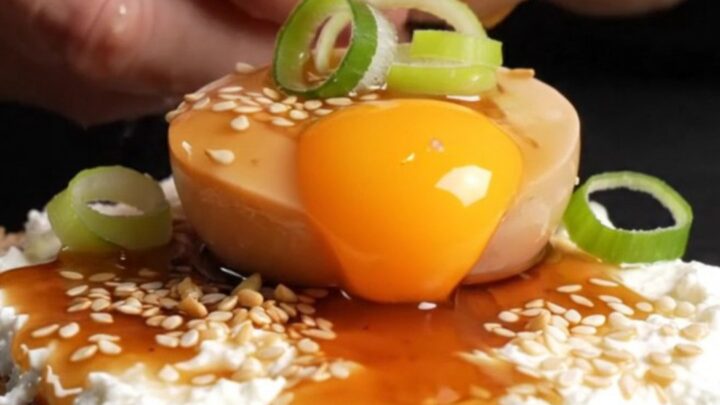
- Peel and MarinatePeel the cooled eggs carefully. Submerge the peeled eggs in the prepared marinade within an airtight container. Refrigerate for twelve hours before serving to allow the flavors to penetrate the egg.Look for The whites will take on a deep mahogany color and a savory flavor, while the yolk will remain a translucent, jammy amber color.Tip Ensure the eggs are completely submerged in the liquid by placing a paper towel on top if they tend to float.
The peeled eggs should be smooth and intact before being submerged in the marinade. Ensure the container is sealed tightly to prevent any spills in the refrigerator. After twelve hours, the eggs should have absorbed the marinade, resulting in a dark, flavorful exterior. The yolks will have transformed into a rich, custard-like consistency, ready to be served over your favorite toasted bread or enjoyed as a snack.
Common mistakes
A common mistake is boiling the eggs for too long, which results in a chalky, pale yellow yolk instead of the desired jammy texture. Another error is failing to use an ice bath, which allows the eggs to continue cooking from residual heat.
Ensure the marinade is fully cooled before adding the eggs if you have heated any part of the mixture. Finally, avoid marinating for too long, as the eggs can become overly salty or the whites may develop a rubbery texture if left beyond twenty-four hours.
How to tell it’s done
The eggs are finished when the whites are fully set and firm to the touch, while the yolks maintain a jammy, custard-like consistency that is not runny but soft. When sliced, the yolk should be a translucent, uniform amber color throughout.
The internal temperature of the egg should reach 160°F (71°C) to ensure safety. The exterior of the egg will be a deep, mahogany brown from the marinade, contrasting beautifully with the bright gold center when served on a slice of toasted sourdough bread.
- Egg dishes: 160°F (71°C) in the thickest part
Up next · Part 3 of 3
2 variations · storage & make-ahead · 3 answers · printable card
Tips, FAQ & printable recipe (Part 3)← Back to the ingredients (Part 1)