Dinner · Part 2 of 3: Instructions
Herb-Crusted Prime Rib Roast Step-by-step instructions
- Prep
- Cook
- Total
- Serves
- 8
Before you start
Before beginning, ensure the roast is removed from the refrigerator at least 30 minutes prior to cooking to reach a more uniform temperature. Gather your fresh herbs and prepare your baking sheet. Preheat your oven fully to 325°F (165°C) to ensure consistent roasting.
Prepare a clean workspace and have your carving board and sharp chef's knife ready nearby for the final step. Having your meat thermometer accessible will make monitoring the internal temperature much easier once the roast is in the oven.
Ingredients at a glance (2)
- 8 lb standing rib roast
- 1/4 cup fresh herbs
Instructions
Seasoning and Preparation
- Prepare the RoastPreheat your oven to 325°F (165°C). Pat the standing rib roast dry with paper towels to ensure the herb crust adheres properly. Press the fresh herbs firmly onto the entire surface of the meat to create a flavorful coating.Look for The herbs should be evenly pressed into the surface of the beef.Tip Remove the meat from the refrigerator 30 minutes before roasting to ensure more even cooking.
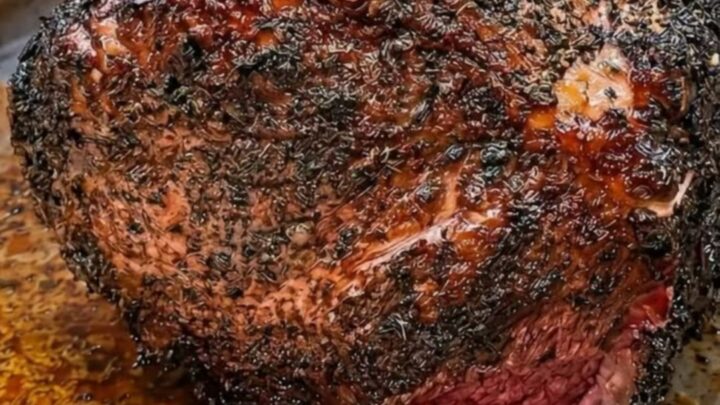
The roast should be completely coated in the fresh herbs, appearing vibrant and fragrant. Once in the oven, the heat should begin to release the essential oils from the herbs.
Check that the oven is maintaining a steady temperature during this initial phase to ensure a consistent and slow roast.
Slow Roasting
- Roast the MeatPlace the seasoned roast on a baking sheet. Transfer to the preheated oven and roast until the internal temperature reaches 145°F (63°C) for a perfect medium-rare finish. Once the temperature is reached, remove the meat from the oven and let it rest for at least 20 minutes before carving.Look for The crust will become dark and fragrant while the meat remains tender.Safe temperature 145°F (63°C) internal temperature (steaks, chops and roasts)Tip Use a reliable meat thermometer inserted into the thickest part of the roast to ensure accurate doneness.
The meat should roast steadily. You will notice a savory, roasted aroma filling the kitchen. The surface of the meat should look browned and firm. Use your thermometer to check the internal temperature periodically, ensuring it is climbing steadily toward the goal of 145°F (63°C).
Resting and Carving
- Carve and ServeTransfer the rested roast to a carving board. Using a sharp knife, carve the meat into thick slices. Serve the slices immediately while they are still steaming and tender.Look for The meat should be easy to slice and reveal a consistent pink center.Tip Keep the carving board stable by placing a damp towel underneath it.
Once removed from the oven, the roast must rest on a board. The exterior will be crisp and well-browned. After 20 minutes, the roast should be ready to slice. It should yield easily to the knife, revealing a consistent pink center and a savory, herb-infused crust.
Common mistakes
A common mistake is failing to let the roast rest sufficiently after removing it from the oven. Resting for at least 20 minutes is mandatory to allow juices to stabilize; slicing too early will cause the flavorful juices to run out onto the board, leaving the meat dry.
Another error is neglecting to pat the roast completely dry before applying the herbs, which prevents the crust from adhering evenly to the surface of the beef.
How to tell it’s done
The meat is done when an instant-read thermometer inserted into the thickest part of the roast registers 145°F (63°C). At this temperature, the prime rib will be a perfect medium-rare with a warm, pink center.
Remember that the temperature will continue to rise slightly as the meat rests, so removing it from the oven just as it hits the target is vital to avoid overcooking the roast.
- Steaks, chops and roasts: 145°F (63°C) in the thickest part, then a 3-minute rest
Up next · Part 3 of 3
2 variations · storage & make-ahead · 3 answers · printable card
Tips, FAQ & printable recipe (Part 3)← Back to the ingredients (Part 1)