Breakfast · Part 2 of 3: Instructions
Hash Brown Patty Breakfast Casserole with Turkey Sausage Step-by-step instructions
- Prep
- Cook
- Total
- Serves
- 8
Before you start
Set the oven to 375°F (190°C) with a rack in the center, and pull everything to the counter in one pass: the frozen hash brown patties, the cooked turkey sausage crumbles, the eggs, the milk, and the shredded cheddar.
The patties stay in the freezer until the second they are needed, since frozen patties tile cleanly and hold their shape. Have the 9x13-inch ceramic baking dish ready, along with a large mixing bowl, a whisk, and an instant-read thermometer.
Ingredients at a glance (5)
- 12 frozen hash brown patties
- 1 lb cooked turkey breakfast sausage crumbles
- 8 large eggs, beaten
- 2 cups whole milk
- 2 cups shredded cheddar cheese
Instructions
Build the potato base
- Heat the oven and set up the dishPosition a rack in the center of the oven and heat it to 375°F (190°C). Set a 9x13-inch ceramic baking dish on the counter and have the frozen hash brown patties ready beside it. Working with the patties straight from the freezer keeps them firm and easy to tile in even rows.Look for The oven is ready when the preheat signal sounds and the dish sits on the counter with a clear landing zone for the patties.Tip Ceramic browns the patties gently and holds heat for serving; a glass dish works too but may bake a few minutes faster.
- Tile the bottom with hash brown pattiesArrange the frozen hash brown patties in the dish in a single layer, edges just touching, filling the bottom completely. Cut one or two patties in half to fill gaps along the short ends so no bare spots of dish show through. An even base keeps every square holding together when it is served.Look for The bottom of the dish should read as a continuous layer of potato, with no ceramic visible between the patties.Tip A kitchen scissors or a knife on a cutting board splits frozen patties cleanly for filling the corners.
At the end of this phase the oven is at 375°F (190°C) and the 9x13-inch dish holds a complete, gapless floor of frozen hash brown patties, edges touching, corners filled with trimmed halves, and no ceramic showing through anywhere.
Nothing has been cooked yet, and the patties should still feel cold and firm from the freezer.
Layer, pour and top
- Scatter the turkey sausageSprinkle the cooked turkey breakfast sausage crumbles evenly over the patties, reaching all the way into the corners. Aim for an even blanket rather than a thick center mound, so every square picks up sausage. Reserve a small pinch of crumbles if a slightly darker topping is wanted after the cheese goes on.Look for The potato layer should be covered edge to edge with crumbles, with the patty shapes still faintly visible beneath.Tip Because the crumbles are already fully cooked, they only need to heat through; breaking up any clumps now keeps them from steaming in one spot.
- Whisk the eggs and milkCrack the eggs into a large mixing bowl, add the milk, and whisk briskly for about a minute until the yolks and whites are fully blended and the mixture looks uniform and pale. Whisking well now is what gives the custard an even, tender set instead of streaks of white and yolk in the bake.Look for No streaks of yolk or white remain, and a thin foam sits on the surface of the mixture.Tip Whisk in the bowl the eggs will be poured from, so the transfer to the dish is one clean motion with no drips on the counter.
- Pour the custard over the layersSlowly pour the egg and milk mixture over the sausage and patties, moving the stream across the dish so it soaks in evenly rather than pooling at one end. Pour until the patties are just covered; a few peaks of potato may break the surface. Tap the dish once on the counter to settle the liquid into the gaps.Look for The liquid reaches the top of the patties and sits level, with the corners filled and no dry potato showing above the surface.Tip Pouring low and slow keeps the sausage layer from shifting and keeps the patties exactly where they were tiled.
- Top with cheddarShower the shredded cheddar evenly over the surface of the custard, covering it from edge to edge. The cheese acts as a lid: it protects the custard underneath as it bakes and turns golden and bubbling at the edges. Scatter any reserved sausage crumbles over the cheese now if using.Look for No wet custard shows through the cheese; the whole surface is covered in an even layer of shredded cheddar.Tip Shredding a block of cheddar takes a minute and melts noticeably better than pre-shredded, which is coated to resist clumping.
The assembled casserole now shows three clean layers: sausage crumbles spread edge to edge over the patties, a level egg-and-milk custard that just covers the potatoes, and an even blanket of shredded cheddar hiding all of the liquid beneath.
Tilt the dish slightly at eye level: the surface should sit flat and level, the corners filled, with no puddles at one end and no dry potato peaks above the cheese except a few small ones, which are fine.
Bake, verify and rest
- Bake until golden and bubblingSet the dish on the center rack and bake at 375°F (190°C) for 45 to 50 minutes. The casserole is done when the top is deep golden, the edges bubble gently, and the center no longer looks glossy, with the sausage and eggs heated through to a safe 160°F (71°C) at the middle. Rotate the dish once around the 30-minute mark so the corners and center brown at the same rate.Look for Bubbling at the edges, a uniformly golden cheese top, and a center that rises slightly and looks fully set rather than wet.Safe temperature 160°F (71°C) internal temperature (ground meat)Tip If the cheese colors before the center is done, lay a sheet of foil loosely over the dish for the last ten minutes.
- Check the center temperatureInsert an instant-read thermometer into the center of the casserole, halfway down into the custard. The eggs are fully cooked through at 160°F (71°C); the reading should hold there or above, even in the middle of the dish. If the center reads lower, return the casserole to the oven for five more minutes and check again.Look for A steady 160°F (71°C) or higher at the center, with the thermometer tip coming out clean and hot to the touch.Safe temperature 160°F (71°C) internal temperature (egg dishes)Tip Check two spots, center and one corner, since oven hot spots leave uneven readings in a dish this size.
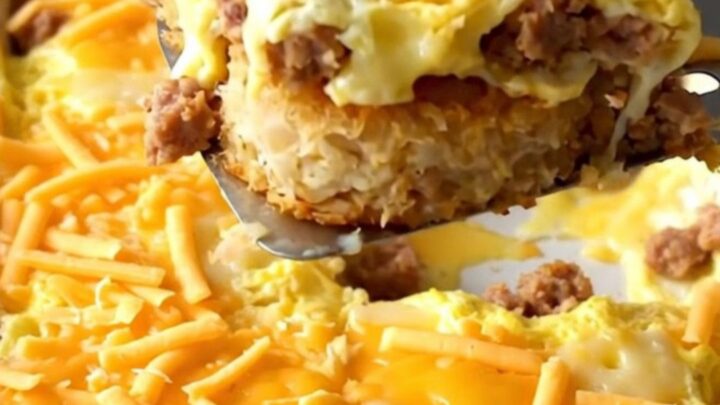
- Rest, cut and serveLet the casserole rest on a cooling rack for 10 minutes before cutting. The custard finishes setting as it stands, the patties firm up, and clean squares lift out with a spatula. Cut into eight squares, lift one to show the layered bottom, and serve straight from the dish while the cheese is still glossy.Look for A spatula slides under a square cleanly, the layers hold their line, and steam rises from the cut edge.Tip Leftovers cool for no more than 2 hours on the counter before they go into the refrigerator, wrapped or in an airtight container.
The finished casserole comes out deep golden on top, bubbling gently at the edges, with the center risen and fully set, and an instant-read thermometer reading at least 160°F (71°C) in the middle of the custard. The kitchen smells of browned cheese and savory sausage.
Common mistakes
The most common slip is over-pouring the custard. If the eggs and milk rise well above the patties, the bake takes longer and the potato layer softens; pour until the patties are just covered and stop.
The second is under-whisking: yolks and whites blended briefly leave pale streaks in the finished squares, so whisk a full minute until uniform. Third, skipping the thermometer and trusting the clock alone; ovens vary, and only 160°F (71°C) at the center guarantees the eggs are done.
How to tell it’s done
The casserole is done on three signs, and any two of them confirm it. First, the top: deep golden across the whole surface with bubbling at the edges, not just spots of color. Second, the center: it should look fully set and slightly risen, with no glossy or wet patches when the dish is tilted gently.
- Egg dishes: 160°F (71°C) in the thickest part
- Ground meat: 160°F (71°C) in the thickest part
Up next · Part 3 of 3
4 variations · storage & make-ahead · 5 answers · printable card
Tips, FAQ & printable recipe (Part 3)← Back to the ingredients (Part 1)