Desserts · Part 2 of 3: Instructions
Gooey Salted Caramel Pecan Turtle Cheesecake Step-by-step instructions
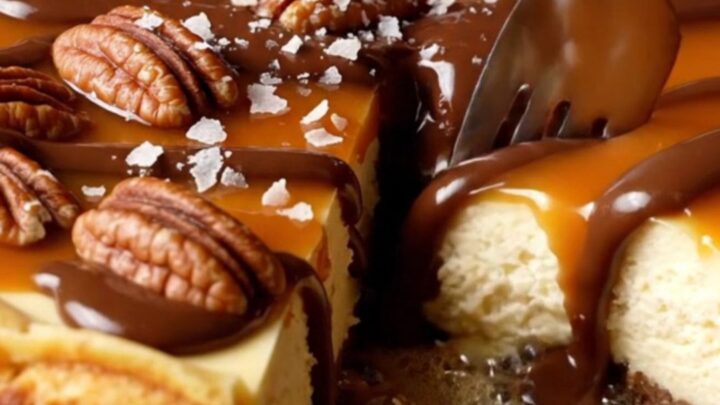
- Prep
- Cook
- Total
- Serves
- 12
Before you start
Before you begin, ensure you have a 9-inch springform pan ready, as this is essential for removing the cheesecake cleanly. Set out your cream cheese and eggs at least one hour before mixing to bring them to room temperature.
Prepare your workspace by gathering all ingredients and measuring them out. Ensure your oven is fully preheated to 330°F (165°C) at least 20 minutes before you are ready to bake to ensure a consistent environment for the cheesecake to set.
Ingredients at a glance (9)
- 700 g softened cream cheese
- 200 g dark brown sugar
- 3 large eggs
- 150 ml homemade sea-salt caramel sauce
- 1 unit chocolate graham crust
- 200 g pecan halves
- 4 tbsp unsalted butter
- 2 tbsp dark fudge sauce
- 1/2 tsp flaky Maldon salt
Instructions
Mixing the Batter
- Prepare the Cheesecake BatterPlace the softened cream cheese and dark brown sugar into the bowl of a stand mixer. Beat on medium speed until the mixture is smooth and aerated. Add the eggs one at a time, ensuring each is fully incorporated before adding the next. Finally, fold in the homemade sea-salt caramel sauce until the batter is uniform in color and texture.Look for The batter should be thick, smooth, and free of any large lumps.Tip Ensure the cream cheese is truly at room temperature to prevent lumps in the final cheesecake.
The batter should be thick, smooth, and uniform in color. Check that there are no visible lumps of cream cheese at the bottom of the bowl. The mixture should feel creamy and look slightly glossy from the caramel sauce integration.
Baking the Cheesecake
- Bake the CheesecakePour the prepared batter into the chocolate graham crust, smoothing the top with a spatula. Place the pan into an oven preheated to 330°F (165°C). Bake for 55 minutes, or until the edges are set and the center retains a slight wobble. Once baked, remove the cake and let it cool completely on a wire rack before transferring it to the refrigerator to chill thoroughly.Look for The edges should look firm and golden, while the center remains slightly jiggly.Safe temperature 160°F (71°C) internal temperature (egg dishes)Tip Do not overbake, as the cheesecake will continue to set as it cools.
The edges of the cheesecake will appear matte and set, while the center remains slightly jiggly. The surface should be smooth and free of deep cracks. If the cake is still very liquid in the center, continue baking for a few more minutes.
Toasting and Finishing
- Toast Pecans and FinishIn a large skillet over medium heat, melt the unsalted butter until it begins to foam and turn a nutty brown color. Add the pecan halves to the skillet and toss frequently for 3 to 5 minutes until toasted and fragrant. Remove the chilled cheesecake from the refrigerator, drizzle with warm salted caramel and dark fudge sauce, then sprinkle with the toasted pecans and flaky Maldon salt.Look for The butter should smell nutty and the pecans should be golden brown.Tip Watch the butter closely, as it can burn very quickly once it starts browning.
The pecans should be a deep golden brown and smell intensely nutty. The brown butter should have visible dark specks. Once drizzled with caramel and fudge, the cake should look glossy and inviting, with the salt flakes visible on top.
Common mistakes
A common mistake is over-mixing the batter after adding the eggs, which incorporates too much air and can cause the cheesecake to puff up and then collapse. Keep the mixer speed low during the final stages.
Another error is failing to let the cheesecake cool gradually. Rapid temperature changes often lead to unsightly cracks on the surface.
Finally, do not rush the chilling process; a cold cheesecake is much easier to slice cleanly and has a superior, dense texture.
How to tell it’s done
The cheesecake is done when the edges are set and look slightly puffed, while the center still has a gentle wobble when the pan is nudged. The internal temperature of the center should reach 160°F (71°C) to ensure the eggs are fully cooked.
Avoid poking the center with a knife, as this can cause cracks; rely on the visual cues and a digital thermometer instead. Let the cake cool completely before attempting to slice it for the best results.
- Egg dishes: 160°F (71°C) in the thickest part
Up next · Part 3 of 3
2 variations · storage & make-ahead · 3 answers · printable card
Tips, FAQ & printable recipe (Part 3)← Back to the ingredients (Part 1)