Dinner · Part 2 of 3: Instructions
Glazed Meatloaf with Creamy Mashed Potatoes, One Pan Step-by-step instructions
- Prep
- Cook
- Total
- Serves
- 6
Before you start
Set the oven to 350°F (175°C) with a rack in the center. Peel the potatoes and cut them into even 2-inch chunks, then leave them in a pot of cold water so they do not gray while waiting. Grate the onion on the coarse side of a box grater and mince the garlic, keeping both near the mixing bowl. Measure the meat-mixture ingredients into one zone and the glaze ingredients into another so assembly moves without stopping.
Ingredients at a glance (17)
- 2 lb ground beef (80/20)
- 1 cup plain breadcrumbs
- 1/2 cup whole milk, for soaking the breadcrumbs
- 2 large eggs, lightly beaten
- 1 small yellow onion, finely grated
- 3 garlic cloves, minced
- 2 tbsp Worcestershire sauce
- 1/4 cup ketchup, for the meat mixture
- 1 1/2 tsp kosher salt
- 1/2 tsp freshly ground black pepper
- 1/2 cup ketchup, for the glaze
- 3 tbsp packed brown sugar
- 1 tsp Worcestershire sauce
- 2 1/2 lb russet potatoes, peeled and cut into chunks
- 6 tbsp unsalted butter
- 3/4 cup whole milk, warmed
- 1 tsp kosher salt, plus more to taste
Instructions
Mix and shape the loaf
- Soak the breadcrumbsPour the milk over the breadcrumbs in a large mixing bowl and stir once. Let the mixture sit for 5 minutes so every crumb drinks up the milk and turns into a thick, soft paste. This panade keeps the loaf tender instead of dense, so do not rush it.Look for The mixture should look like wet sand with no dry crumbs left at the bottom of the bowl.Tip Grate the onion directly into the bowl while the crumbs soak to save a few minutes.
- Build the meat mixtureAdd the ground beef, eggs, grated onion, garlic, Worcestershire sauce, ketchup, salt and pepper to the soaked breadcrumbs. Mix with clean hands just until evenly combined, about 1 minute. Stop as soon as it looks uniform; overworking the meat squeezes out the fat and bakes into a tight, dry loaf.Look for No streaks of egg white or bare spice should remain, and the mix should still feel loose.Tip Cold meat mixes more cleanly, so keep the beef in the fridge until this moment.
- Shape the loafTip the mixture into the loaf pan or onto the baking sheet and shape a free-form loaf about 9 inches long and 2 inches tall, pressing gently so it holds together without compacting. Smooth the top with the back of a spoon so the glaze has an even surface to cling to.Look for The loaf should hold its shape with a slight dome and no cracks along the sides.Tip Wet hands shape the meat without sticking and give the top a smoother finish.
At the end of this phase the raw loaf sits in its pan, about 9 inches long and 2 inches tall, with a smooth, slightly domed top and no cracks down the sides.
The mixture should look evenly blended, a rich reddish brown with visible flecks of onion and garlic, and still feel loose and springy when pressed, never tight. If the surface looks dry or the mix feels sticky and dense, it has been worked too much; reshape gently rather than kneading harder.
Bake, glaze and mash
- Stir the glaze togetherIn a small bowl, stir the ketchup, brown sugar and Worcestershire sauce until the sugar dissolves and the glaze turns glossy and deep red. Taste and adjust: sweeter with a little more sugar, tangier with a spoon of ketchup. Reserve a third for serving at the table.Look for The glaze should coat the spoon thickly and slide off in a slow ribbon.Tip Warm the glaze 15 seconds in the microwave so it brushes on in an even, thin layer.
- Glaze and bake the loafBrush a generous layer of glaze over the top and sides of the loaf. Bake at 350°F (175°C) for 45 minutes, brush on more glaze, then bake 10 to 15 minutes more, until an instant-read thermometer reads 160°F (71°C) in the thickest part. That temperature means the ground beef is fully and safely cooked.Look for The glaze should look dark, shiny and slightly blistered at the edges.Safe temperature 160°F (71°C) internal temperature (ground meat)Tip Check the temperature through the side of the loaf, not the top, for the truest reading.
- Boil the potatoesWhile the loaf bakes, put the potato chunks in a large pot, cover with cold water by an inch and add the salt. Bring to a boil and cook 15 to 18 minutes, until a fork slides into the centers with no resistance. Starting cold cooks the chunks evenly so no hard corners survive.Look for The chunks should look frayed at the edges but not falling apart in the water.Tip Cut the potatoes into even 2-inch chunks so they finish at the same time.
- Mash until creamyDrain the potatoes well and return them to the warm pot for a minute so the steam escapes. Add the butter and mash until it melts in, then pour in the warm milk in two additions, mashing after each. Stop when the potatoes are smooth and creamy with a few soft lumps.Look for The mash should hold soft peaks on the spoon and look glossy, never wet.Tip Warm milk absorbs faster than cold, so heat it briefly before it goes in.
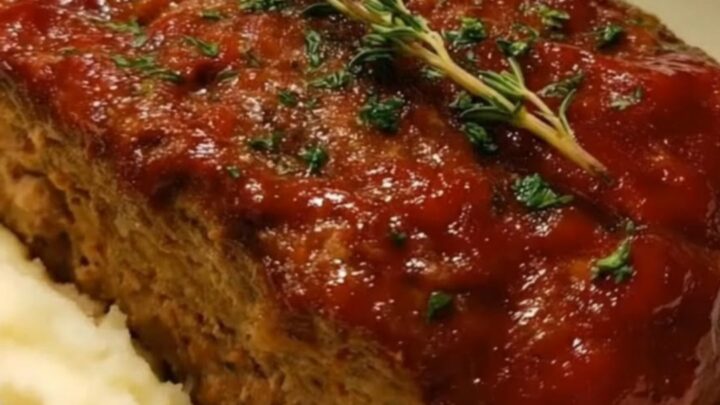
The loaf comes out of the oven with a glaze that is deep red, lacquered and slightly blistered at the edges, and the thermometer reads 160°F (71°C) at the center. The pan juices around a free-form loaf should be mostly clear with a little rendered fat.
The potatoes should be fully tender, a fork meeting no resistance, and the mash should look smooth and glossy, holding soft peaks without pooling liquid. Before moving on, smell the kitchen: browned tomato and caramelizing sugar, never scorched.
Rest, slice and plate
- Rest the meatloafTake the loaf out of the oven and let it rest in the pan for 10 minutes before slicing. The juices that rushed to the center during baking settle back through the meat, so each slice holds together and stays moist instead of leaking onto the plate. Resting gives tidy slices.Look for Steam should still rise from the glaze, but the loaf should feel firm to a gentle press.Tip Tent loosely with foil if the kitchen is cold; do not wrap it tight or the glaze sticks.
- Slice and serveSpoon the mashed potatoes into a warm serving dish and nestle the sliced meatloaf alongside or on top. Lift each thick slice with a spatula, spoon any pan juices over it and serve hot with the reserved glaze on the side. Bring the whole dish to the table while it steams.Look for Each slice should show a juicy, evenly cooked interior under a bright red glaze.Tip A thin spatula or cake server slides under a glazed slice without lifting the crust off.
After 10 minutes of rest, the loaf slices cleanly with a thin knife or lifts whole on a spatula, each piece showing a juicy, evenly colored interior with no pink at the center and a bright glaze on top. The mashed potatoes should still be steaming, creamy and spoonable, not stiff or dry at the edges. Assemble the serving dish as in the video: a bed of mash with the sliced loaf nestled on or beside it and any pan juices spooned over.
Common mistakes
The most common mistake is squeezing the meat mixture as if it were bread dough; compacting it drives out the fat and bakes a brick, so mix only until uniform. Skipping the breadcrumb soak is the second: dry crumbs steal moisture from the meat instead of holding it.
Over-mashing the potatoes releases starch and turns them gluey, so stop at creamy with a few lumps. Opening the oven repeatedly drops the temperature and slows the glaze. Finally, slicing too soon spills the juices onto the board; the 10-minute rest is not optional.
How to tell it’s done
The loaf is done when an instant-read thermometer pushed through the side into the center reads 160°F (71°C), the safe temperature for ground beef. Visually, the glaze should be deep red and shiny with dark, slightly blistered edges, and any juices running into the pan should look clear rather than pink.
The loaf will feel firm under a gentle press in the center but still give slightly. The mashed potatoes are ready when a fork slides into a chunk with no resistance and the mash holds soft, glossy peaks on the spoon.
- Ground meat: 160°F (71°C) in the thickest part
Up next · Part 3 of 3
4 variations · storage & make-ahead · 5 answers · printable card
Tips, FAQ & printable recipe (Part 3)← Back to the ingredients (Part 1)