Breakfast · Part 2 of 3: Instructions
Giant Crispy Churro French Toast with Dulce de Leche Step-by-step instructions
- Prep
- Cook
- Total
- Serves
- 4
Before you start
Before you start, set out all your ingredients. Whisk the eggs, milk, cream, vanilla, and cinnamon in a large shallow dish until smooth. Measure the cinnamon sugar into a separate bowl and have it ready next to the stove.
Warm the dulce de leche in a small saucepan over low heat or in the microwave in 15-second bursts, stirring between, until it’s pourable. Scoop the ice cream into a bowl and return it to the freezer while you cook. Have your serving plate ready nearby.
Ingredients at a glance (11)
- 4 slices thick brioche bread (1 1/2-inch thick)
- 3 large eggs
- 1/2 cup whole milk
- 1/4 cup heavy cream
- 1 tsp vanilla extract
- 1/2 tsp ground cinnamon
- 3 tbsp unsalted butter, for the pan
- 1/2 cup granulated sugar
- 1 tbsp ground cinnamon
- 1/2 cup warm dulce de leche
- 1 pint vanilla bean ice cream
Instructions
Custard Soak
- Make the CustardIn a large shallow dish, whisk the eggs, milk, cream, vanilla, and cinnamon until fully combined and smooth. The mixture should be uniform and slightly frothy.Look for The custard is a single, pale tan liquid with no streaks of egg.Tip Use a dish wide enough to hold a slice of bread flat. A pie plate works perfectly.
- Soak the BriocheSubmerge each slice of brioche in the custard for 20 seconds per side. Press gently to allow the bread to absorb the custard. The bread should be saturated but not falling apart.Look for The bread feels heavy and looks moist all the way through, but still holds its shape.Tip Set the soaked slices on a wire rack while soaking the remaining slices to let any excess drip off.
The custard is a smooth, tan liquid with no streaks of egg. The brioche slices are saturated but still hold their shape when lifted. They feel heavy and look moist all the way through.
The cinnamon and vanilla aroma is fragrant. If any slices are too wet, let them rest on a wire rack for a minute to drain excess custard before cooking.
Sear and Sugar Coat
- Sear in ButterHeat a large skillet over medium-high heat and add the butter. When the butter is foaming, place the soaked bread in the skillet. Cook for 3 minutes per side, until deep golden brown and caramelized. The interior should be set and cooked through.Look for The underside is deep golden with crispy edges. The center feels slightly firm when pressed.Safe temperature 160°F (71°C) internal temperature (egg dishes)Tip Do not overcrowd the pan; cook in batches if needed. Lower the heat if the bread browns too quickly.
- Coat in Cinnamon SugarIn a medium bowl, mix the sugar and cinnamon. Immediately after searing, toss each hot slice in the cinnamon sugar until fully coated on all sides. The sugar will stick to the buttery surface and create a crunchy crust.Look for Every surface sparkles with sugar crystals, like a fresh churro.Tip Work quickly while the toast is still hot so the sugar adheres well.
The skillet sizzles as the butter foams. The bread turns deep golden brown on both sides, with crispy edges and a caramelized sheen. When you press the center, it feels set. The cinnamon sugar coating adheres completely, making the surface sparkle like fresh churros. The kitchen smells of toasted butter, cinnamon, and sugar.
Stack and Finish
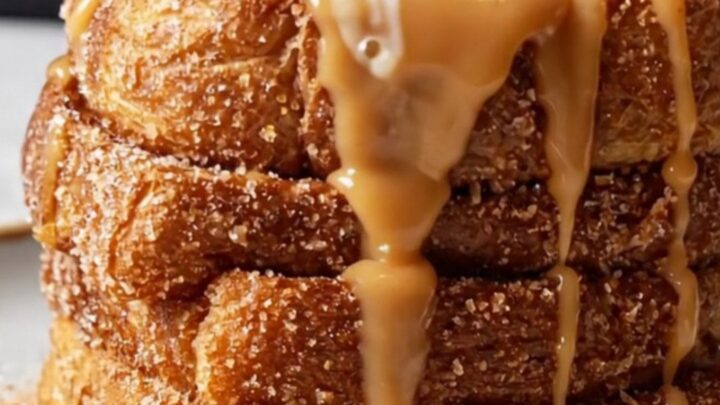
- Stack and TopStack the churro-crusted French toast on a serving plate. Crown with a generous scoop of vanilla bean ice cream. Warm the dulce de leche until pourable, then drizzle it over the stack, letting it cascade down the sides.Look for The ice cream starts to melt slightly against the warm toast, and the dulce de leche coats the top and drips down.Tip For a dramatic presentation, use a tall stack of 3-4 slices. Serve immediately so the crust stays crisp.
The stack stands tall, with the ice cream beginning to melt and slide down the warm toast. The dulce de leche flows in thick ribbons, coating the top and dripping slowly down the sides. The first cut produces an audible crunch, revealing the tender, custardy interior. The plate is a study in golden browns and creamy whites.
Common mistakes
One common mistake is over-soaking the bread, which causes it to fall apart in the pan. Stick to 20 seconds per side and handle the slices gently. Another pitfall is using medium-low heat, which makes the bread absorb too much butter and become greasy instead of crisp.
Use medium-high heat and let the butter foam before adding the bread. Also, don’t skip the immediate toss in cinnamon sugar—if you wait, the steam from the toast will make the sugar melt into a sticky glaze rather than forming a crunchy crust. Finally, resist the urge to crowd the pan; cook in batches to ensure even browning.
How to tell it’s done
The French toast is done when the exterior is deep golden brown and caramelized, and the interior is set—no longer wet or translucent. To check, press the center of a slice with your fingertip; it should feel firm but slightly springy.
For food safety, the custard must reach 160°F (71°C) throughout, which is the safe internal temperature for eggs. If you’re unsure, use an instant-read thermometer inserted into the thickest part of the bread. Once cooked, the toast should be crisp on the outside and tender on the inside, with no raw egg visible.
- Egg dishes: 160°F (71°C) in the thickest part
Up next · Part 3 of 3
4 variations · storage & make-ahead · 5 answers · printable card
Tips, FAQ & printable recipe (Part 3)← Back to the ingredients (Part 1)