Dinner · Part 2 of 3: Instructions
Garlic Parmesan Bacon Cheeseburger Lasagna Step-by-step instructions
- Prep
- Cook
- Total
- Serves
- 8
Before you start
Before beginning the cooking process, organize all ingredients and kitchen tools to ensure a smooth, efficient workflow. Measure out the ground beef, burger seasoning, garlic parmesan cheese sauce, and shredded cheddar cheese.
Cook the bacon slices in a skillet over medium heat until they are fully crispy, then drain them thoroughly on paper towels and crumble them into small pieces.
Grate the cheddar cheese if using a block, and finely chop the fresh parsley. Pre-heat your oven to 375°F (190°C) and lightly grease a 9x13-inch baking dish with non-stick cooking spray or a thin layer of butter to prevent sticking.
Ingredients at a glance (7)
- 1 1/2 lb ground beef
- 1 tbsp burger seasoning
- 2 cups garlic parmesan cheese sauce (store-bought or made ahead)
- 9 oven-ready lasagna sheets
- 2 cups shredded cheddar cheese
- 8 slices bacon, cooked and crumbled
- 2 tbsp fresh parsley, chopped
Instructions
Prepping the Meat
- Brown the Ground BeefPlace a large skillet over medium-high heat. Add the ground beef and break it apart with a spatula. Sprinkle the burger seasoning evenly over the meat. Cook, stirring occasionally, until the beef is fully browned and cooked through, ensuring it reaches a safe internal temperature of 160°F (71°C) to eliminate foodborne pathogens. Drain any excess grease from the skillet and set the seasoned beef aside in a bowl.Look for The meat is fully browned with no pink remaining.Safe temperature 160°F (71°C) internal temperature (ground meat)Tip Drain the grease thoroughly to prevent a soggy lasagna.
At the end of this initial phase, the seasoned ground beef should be deeply browned, crumbly, and highly savory, with all excess fat carefully drained away from the skillet. The meat must be fully cooked to a safe temperature and set aside in a clean bowl, ready for the assembly stage alongside the prepared garlic parmesan cheese sauce and other layered ingredients.
Assembling the Layers
- Assemble the Lasagna LayersSpread a thin layer of the garlic parmesan cheese sauce at the bottom of the prepared 9x13-inch baking dish. Arrange three lasagna sheets on top of the sauce. Evenly distribute half of the seasoned ground beef over the pasta sheets, followed by a generous layer of shredded cheddar cheese, a sprinkle of crumbled bacon, and another layer of the garlic parmesan cheese sauce. Repeat this layering pattern once more.Look for The layers are evenly distributed across the dish.Tip Make sure the pasta sheets do not overlap too much.
- Add the Final Cheese ToppingPlace the final three lasagna sheets on top of the second layer. Pour the remaining garlic parmesan cheese sauce evenly over the pasta, ensuring the sheets are completely covered to prevent them from drying out. Scatter the remaining shredded cheddar cheese and a handful of crumbled bacon over the top, creating a thick, uniform layer that will melt into a golden crust.Look for The top layer of pasta is completely submerged in sauce.Tip Tuck in any dry pasta edges to ensure they cook through.
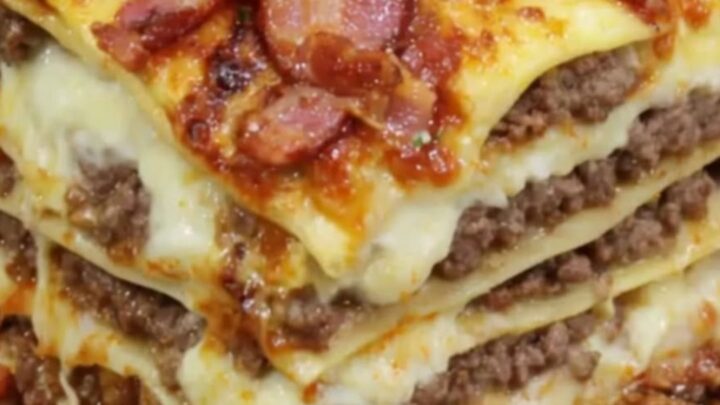
The baking dish should now contain clean, beautifully even layers of pasta sheets, seasoned ground beef, rich garlic parmesan cheese sauce, shredded cheddar cheese, and crispy crumbled bacon. The top layer must be completely covered with the remaining sauce and a generous blanket of cheese and bacon, ensuring no dry pasta is exposed before going into the preheated oven.
Baking and Garnishing
- Bake and GarnishCover the baking dish loosely with aluminum foil, ensuring it does not touch the cheese. Bake in the preheated oven at 375°F (190°C) for 25 minutes. Carefully remove the foil and bake for an additional 10 to 15 minutes, or until the cheese is bubbling and golden brown. Let the lasagna rest for 15 minutes to set before slicing. Garnish with the remaining crispy bacon and fresh chopped parsley.Look for The cheese is bubbling and golden brown around the edges.Tip Letting the lasagna rest prevents it from falling apart when sliced.
The lasagna emerges from the oven with a deeply golden, bubbling cheese crust, beautifully speckled with crispy bacon pieces. The edges should be sizzling actively, and the center should be piping hot and fully set. After a brief resting period, the freshly garnished chopped parsley adds a bright green contrast to this rich, decadent, and comforting masterpiece.
Common mistakes
One common mistake is failing to drain the ground beef thoroughly after browning in the skillet, which introduces excess grease and results in a soggy, oily lasagna. Another frequent error is not covering the oven-ready pasta sheets completely with the garlic parmesan cheese sauce during assembly; any exposed dry edges will remain hard and chewy after baking.
Lastly, slicing the lasagna immediately after removing it from the oven will cause the layers to slide apart. Always allow the dish to rest undisturbed for at least fifteen minutes so the structure can firm up.
How to tell it’s done
The lasagna is perfectly done when the cheese on top is completely melted, bubbling vigorously around the edges, and has turned a beautiful, deep golden-brown color.
To ensure absolute food safety and perfect texture, insert an instant-read thermometer into the very center of the dish; it must register at least 160°F (71°C), confirming that the entire casserole is heated through and the ground beef is safe to consume. The pasta sheets should also feel completely tender when pierced with a fork, showing no resistance.
- Ground meat: 160°F (71°C) in the thickest part
Up next · Part 3 of 3
2 variations · storage & make-ahead · 3 answers · printable card
Tips, FAQ & printable recipe (Part 3)← Back to the ingredients (Part 1)