Dinner · Part 2 of 3: Instructions
Garlic Herb Roasted Standing Rib Roast Step-by-step instructions
- Prep
- Cook
- Total
- Serves
- 6
Before you start
Before starting, ensure the standing rib roast is removed from the refrigerator exactly thirty minutes prior to cooking to take the chill off, allowing for more even heat distribution.
Gather a heavy-duty roasting pan fitted with a sturdy wire rack, a small mixing bowl for the herb butter, and an accurate digital meat thermometer. Finely mince the fresh garlic cloves, finely chop the mixed herbs, and measure out the butter so everything is ready for assembly.
Ingredients at a glance (4)
- 7 lb standing rib roast
- 1/2 cup butter, softened
- 4 cloves garlic, minced
- 2 tbsp mixed herbs, finely chopped
Instructions
Prep and Herb Butter Assembly
- Prepare the Beef RoastRemove the standing rib roast from the refrigerator exactly thirty minutes before cooking to take the chill off. Pat the entire surface of the meat completely dry with paper towels to ensure the garlic-herb butter adheres properly. Place the dried roast on a clean work surface.Look for The meat surface should feel completely dry to the touch.Tip Removing the chill helps the beef cook much more evenly.
- Mix the Garlic Herb ButterIn a small mixing bowl, combine the softened butter, minced garlic, and finely chopped mixed herbs. Mash the ingredients together with a fork until they form a smooth, uniform, and fragrant paste.Look for The herbs and garlic should be evenly distributed through the butter.Tip Ensure the butter is fully softened so it mixes and spreads easily.
At the end of this phase, the standing rib roast should be completely dry on the surface, which allows the herb butter to adhere properly. The garlic-herb butter mixture should be a smooth, fragrant paste with the green herbs and minced garlic evenly distributed throughout the creamy butter.
Roasting and Temperature Control
- Apply the Herb Butter RubUsing a spatula or clean hands, spread the garlic-herb butter paste evenly over the entire surface of the raw standing rib roast, coating the top, sides, and exposed meat thoroughly. Place the coated roast, bone-side down, on a wire rack set inside a heavy-duty roasting pan.Look for The roast should be fully blanketed in the herb butter.Tip Press the butter firmly so it sticks to the meat.
- Roast the BeefPreheat the oven to 450°F (230°C). Roast the beef at 450°F (230°C) for 15 minutes, then reduce the oven temperature to 325°F (160°C) and continue roasting until the internal temperature reaches 145°F (63°C) on a meat thermometer. Remove the roast from the oven and let the meat rest for at least 3 minutes before carving to allow the juices to redistribute.Look for The exterior should have a deep golden-brown, caramelized crust.Safe temperature 145°F (63°C) internal temperature (steaks, chops and roasts)Tip Avoid opening the oven door too often to prevent heat loss.
By the end of this phase, the kitchen will be filled with the rich aroma of roasting beef and garlic. The exterior of the roast will have a deep golden-brown, caramelized crust, and the juices in the bottom of the roasting pan should be bubbling gently under the oven light.
Resting and Carving
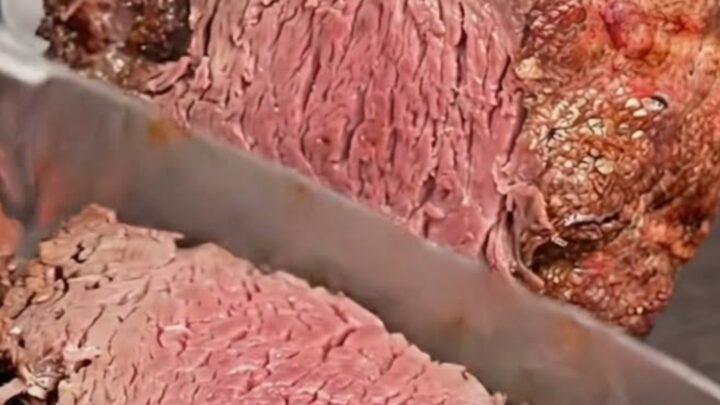
- Carve and ServeTransfer the rested roast to a solid wooden carving board. Using a long, sharp carving knife, carefully separate the roast from the bones and slice the tender beef into thick, uniform portions. Arrange the slices on a serving platter and spoon the warm pan juices over them before serving.Look for The knife should glide easily through the tender meat.Tip Slice against the grain for the most tender bite.
After resting, the roast will look slightly plumped as the internal juices redistribute throughout the muscle fibers.
When carving, the knife should glide smoothly through the meat, revealing a uniformly tender, juicy pink interior with minimal juice pooling on the cutting board, indicating the resting period was successful.
Common mistakes
One of the most common mistakes when roasting prime rib is skipping the resting period immediately after cooking. Cutting into the meat too quickly causes all the hot, flavorful juices to rush out onto the cutting board, leaving the roast dry and tough.
Another frequent error is using a dull knife for carving, which tears the delicate fibers of the beef instead of slicing them cleanly. Always use a long, sharp carving knife and slice against the grain for the most tender results.
How to tell it’s done
True doneness is determined solely by internal temperature, not by visual cues or cooking times. To ensure the meat is safe to consume, insert a digital thermometer into the thickest part of the beef, avoiding any bones or fat pockets.
The roast must reach an internal temperature of 145°F (63°C) for safe consumption. Once this temperature is reached, remove the roast from the oven and let the meat rest for at least 3 minutes before slicing.
- Steaks, chops and roasts: 145°F (63°C) in the thickest part, then a 3-minute rest
Up next · Part 3 of 3
2 variations · storage & make-ahead · 4 answers · printable card
Tips, FAQ & printable recipe (Part 3)← Back to the ingredients (Part 1)