Dinner · Part 2 of 3: Instructions
Garlic Herb Pork Roast with Crispy Potatoes Step-by-step instructions
- Prep
- Cook
- Total
- Serves
- 4
Before you start
Before beginning the cooking process, gather all ingredients and equipment to ensure a smooth workflow. Pat the pork loin roast completely dry with paper towels; removing surface moisture is crucial for helping the herb rub adhere properly and for achieving a beautiful brown crust.
Chop the fresh herbs and garlic finely. Cut the potatoes into even wedges, keeping them uniform in size. Preheat the oven to 400°F (204°C) so it is hot and ready when the roasting pan is assembled.
Ingredients at a glance (4)
- 3 lb pork loin roast
- 6 cloves garlic, minced
- 1/4 cup chopped fresh herbs
- 4 large potatoes, cut into wedges
Instructions
Seasoning and Preparation
- Prep the Roast and PotatoesPat the pork loin roast dry with paper towels. Cut the potatoes into uniform wedges. Place the potato wedges in a bowl and set aside while preparing the herb-garlic rub.Look for The potatoes should be cut into uniform wedges and the pork should be completely dry.Tip Drying the pork roast thoroughly ensures the herb-garlic rub sticks perfectly to the meat.
- Apply the Herb-Garlic RubIn a small bowl, combine the minced garlic and chopped fresh herbs to form a thick paste. Rub this herb-garlic mixture evenly over all sides of the pork loin roast, pressing it gently into the meat to ensure it adheres.Look for The pork should be fully coated in a thick, fragrant herb paste.Tip Press the herbs firmly onto the meat so they do not fall off during roasting.
At the end of this preparation phase, the pork loin roast is completely enveloped in a vibrant, thick paste of minced garlic and chopped fresh herbs. The kitchen should already smell strongly of fresh herbs and pungent garlic. The potato wedges are cut uniformly and ready to be arranged in the roasting pan alongside the meat.
Active Roasting
- Roast the Pork and PotatoesPlace the seasoned pork loin roast in the center of a large roasting pan, fat side up. Arrange the potato wedges in a single layer around the pork. Transfer the pan to the preheated oven and roast at 400°F (204°C) for fifty to sixty minutes.Look for The potatoes should sizzle in the pan drippings and the pork surface should turn golden-brown.Tip Toss the potatoes halfway through the roasting time to ensure they brown evenly on all sides.
During this roasting phase, the oven fills with the rich aroma of roasting meat, sizzling garlic, and toasted herbs. The pork fat cap renders down, dripping over the sides of the roast.
The potatoes sizzle loudly in the pan juices, turning a deep golden-brown color with crispy edges, while the pork exterior develops a beautiful herb-flecked crust.
Resting and Slicing
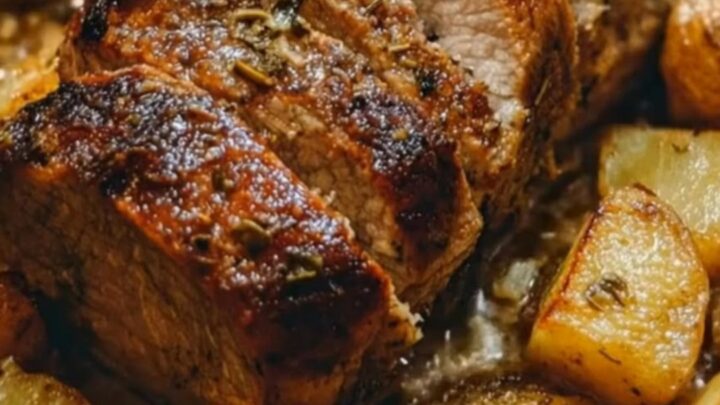
- Verify Temperature, Rest, and SliceInsert an instant-read thermometer into the thickest part of the pork loin. Ensure the internal temperature reaches 145°F (63°C). Transfer the roast to a cutting board and let it rest for at least 3 minutes. Slice the tender pork roast and serve hot alongside the crispy potatoes.Look for The pork slices should be juicy and slightly pink, and the potatoes golden-brown and crispy.Safe temperature 145°F (63°C) internal temperature (steaks, chops and roasts)Tip Resting the meat is essential to allow the juices to redistribute, keeping the pork tender.
At the conclusion of the resting period, the pork loin is firm yet yielding to the touch, with its natural juices settled back into the muscle fibers. When carved with a sharp knife, the roast slices cleanly without tearing, revealing a pale, incredibly juicy interior. The potatoes are perfectly tender inside and deeply crispy on the outside.
Common mistakes
One common mistake is slicing the pork immediately after removing it from the oven. Skipping the resting period causes the hot juices to run out onto the cutting board, leaving the meat dry and tough.
Another frequent error is overcrowding the roasting pan with potatoes. If the potato wedges are piled on top of each other, they will steam instead of roast, resulting in a soggy texture rather than a crispy, golden-brown exterior.
How to tell it’s done
Doneness is determined by measuring the internal temperature of the pork roast with a reliable meat thermometer. Insert the probe into the thickest part of the loin, avoiding any fat pockets.
The pork is safe and perfectly cooked when it reaches an internal temperature of 145°F (63°C). After reaching this temperature, remove the roast from the heat and let it rest for at least 3 minutes before carving.
- Steaks, chops and roasts: 145°F (63°C) in the thickest part, then a 3-minute rest
Up next · Part 3 of 3
2 variations · storage & make-ahead · 3 answers · printable card
Tips, FAQ & printable recipe (Part 3)← Back to the ingredients (Part 1)