Dinner · Part 2 of 3: Instructions
Garlic Herb Maple Bourbon Beef Short Ribs Step-by-step instructions
- Prep
- Cook
- Total
- Serves
- 4
Before you start
Before starting, pat the short ribs dry with paper towels—this helps the sauce cling better. Smash the garlic cloves with the flat side of a knife to release their flavor. Rinse the rosemary sprigs and pat dry.
Measure the barbecue sauce and have it ready. No need to sear the meat or preheat anything; the slow cooker does the work. If your slow cooker insert is not removable, be careful when placing the ribs to avoid scratching the surface.
Ingredients at a glance (4)
- 5 lb bone-in English-cut beef short ribs
- 10 cloves garlic, smashed
- 4 sprigs fresh rosemary
- 2 cups maple bourbon barbecue sauce
Instructions
Layer and Sauce
- Layer the Ribs and AromaticsPlace the beef short ribs in the slow cooker insert in a single layer, overlapping slightly if needed. Scatter the smashed garlic cloves and fresh rosemary sprigs evenly over the ribs.Look for Ribs are nestled in the pot with garlic and rosemary scattered on top.Tip No need to sear the ribs first—the slow cooker does all the work.
- Pour on the SaucePour the maple bourbon barbecue sauce over the ribs, using a spatula to spread it evenly so all surfaces are coated. The sauce should pool around the ribs, not drown them.Look for The ribs are fully coated in a glossy amber sauce.Tip If the sauce is very thick, add 1/4 cup water or beef broth to help it create steam.
The slow cooker is filled with raw ribs, garlic, rosemary, and a glossy layer of barbecue sauce. The aroma is sweet and savory, with a hint of bourbon. The ribs are coated but not drowned; there should be about 1/4 inch of sauce pooling at the bottom. The garlic and rosemary are scattered evenly, ready to infuse the meat as it cooks.
Slow Cook
- Cook Low and SlowCover the slow cooker and cook on low for 8 hours, or until the meat is fork-tender and easily pulls away from the bone. Do not lift the lid during cooking—each peek adds 20 minutes of cook time. Let it rest for 3 minutes before slicing.Look for The sauce is bubbling gently and the meat has shrunk from the bone.Safe temperature 145°F (63°C) internal temperature (steaks, chops and roasts)Tip If the sauce looks too thin at the end, remove the ribs and simmer the sauce on high for 20 minutes to reduce.
After 8 hours on low, the sauce is bubbling gently around the edges of the pot. The ribs have darkened and shrunk from the bone, and the meat looks tender enough to flake with a fork.
The garlic cloves have turned golden and soft, and the rosemary has released its fragrance. The kitchen smells like a barbecue joint, and the sauce has thickened slightly.
Rest and Serve
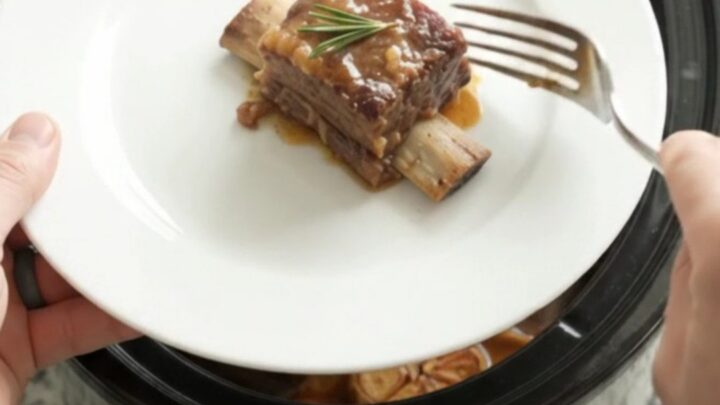
- Rest and ServeTurn off the slow cooker. Using tongs or a carving fork, carefully transfer the ribs to a plate. Let the meat rest for at least 3 minutes before serving. Spoon some of the sauce from the pot over the ribs.Look for The ribs are glistening, and the sauce has thickened slightly.Safe temperature 145°F (63°C) internal temperature (steaks, chops and roasts)Tip For extra-thick glaze, skim the fat from the sauce before spooning over.
The ribs are lifted out of the pot, glistening with a sticky, amber glaze. The meat nearly slips off the bone as you transfer it to a plate. Letting them rest for a few minutes allows the juices to settle. Spoon extra sauce over the top—it should be thick enough to coat the back of a spoon. Serve hot, with plenty of sauce.
Common mistakes
The most common mistake is lifting the lid to check on the ribs. Every time the lid comes off, heat escapes and adds 20 minutes to the cooking time. Trust the process and keep the lid on.
Another mistake is using a barbecue sauce that is too thin; look for one with a thick, clingy consistency. If the sauce is watery, the ribs will be less glazed. Finally, don't skip the resting step—cutting into the meat too soon causes the juices to run out, leaving dry ribs.
How to tell it’s done
The ribs are done when the meat is fork-tender and pulls easily away from the bone. Insert a fork into the thickest part of a rib; it should slide in with little resistance.
The internal temperature should read at least 145°F (63°C) for food safety, but because the meat is cooked low and slow, it will likely be much higher—around 200°F (93°C)—which is ideal for breaking down collagen. Let the ribs rest for at least 3 minutes before serving to allow the juices to redistribute.
- Steaks, chops and roasts: 145°F (63°C) in the thickest part, then a 3-minute rest
Up next · Part 3 of 3
4 variations · storage & make-ahead · 5 answers · printable card
Tips, FAQ & printable recipe (Part 3)← Back to the ingredients (Part 1)