Dinner · Part 1 of 3: Ingredients
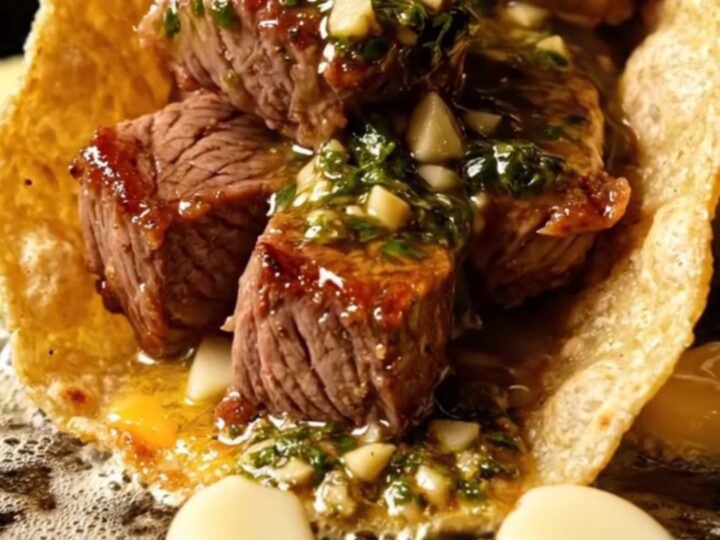
Garlic Butter Steak Bite Tacos with Fresh Chimichurri
- Prep
- Cook
- Total
- Serves
- 4
Steakhouse sear, taco-night format. Cubes of prime ribeye hit a screaming cast-iron skillet for ninety seconds, get basted in foaming garlic butter for thirty more, then land in tortillas toasted onto a crisp crust of melted Oaxaca cheese.
A bright, garlicky parsley chimichurri cuts through all that richness. It is a complete dinner built from one skillet and one bowl, on the table in about thirty minutes.
This is the rare taco that behaves like a steak dinner. The method borrows straight from the steakhouse: a very hot pan, a hard sear, then a butter baste with crushed garlic that keeps the cubes juicy while they finish. The tortillas get their own treatment, toasted onto a thin bed of shredded Oaxaca cheese until the underside turns crisp, golden and lacy.
The finishing sauce is a classic parsley-garlic chimichurri, sharp with red wine vinegar and olive oil, spooned over at the last second so the herbs stay vivid. Everything is scaled for four people, eight tacos, one very satisfying weeknight.
Ingredients
- 1 1/4 lb prime ribeye steak, cut into 3/4-inch cubes
- 1 1/2 tsp coarse sea salt
- Cracked black pepper, to taste
- 1 tsp garlic powder
- 3 tbsp salted butter
- 4 garlic cloves, crushed
- 8 small flour tortillas, topped with shredded Oaxaca cheese and toasted until crisp
Chimichurri
- 1 cup fresh parsley leaves, finely chopped
- 2 cloves garlic, minced
- 3 tbsp red wine vinegar
- 1/2 cup olive oil
- 1 tsp dried oregano
- 1/2 tsp red pepper flakes
Why this recipe works
The sear-then-baste sequence is what separates these bites from ordinary steak tacos. A 475°F cast-iron surface triggers fast Maillard browning on the cube faces, building the dark crust that carries most of the flavor. Ninety seconds is enough because the pieces are small; anything longer only drives out moisture.
Dropping the heat and adding butter then changes the physics: the foaming butter conducts heat gently into the crevices while the crushed garlic perfumes every surface, so the outside stays crusty and the interior finishes tender.
The cheese-crusted tortilla and the chimichurri solve the two classic taco problems from opposite ends. Melted Oaxaca toasts onto the tortilla and forms a rigid, golden layer that resists sogginess from the buttery steak and the sauce.
The chimichurri, built on vinegar and oil rather than cream, adds acidity and freshness that reset the palate between rich, seared bites, which is why the last taco tastes as good as the first.
Notes and substitutions
Choose a ribeye with good marbling and cut the cubes to a true 3/4 inch; uneven pieces cook unevenly, some gray while others char. Coarse sea salt adheres better than fine table salt, and garlic powder seasons the interior of the crust where fresh garlic would burn. For the sauce, flat-leaf parsley and a young, fruity olive oil matter more than any other detail; a bitter oil will dominate the whole taco.
Equipment is simple but specific: heavy cast iron for the sear, a second skillet for the tortillas, and an instant-read thermometer so the beef can be cooked through to a safe 145°F without guessing. Oaxaca cheese shreds best when chilled; if it is only sold in balls, pull it into threads by hand. Every substitution listed below keeps the same structure, so the method does not change.
- prime ribeye steak: Sirloin or strip steak works well; cut against the grain into even cubes so every piece sears at the same rate.
- Oaxaca cheese: Low-moisture mozzarella or Monterey Jack melts similarly and still gives the tortilla a crisp, lacy cheese crust.
- red wine vinegar: White wine vinegar or fresh lime juice brightens the chimichurri in a slightly different direction.
- fresh parsley: Half parsley and half cilantro makes a greener, more herbaceous sauce that suits the tacos.
Equipment
- Cast-iron skillet
- Chef's knife
- Cutting board
- Mixing bowl
- Large nonstick or cast-iron skillet for the tortillas
- Instant-read thermometer
- Tongs
Up next · Part 2 of 3
6 steps · 10 min of cooking · what to look for at each stage
Step-by-step instructions (Part 2)