Dinner · Part 2 of 3: Instructions
French Onion Dijon Cream Beef Brisket Step-by-step instructions
- Prep
- Cook
- Total
- Serves
- 8
Before you start
Before starting, trim the brisket of excess fat, leaving a thin layer for moisture. Slice the Vidalia onions thinly. Measure out the beef consommé, sour cream, Dijon mustard, and au jus. Have a 7-quart slow cooker ready.
No searing is required—the slow cooker does all the work. If you prefer a deeper flavor, you can sear the brisket in a hot skillet for 2-3 minutes per side before adding it to the slow cooker, but it is not necessary.
Ingredients at a glance (6)
- 3 1/2 lb beef brisket, trimmed
- 2 large Vidalia onions, thinly sliced
- 1 cup beef consommé
- 1/2 cup sour cream
- 2 tbsp whole-grain Dijon mustard
- 1/2 cup au jus
Instructions
Layer and Set
- Layer the Brisket and OnionsPlace the trimmed beef brisket flat in the bottom of a 7-quart slow cooker. Pile the thinly sliced Vidalia onions over and around the brisket. Pour the beef consommé around the base, not over the top, to keep the seasoning in place.Look for The brisket should be nestled among the onions, with the consommé pooling at the sides.Tip If the brisket is too large, trim it to fit, or cut it into two large pieces.
- Add the Creamy SauceDollop the sour cream and whole-grain Dijon mustard on top of the brisket and onions. Pour the au jus along the side of the pot. Do not stir; the layers will meld during cooking.Look for The sour cream and mustard sit in distinct dollops over the meat.Tip Stirring now can break up the brisket; let the slow cooker do the work.
At the end of this phase, the brisket is nestled in the slow cooker with onions piled on top. The consommé pools around the base, and dollops of sour cream and Dijon sit on the meat. The au jus has been poured along the side. The raw brisket is still visible in places, and the onions are crisp and raw. The scene is neat and layered, ready for the long cook.
Slow-Cook and Rest
- Slow-Cook Until Fork-TenderCover the slow cooker and cook on LOW for 8 to 10 hours, or on HIGH for 4 to 6 hours, until the brisket is fork-tender and shreds easily. The internal temperature should reach at least 145°F (63°C) for food safety, though it will likely be higher. Let it rest for 3 minutes before slicing.Look for The meat should shred with a fork and the onions should be very soft and caramelized.Safe temperature 145°F (63°C) internal temperature (steaks, chops and roasts)Tip For the most tender result, cook on LOW. Resist the urge to lift the lid during cooking.
- Rest the BrisketOnce the brisket reaches at least 145°F (63°C), remove the slow cooker insert or turn off the heat. Let the brisket rest, covered, for at least 3 minutes before shredding. This allows the juices to redistribute.Look for The meat rests in the hot liquid; the steam subsides slightly.Safe temperature 145°F (63°C) internal temperature (steaks, chops and roasts)Tip Use this time to prepare the rice or any side dishes.
After 8-10 hours on low, the kitchen smells deeply savory and sweet from the caramelizing onions. The brisket is fork-tender and shreds easily, and the sauce has turned a rich brown, with the sour cream and mustard fully incorporated.
The onions are silky and jammy. The meat rests in the hot liquid, steaming gently. The internal temperature is well above 145°F (63°C).
Shred and Serve
- Shred and Stir the GravyUsing two forks, shred the brisket directly in the slow cooker, mixing it with the onions and pan juices. Stir gently to combine the sour cream and mustard into a creamy gravy. The onions should be silky and the meat coated in the sauce.Look for The sauce should be thick and creamy, clinging to the shredded beef.Tip If the gravy seems thin, remove the meat and simmer the sauce on the stovetop to reduce, then return the meat.
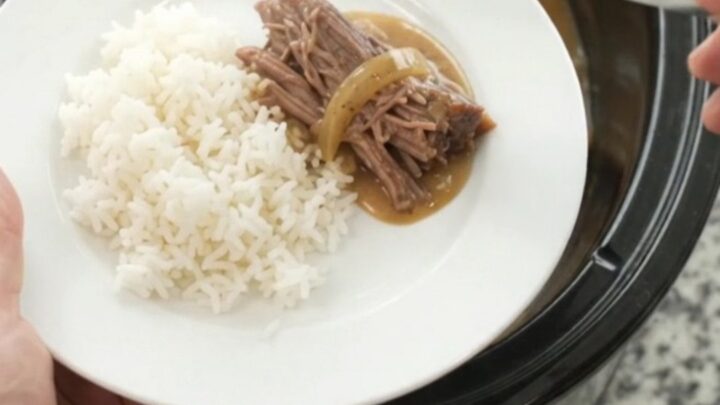
- Serve and EnjoyServe the shredded brisket and creamy onion gravy over steamed white rice or with crusty bread. Spoon extra gravy over the top.Look for The dish should be piping hot and the gravy glossy.Tip Garnish with fresh thyme or parsley if desired, though the video does not show it.
Once shredded, the brisket is coated in a creamy, glossy gravy. The onions are scattered throughout, and the sauce clings to the meat. The dish is piping hot, with a velvety texture and a tangy, savory aroma. Serve over rice or with bread, spooning extra gravy over the top. The plate is hearty and satisfying.
Common mistakes
One common mistake is lifting the lid too often, which lets heat escape and extends cooking time. Another is adding too much liquid—the brisket and onions release plenty of moisture, so follow the amounts exactly.
Do not stir the sour cream and mustard into the sauce before cooking, as they can separate; instead, let them melt slowly. Finally, do not rush the cooking: low and slow is essential for tender brisket.
How to tell it’s done
The brisket is done when it is fork-tender and shreds easily with a fork. The internal temperature should read at least 145°F (63°C) on an instant-read thermometer, though it will likely be higher after 8-10 hours on low.
The onions should be very soft and translucent, and the sauce should be thick enough to coat the back of a spoon. If the meat is still tough, continue cooking for another hour and check again.
- Steaks, chops and roasts: 145°F (63°C) in the thickest part, then a 3-minute rest
Up next · Part 3 of 3
4 variations · storage & make-ahead · 5 answers · printable card
Tips, FAQ & printable recipe (Part 3)← Back to the ingredients (Part 1)