Breakfast · Part 2 of 3: Instructions
Viral Four-Quadrant Breakfast Tortilla Fold — Crispy, Cheesy, 15 Minutes Step-by-step instructions
- Prep
- Cook
- Total
- Serves
- 1
Before you start
Before any folding starts, get every component cooked, drained and within reach, because assembly takes under two minutes once the tortilla is slit. Scramble the eggs, crisp the bacon and blot it, brown the hashbrowns until they crackle, and shred the cheddar.
Warm the tortilla briefly so it flexes without cracking, then set out a sharp knife, a cutting board and the buttered skillet or preheated panini press. Have a spatula and a paper-towel-lined plate ready for draining. With everything staged on one board, the fold itself is calm, quick and clean — no scrambling for ingredients while hot fillings cool and the pan overheats.
Ingredients at a glance (7)
- 2 large eggs, lightly beaten and scrambled
- 3 bacon strips, cooked until crispy
- 1/2 cup crispy hashbrowns, shredded and browned
- 1/2 cup shredded cheddar cheese
- 1 large 10-inch flour tortilla
- 1 tbsp unsalted butter, for the skillet
- Chipotle ketchup, for serving
Instructions
Cook and crisp the fillings
- Scramble the eggsWhisk the eggs in a bowl until evenly beaten, then pour them into a lightly greased nonstick skillet over medium-low heat. Push the curds gently with a spatula, pulling the pan off the heat while the eggs still look glossy, and continue folding until they are fully set and reach 160°F (74°C) on an instant-read thermometer.Look for The eggs should be moist, glossy and fully set, with no shine of raw egg left on the curds.Safe temperature 160°F (71°C) internal temperature (egg dishes)Tip Low heat and constant folding keep the curds tender instead of rubbery.
- Crisp the baconLay the bacon strips in a cold skillet, turn the heat to medium and cook, turning once, until the fat has rendered and the edges are deeply crisp, 8 to 10 minutes total. Drain on a paper towel and, once cool enough to handle, cut or break each strip in half so the pieces fit neatly inside a tortilla quadrant.Look for The strips should be rigid and mahogany at the edges, with no limp, pale sections.Tip Starting in a cold pan renders the fat slowly and evenly for uniformly crisp bacon.
- Brown the hashbrownsSpread the hashbrowns in a thin, even layer in a lightly oiled skillet over medium-high heat and leave them alone for 3 to 4 minutes so a golden crust forms. Stir once, press flat again and cook 2 to 3 minutes more until the shreds are browned and audibly crisp. Season with a pinch of salt and set aside.Look for Listen for a dry, crackling sound; the shreds should be deep golden with no pale, soggy patches.Tip Pat the shreds dry before they hit the pan — surface moisture is what steams instead of crisps.
At the end of this phase, three separate pans-worth of work sit ready on one board: eggs that are moist, glossy and cooked to 160°F (74°C) for a fully cooked finish, bacon that snaps when bent, and hashbrowns that sound dry and crackling when nudged with a spatula.
The kitchen should smell of rendered bacon fat and browned butter, not of steaming potatoes. Check each component before moving on: no pale, limp bacon sections, no soggy potato shreds, no raw egg sheen. If anything is underdone, finish it now — once the fold closes, there is no second chance to cook the insides.
Slit, fill and fold
- Cut the slitLay the tortilla flat on a clean cutting board and make a single straight slit with a sharp knife, running from the very center of the tortilla down to its bottom edge. The cut should slice cleanly through but stop exactly at the rim, leaving the rest of the circle intact — this one line is what allows the wrap to fold flat.Look for The slit should open like a hinge when gently lifted, not separate into two pieces.Tip Warming the tortilla 10 seconds in the microwave first makes it flexible and less likely to crack.
- Fill the four quadrantsMentally divide the tortilla into four quarters around the center point. Place the scrambled eggs in one quadrant, the halved bacon strips in the next, the crispy hashbrowns in the third and the shredded cheddar in the last, keeping every portion within its quarter and clear of the outer half-inch rim so the fold can seal.Look for Each quadrant should look full but flat enough that the tortilla still lies level.Tip Overfilling is the main reason these burst; a flat, even layer folds and seals far better.
- Fold clockwise into a triangleStarting with the quadrant nearest the slit, fold it clockwise over the center onto its neighbor. Continue folding each filled quadrant clockwise onto the next, pressing gently after every turn, until the tortilla closes into a thick, layered triangle with no gaps. Press the seam lightly with your palm to help it hold.Look for The finished parcel should be a compact triangle with a clean, flat seam on top.Tip Keep the folds snug but not crushing — compressed fillings push out of the seam when pressed.
The tortilla should now be a tight, layered triangle with a flat seam on top and no visible gaps at the edges. Lift it gently: it should hold its shape without sagging, and no filling should peek out of the seam. The surface still feels soft and pliable at this stage, which is correct — the crust comes only from the pan. If any quadrant has pushed past the outer half-inch rim, tuck it back under the tortilla wall now. Work efficiently here, because the warm fillings begin steaming the tortilla the longer the folded parcel waits.
Press until golden and crisp
- Toast the first sideMelt the butter in a heavy skillet or panini press over medium heat, about 375°F (190°C) at the surface. Lay the folded tortilla seam-side down, press it gently with a spatula and toast undisturbed for 2 minutes, until the underside is deep golden and the cheese inside has begun to melt and glue the layers together.Look for Lift an edge with the spatula: the crust should be bronzed and firm, not pale or soft.Tip A weighted press or a second skillet on top keeps the fold tight and maximizes crisp contact.
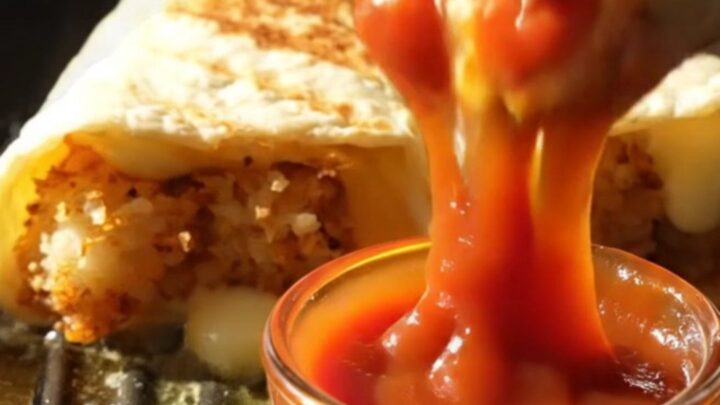
- Toast, slice and serveFlip the triangle carefully, press again and toast a second 2 minutes until the other side matches the first. Transfer to a cutting board, let it sit 1 minute so the cheese stops flowing, then slice straight down the middle with a sharp knife. Serve hot, dipping the molten cheesy corner into chipotle ketchup.Look for The knife should meet real resistance from the crisp crust, then sink through tender layers.Tip A long serrated knife saws through the crust without compressing the layered fillings.
Both faces should be deep golden with a blistered, crackly texture, and the triangle should feel rigid, almost like a toasted sandwich, when lifted. Faint sizzling should still echo when it first lands on the board, then quiet as the steam settles. The seam must be fully sealed with browned, melted cheese visible at the edges. After a one-minute rest, the knife should cut through with a loud, satisfying crunch followed by tender layers of egg, bacon, potato and stretchy cheddar. If the crust is pale anywhere, return it to the pan rather than serving it soft.
Common mistakes
The most common failure is overfilling: heaping quadrants forces filling into the seam and the fold bursts open in the pan. Keep each portion flat and inside its quarter. A second mistake is skipping the rest after cooking the fillings — steaming hot eggs and potatoes soften the tortilla from inside and make it tear.
Under-toasting is third: two minutes per side at a properly hot surface is what melts the cheddar into glue; a pale wrap tastes mostly of raw tortilla. Finally, pressing too hard squeezes the fillings toward the slit; press firmly enough for contact, not enough to compress the layers.
How to tell it’s done
The wrap is done when both faces are evenly golden with darker blistered spots, the triangle feels rigid when lifted with a spatula, and the seam is sealed shut with melted cheese. Slicing should meet a crackling crust before yielding to tender, layered insides.
Because eggs are the protein here, cooking the scrambled eggs to 160°F (74°C) is the way to serve them fully cooked through, with set curds and no glossy raw patches; a creamier finish means the eggs are not cooked all the way, so choose pasteurised eggs in that case. The final rest of one minute lets the cheese thicken slightly so the cross-section cuts cleanly instead of flooding the board.
- Egg dishes: 160°F (71°C) in the thickest part
Up next · Part 3 of 3
4 variations · storage & make-ahead · 5 answers · printable card
Tips, FAQ & printable recipe (Part 3)← Back to the ingredients (Part 1)