Dinner · Part 2 of 3: Instructions
Fork-Tender Beef Chuck Pot Roast for Cozy Dinners Step-by-step instructions
- Prep
- Cook
- Total
- Serves
- 6
Before you start
Before starting, ensure the beef chuck is patted dry with paper towels to facilitate a better sear. Prepare all vegetables by peeling and chopping the carrots into large chunks, halving the mushrooms, and cleaning the baby potatoes.
Have the beef broth measured and ready, and preheat the oven to 325°F. Clear enough counter space to accommodate the Dutch oven and a large cutting board, and ensure you have a pair of sturdy tongs ready for safely turning the heavy meat during the searing process.
Ingredients at a glance (5)
- 3 lb beef chuck roast
- 4 large carrots, peeled and cut into chunks
- 8 oz mushrooms, halved
- 1 lb baby potatoes, scrubbed
- 2 cups beef broth
Instructions
Searing the Beef
- Sear the beefHeat a heavy-bottomed Dutch oven over medium-high heat with a splash of oil. Sear the beef chuck on all sides until a deep, dark brown crust develops. Remove the beef and set it aside momentarily on a clean plate.Look for The meat should be browned deeply on every surface.Tip Ensure the pan is hot before adding the beef to get the best sear.
At this phase, the beef should have a deep, mahogany-brown crust on all sides. The kitchen will smell intensely savory, and there should be a thin layer of browned bits, known as fond, forming on the bottom of the Dutch oven. This fond is the key to building the base of the gravy, so ensure it is well-developed but not burnt before proceeding to the next step of adding the braising liquid.
Braising the Roast
- Simmer the roastAdd the beef broth to the Dutch oven, scraping up the browned bits from the bottom. Return the beef to the pot, cover tightly with a lid, and transfer to a 325°F oven. Braise until the meat reaches 145°F (63°C). Let the meat rest at least 3 minutes before serving.Look for The liquid should be at a gentle simmer, not a rolling boil.Safe temperature 145°F (63°C) internal temperature (steaks, chops and roasts)Tip Keep the lid sealed to trap moisture for the most tender result.
During the braising phase, the beef should be submerged in the broth and covered tightly. The liquid will be simmering steadily, filling the oven with a rich, meaty aroma.
You should check the pot occasionally to ensure the liquid level remains sufficient. The meat will start to soften, and the color will deepen as it absorbs the savory flavors of the broth, signaling that it is on its way to becoming perfectly tender.
Vegetable Integration
- Add vegetablesAdd the carrots, mushrooms, and baby potatoes to the pot around the beef. Cover and continue cooking until the vegetables are tender and the beef is completely soft.Look for The vegetables should be tender when pierced with a fork.Tip Check the liquid level and add a splash of water if it gets too low.
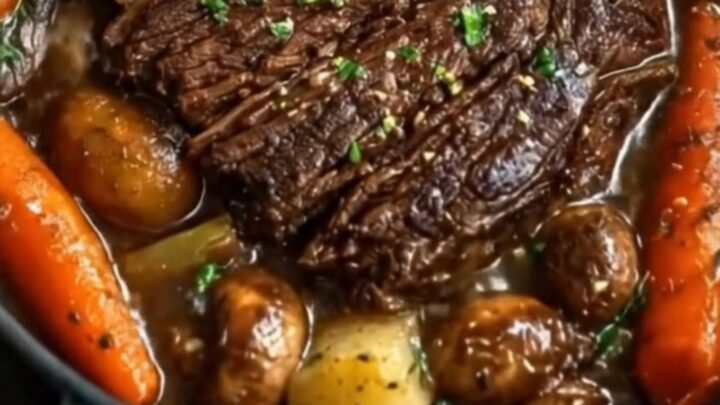
In this final phase, the vegetables are added to the pot. Once cooked, the carrots should be soft but still hold their shape, the potatoes should be tender enough to yield to a fork, and the mushrooms should be plump and glossy. The gravy will have thickened slightly from the starches in the potatoes, and the entire dish will look cohesive, with the meat and vegetables perfectly glazed in the rich, dark pan sauce.
Common mistakes
A common mistake is rushing the searing step or failing to dry the meat properly, which prevents the development of the essential brown crust that gives the gravy its depth. Another error is adding the vegetables too early, which leads to overcooked, mushy produce that disintegrates into the sauce.
Finally, neglecting to let the meat rest after cooking causes the juices to run out immediately upon slicing, resulting in a drier final product that lacks the desired level of succulence and rich mouthfeel.
How to tell it’s done
The roast is finished when the beef can be easily pulled apart with nothing more than a fork. Use a meat thermometer to ensure the internal temperature has reached at least 145°F (63°C). The meat should be dark, succulent, and visibly shredding when prodded.
Allow the roast to rest for at least 3 minutes before carving or shredding, which helps the juices redistribute throughout the meat, ensuring that every bite remains juicy and flavorful rather than drying out during the serving process.
- Steaks, chops and roasts: 145°F (63°C) in the thickest part, then a 3-minute rest
Up next · Part 3 of 3
2 variations · storage & make-ahead · 3 answers · printable card
Tips, FAQ & printable recipe (Part 3)← Back to the ingredients (Part 1)