Breakfast · Part 2 of 3: Instructions
Espresso-Soaked Tiramisu French Toast with Mascarpone Cream Step-by-step instructions
- Prep
- Cook
- Total
- Serves
- 2
Before you start
Before starting, set out the brioche slices, eggs, heavy cream, espresso, brown sugar, mascarpone, vanilla cream, butter, and cocoa powder. Brew the espresso and let it cool slightly so it doesn’t scramble the eggs.
Whisk the custard in a shallow dish large enough to hold a brioche slice. In a separate bowl, whip the mascarpone cream until smooth and refrigerate it while you cook. Have a large skillet, a spatula, and a piping bag or zip-top bag ready.
Ingredients at a glance (9)
- 2 slices thick brioche bread (about 1 inch thick)
- 2 large eggs
- 80 ml heavy cream (about 1/3 cup)
- 40 ml freshly brewed espresso (about 3 tbsp)
- 15 g brown sugar (about 1 tbsp)
- 100 g mascarpone cheese (about 1/2 cup)
- 15 ml vanilla cream (about 1 tbsp)
- 25 g unsalted butter (about 2 tbsp)
- Dark cocoa powder, for dusting, to taste
Instructions
Build the Custard and Cream
- Whisk the CustardIn a shallow dish, whisk together the eggs, heavy cream, freshly brewed espresso, and brown sugar until the sugar is dissolved and the mixture is smooth. The custard should be a rich, coffee-colored liquid.Look for The custard is uniform with no streaks of egg yolk.Tip Use a fork or small whisk to ensure the brown sugar fully dissolves.
- Whip the Mascarpone CreamIn a separate bowl, combine the mascarpone and vanilla cream. Whisk vigorously until the mixture is smooth, glossy, and holds soft peaks when the whisk is lifted. Chill until ready to use.Look for The mascarpone cream is thick, smooth, and forms soft peaks.Tip If the mascarpone seems too stiff, add a teaspoon of heavy cream to loosen it.
By the end of this phase, you should have a smooth, coffee-colored custard with no streaks of egg, and a glossy, thick mascarpone cream that holds soft peaks.
The custard should smell of espresso and brown sugar, and the cream should be light and airy. If the cream is too stiff, add a teaspoon of cream; if too loose, whisk a bit more. Both should be ready before you start soaking the bread.
Soak and Sear
- Soak the BriochePlace the brioche slices in the custard and let them soak for 45 seconds per side. The bread should be saturated but not falling apart. Use a gentle touch when turning.Look for The bread is moist throughout but still holds its shape.Tip If the brioche is very fresh, reduce soak time to 30 seconds per side.
- Heat the SkilletPlace a large skillet over medium heat and add the butter. Let it melt and foam until it smells nutty and the foaming subsides, but before it browns. The skillet should be hot enough that a drop of water sizzles on contact.Look for The butter is melted, foamy, and fragrant but not browned.Tip Use a heavy-bottomed skillet to maintain even heat.
- Sear the French ToastCarefully lay the soaked brioche slices in the hot skillet. Cook for 3 minutes per side, until the bottom is deeply caramelized and the custard is set. The internal temperature of the egg custard should reach 160°F (71°C) to ensure the eggs are fully cooked.Look for The bottom is golden brown with darker caramelized spots; the center feels springy.Safe temperature 160°F (71°C) internal temperature (egg dishes)Tip If the toast browns too quickly, lower the heat to prevent burning before the center cooks.
The brioche slices should be saturated but intact, with a custard that clings to the surface. As they sear, the butter will foam and the sugars will caramelize, filling the kitchen with a nutty, coffee aroma. The undersides should turn deep golden brown with darker spots. When you flip, the cooked side should be crisp and caramelized. The center should feel set but tender.
Top and Serve
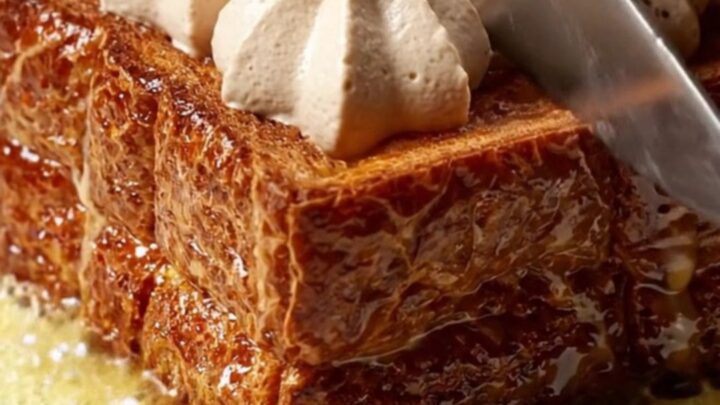
- Pipe the CreamTransfer the chilled mascarpone cream to a piping bag fitted with a star tip (or a zip-top bag with a corner snipped). Pipe tall swirls onto each warm French toast slice.Look for The cream sits in soft, tall peaks that hold their shape.Tip For a rustic look, dollop the cream with a spoon instead of piping.
- Dust with CocoaDust the mascarpone cream generously with dark cocoa powder through a fine-mesh strainer. Serve immediately while the toast is still warm and the cream is cool.Look for The cocoa forms an even, dark layer over the white cream.Tip Tap the strainer gently for a fine, even dusting.
The warm French toast should be topped with tall, swirled peaks of mascarpone cream that hold their shape. The cocoa dusting should form an even, dark layer over the cream. When you slice through, the custard center should be moist but set, and the cream should be cool and creamy. Serve immediately, as the cream will begin to soften on the warm toast.
Common mistakes
One common mistake is over-soaking the brioche, which makes it fall apart in the skillet. Stick to 45 seconds per side. Another is using a pan that’s too hot, causing the outside to burn before the inside cooks.
If the toast browns too quickly, lower the heat. Skipping the chill on the mascarpone cream can make it too loose to pipe; refrigerate it for at least 10 minutes before using. Finally, use a fine-mesh strainer for the cocoa to avoid clumps.
How to tell it’s done
The French toast is done when the exterior is deeply caramelized and the interior is set but still moist. To check, press the center gently—it should feel springy, not wet. For food safety, the egg custard must reach 160°F (71°C).
If you have an instant-read thermometer, insert it into the center of a slice; it should read 160°F (71°C). If not, cut into the thickest part—the custard should be set, not runny.
- Egg dishes: 160°F (71°C) in the thickest part
Up next · Part 3 of 3
4 variations · storage & make-ahead · 5 answers · printable card
Tips, FAQ & printable recipe (Part 3)← Back to the ingredients (Part 1)